Showing posts with label 82nd Airborne. Show all posts

Tuesday, November 01, 2011

101st Airborne: The Screaming Eagles at Normandy by Mark A. Bando

"101st Airborne: The Screaming Eagles at Normandy" by Mark A. Bando is a well presented book. It has a nice blend of photography and prose. It is organized into ten chapters. They detail the training, preparation as well as the jump into Normandy of the 101st Airborne Division. 

The 10.5 x 10.5 inches format allows for an excellent presentation of the photographs. The pictures cover the entire spectrum. Some are very familiar. Some are rare. Some are disturbing. The photograph on page 73 of a double row of dead German paratroopers is an example. There were so many dead in the photo than I could count them all!  I was surprised at the large amount of color pictures in the book. Amazing best describes the collection of photographs.

As good as the pictures were I especially enjoyed the story. The book chronicles the 101st in a way that blends a well-written narrative with first person testimonials of the veterans. Their recollections illustrate and explain the events of the chapter with a human touch.

Interestingly Bando includes one chapter on the 82nd Airborne Division and a chapter about the true story of the movie “Saving Private Ryan” titled “Saving Sergeant Niland”.  The book also contains a glossary of terms and an abbreviated index.

The book would be a great addition to the library of a military historian and is ideal for inclusion in a community or school library.

Sunday, June 05, 2011

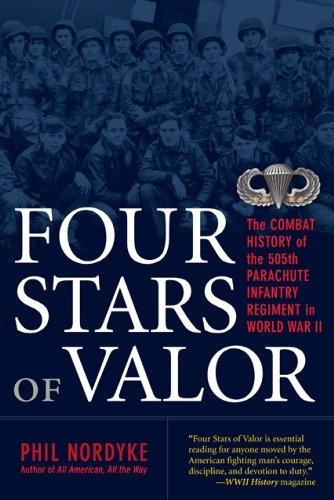
Four Stars of Valor: The Combat History of the 505th Parachute Infantry Regiment in World War II

Phil Nordyke's "Four Stars of Valor: The Combat History of the 505th Parachute Infantry Regiment in World War II" is excellent. It is must reading for any student of World War II. Mr. Nordyke does an great job as he takes us with the 505th Parachute Infantry Regiment (PIR) from its beginnings and training in the United States, through its deployment to North Africa, and through its campaigns in Sicily, Italy, Normandy, Holland, the Bulge, and Germany before returning home.

The book takes it title from the 505 PIR's record four combat jumps in Sicily, Salerno/Naples, Ste Mere Eglise/Normandy, and Nijmegen/Holland. Stars representing participation in combat jumps had been worn unofficially on parachute wings during and after World War II. FYI - this practice did not gain official sanction until after the 1983 invasion of Grenada, Operation Urgent Fury.

I took about six weeks to read the book. I found it a book that demanded I read every word on every page. Be prepared for some very graphic descriptions of the training and combat. You'll feel the heat of north Africa. I was disappointed as I read the Hermann Goring Fallschrim Panzer and 15th Panzer Grenadier Divisions were on Sicily, that General Bradley knew it, and because of secrecy of Ultra they did not pass this information on to the attacking forces! "This was a cruel deception of our own forces, but necessary in order to protect the secrets of Ultra."

Mr. Nordyke does an excellent job of using primary sources. At first I was a little confused when I encountered an incident that was described from multiple persons points of view, but quickly saw the value in seeing the way more than one person viewed/remembered an incident. It helped paint a more complete picture. Pages 300 - 301 and the actions of Private Camille E. Gagne's response to the killing of First Lieutenant John Dodd is one example. The coverage giving to the 505th's role in Nijmegen/Holland is very detailed and had me feeling I was were there.

The 505th PIR's involvement didn't stop after it's fourth jump into Nijmegen/Holland. They played a key role being deployed by truck into Belgium's Ardennes Forest as the 82 Airborne Division helped stop Hitler's in The Battle of the Bulge in freezing December 1944 and January 1945.

The book has exceptional maps and an amazing index. This book should be required reading for active duty members wearing jump wings. It is a must addition to any military historian's library and would be an excellent addition for all university and community libraries.It would a wonderful gift for anyone who has severed in the 505th.

Sunday, January 16, 2011

The All Americans in World War II: A Photographic History of the 82nd Airborne Division at War by Phil Nordyke

"The All Americans in World War II: a Photographic History of the 82nd Airborne Division at War" by Phil Nordyke delivers what the book’s title promises, a photographic history of the 82nd Airborne Division at war. The book is filled with numerous black and white photographs. The photographs are excellent and many that have never before been published.

The book is organized into 36 chapters. The chapters chronicle the 82nd Airborne Division’s from the division’s reactivation in February 1942 to the return to the USA in January 1946. The chapters begin with a one-page summary of that stage of the 82nd’s action. A skillfully produced map showing the locations of allied follows the chapter summary. It contains locations of allied and axis units visually showing their actions that are covered in the chapter. Next, the reader feasts with pages of period photographs of the action.  There are 30 detailed maps and 365 photographs.

This book is a very useful addition to or a great stand-alone volume for the reader wanting to learn more about the All American Division in World War II. It really is spectacular. It would be an excellent addition to any military historian’s library of college and community library.

I am a former US Army officer who graduated from airborne school in class 36-76. I found myself reading the book in one sitting. My father is a World War II veteran who served in the European Theater of Operations. He also could not put the book down until he had read it from cover to cover.

Thursday, January 13, 2011

Into the Viper's Nest: The First Pivotal Battle of the Afghan War by Stephen Grey

"Into the Viper's Nest: The First Pivotal Battle of the Afghan War" by Stephen Grey is the story of American and Afghan forces cooperation in dealing with the Taliban stronghold on southern Afghanistan. It details the vivid three-day battle for the Taliban stronghold of Musa Qala. The battle started on 7 December 2007 This is an excellent, well-written book.  Grey skillfully tells the story of how American, British, and Afghan forces took the fight to the Taliban in 2007.

The town of Musa Qala was a notorious Taliban stronghold. This was the location chosen for everything to change. A local leader decided he was going to leave the Taliban. He was joining the Hamid Karzai's government. This defection needed coalition protection.

Stephen Grey is an excellent writer. He captures all phases of this story. He covers the discussions between President Karzai and coalition leaders. He covers the particulars of the deadly combat to wrest control of Musa Qala from the hands of the Taliban. He paints a picture of International cooperation as he tells the story through the words of the British, Afghani, and American men who were there. The publisher did an excellent job with eight pages of graphics and charts to showing systematically how the battle took place.

I highly recommend this book for any reader looking for a tactical-level viewpoint on the Afghan War. Anyone interested in Afghanistan and the war against the Taliban will benefit from reading the book. I recommend for community and university libraries as well as the personal libraries of all military historians. This is the best I have read on United States involvement in Afghanistan.

Wednesday, September 16, 2009

A Bridge Too Far by Cornelius Ryan

A Bridge Too Far: The Classic History of the Greatest Battle of World War II by Cornelius Ryan gives one of the best accounts of General Montgomery's ill-fated plan and operation to turn the German northern flank on the Western front during September 1944 of World War II. Montgomery hoped to press into the heart of industrial Germany to end the war in 1944. This narrative non-fiction work by Cornelius Ryan brings together the objectivity and insights of a historian with the narrative style of a novelist. Ryan brings historical events to life. Ryan's writings keep your interest. He gives the experiences of the individual soldiers and Dutch resistance members. He tells the story from all sides. The roles and effects of these operations on the civilians unfortunate enough to be caught up in events are included. 

From reading Ryan's work I found a dramatic lack of urgency on the part of the British. An example is after the 82nd had secured their main bridge objective which included tremendous sacrifice the British simply camped for the night brewing their tea while their fellow countryman were still encircled and dying in Arhen. I was disappointed that Montgomery was not slammed for this operation. From he account Montgomery is lucky he wasn't relieved of command or sacked on the spot.

I recommend the book, tough at times I found the reading and the story slowly unfolding. It is one of the all time classics of World War II and should be in the library of every military history buff. Read and reviewed by Jimmie A. Kepler.

Wednesday, August 05, 2009

Omaha Beach: D-Day, June 6, 1944 by Joseph Balkoski

Joseph Balkoski's book on Omaha Beach is a great historical resource like his book Utah Beach. Omaha Beach tells the story of when largely untested American troops assaulted the German army's Atlantic wall. This is a great read covering the events of the day almost minute by minute. It reads like a great documentary. This is not written in the format of a memoir. Balkoski relies mainly on primary sources such as after action reports, unit journals, and citations to create his blow by blow narrative. He includes the invasion's diplomatic and strategic context. Omaha Beach is the closest the modern reader can get to experiencing the Normandy landings firsthand.

Sprinkled throughout the battle account are the accounts of those in the battle. It is a classic. It is a must for any D-day library. It also included comprehensive lists of all Medal of Honor and Distinguished Service Cross winners at Omaha Beach. It has: the Order of Battle, unit casualty list for the first twenty-four hours, unit organization of a 30man assault boat unit weapons, and equipment carried in the assault by a typical soldier, and a series of detailed maps allowing the reader unparalleled insight into the minute-by-minute combat on Omaha Beach. This book included several appendixes with great information about the battle at Omaha Beach.

Airborne: A Combat History of American Airborne Forces by LTG (Retired) E. M. Flanagan Jr.

Airborne Airborne: A Combat History of American Airborne Forces by LTG (Retired) E. M. Flanagan Jr. Allow me to state my prejudices...