Showing posts with label memoir. Show all posts

Tuesday, May 21, 2019

Undaunted Courage: Meriwether Lewis, Thomas Jefferson, and the Opening of the American West (Lewis & Clark Expedition) by Stephen E. Ambrose


Narrative Style


The narrative style of Ambrose takes what could be a dry lecture and makes it extremely interesting. The book reads like the best selling novel. The book gives a nice background on Captain Meriwether Lewis.

As the story unfolds, it shows how Lewis's background prepared him for the journey and how it provided the relationship he had with Jefferson to lead to his selection for the journey. Lewis was Jefferson’s personal secretary when selected to lead the voyage that would take him up the Missouri River, to wintering with the Indians, to the Rockies, over the mountains, down the Columbia River to the Pacific Ocean, and back.

Lewis experienced hardships and saw wonderful sights. The sites included herds of buffalo and Indian tribes with no previous contact with white men. He and his partner, Captain William Clark, made the first maps of the trans-Mississippi West, provided data on the flora and fauna of the Louisiana Purchase territory, and most importantly established the American claim to Oregon, Washington, and Idaho.

The book shows how Lewis is financially underwritten by a variety of characters. This list includes Jefferson, Clark, numerous Indian chiefs, and Sacagawea, the Indian girl who accompanied the expedition, along with the French-Indian hunter Drouillard, the great naturalists of Philadelphia, the French and Spanish fur traders of St. Louis, John Quincy Adams, and many more leading political, scientific, and military figures of the turn of the century.

National Unity


This is a book about a hero and national unity. This is a book also about a tragedy. When Lewis returned to Washington in the fall of 1806, he was a national hero.

Lewis greatest failure was he did not get his journals and notes organized and published. The scholarly value of those would have been great. Publishing them in a timely manner would have made Lewis financially independent.

Instead, Lewis took to drink, drugs, engaged in land speculation, piled up debts he could not pay, made jealous political enemies, experienced severe depression (probably from the drugs), and ultimately took his own life.

Monday, May 20, 2019

The Wild Blue: The Men and Boys Who Flew the B-24s Over Germany by Stephen E. Ambrose


Controversial


"The Wild Blue: The Men and Boys Who Flew the B-24s Over Germany" by Stephen E. Ambrose is controversial because some scholars point out Ambrose has lifted the work of other authors without placing said work inside "quotation" marks. That is a tragic error. Is it an error of omission or commission? I do not know. I do know it is ethically wrong.

The Story of the Late US Senator George McGovern


The book tells the story of former US Presidential candidate and US Senator George McGovern. It tells of McGovern's upbringing, his journey to college, the outbreak of World War II, his falling in love and marriage, his joining the US Army Air Corps, his training as a pilot, and his combat deployment and action where he was based out of Italy bombing the Axis war machine.

Nonfiction Narrative Style


It is written in Ambrose's wonderful narrative style. It is highly readable and entertaining.

Friday, May 17, 2019

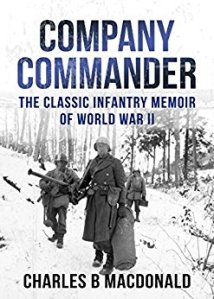
Company Commander: The Classic Infantry Memoir of World War II by Charles B. MacDonald


A Template for Writing a Personal Military Memoir


I highly recommend Company Commander: The Classic Infantry Memoir of World War II by Charles B. MacDonald. At just 21 years of age, Captain Charles B. MacDonald first commanded I Company, 3 Battalion 23rd Infantry, 2nd Infantry Division from October 1944 to January 1945 and later G Company, 2 Battalion 23rd Infantry, 2nd Infantry Division from March to May 1945. This memoir was written in 1947 when recollections were still sharp. It resulted in a very detailed account of what it was like to take command of a line infantry company and lead it into battle. The book gives us a template for writing a personal military memoir.

The Best Memoir of Any Junior Officer in World War Two


It is by far the best memoir of any junior officer in World War Two. Charles MacDonald does a great job of keeping his focus on his own experiences. He does not speculate or wastes my time by giving conjecture on the big picture. We only have first-hand information from the events of his personal participation. He sticks to what life was like for a junior officer in command of an infantry company, sleepless, hungry, dirty, stressful, and very dangerous. He takes us from the Siegfried Line in the Ardennes, through the Battle of the Bulge, and to the end of the war in Czechoslovakia.

A Must-read for all US Army Officers


This book is a must-read for all army officers who seek to command at company-level and it is informative for military historians as well. It is still required reading at West Point and on the company level officer (second lieutenant, first lieutenant, and captain) recommended reading list by the U.S. Army today.

An Official Civilian Historian of World War Two


Upon this book's publication in 1947, Charles B. MacDonald was invited to join the U.S. Army Center of Military History as a civilian historian, the start of a career during which he wrote three of the official histories of World War II in Europe and supervised the preparation of others. The book is simply the best.

Thursday, May 16, 2019

One Soldier's Story: A Memoir by Robert Dole


The Story of Robert Dole


"One Soldier's Story" by Robert Dole tells the story of former US Senator and Republican presidential candidate Robert Dole, of Kansas. It shares tales of his growing up in Russell, Kansas. We learn of his running track, attending high school, working as a soda jerk, and attending Kansas University (KU). He opens the window to his experiences at KU where we see him running track, joining a fraternity, working odd jobs to help pay for his college, buying a phonograph, and experiencing the bombing of Pearl Harbor.

US Army Air Corps or the US Army Infantry


His story continues where he struggles with the choice of joining the US Army Air Corps or the US Army infantry. He joins the Army, goes through Officer Candidate School, and ultimately becomes an infantry officer. His tour of duty in World War II takes him to the Italian theater of the war. In Italy, his life is forever altered. He receives a critical wound while on a combat mission.

Wounded Warrior's Rehabilitation


The remainder of "One Soldier's Story" tells of his struggles through hospitalization, evacuation, and transport to the USA, rehabilitation, depression, learning to walk again, falling in love and his first marriage, return to Russell, Kansas and his daily challenges. We follow Bob Dole through his return to complete his college degree and his decision to attend law school. We experience his building a career as a young lawyer, the decision to run for political office, and his ultimate service as a US Senator, and being both a vice presidential candidate (1976) and presidential candidate (1996).

A Very Inspirational Story


Whether you like Bob Dole's conservative politics or not, you will find his story very inspirational. This extremely well-written memoir is hard to put down.

Tuesday, April 09, 2019

Scandalon: Running from Shame and Finding God's Scandalous Love


Have you thought what it would like to get to know, work with the people in China, and live with them? Have you wondered what it would be like to grow up in a minister’s family? Susan Elaine Jenkins paints an insightful and sobering picture that answers these questions in her compelling memoir, “Scandalon: Running From Shame and Finding God's Scandalous Love.“

As I read the book, her narrative format had me feeling like I was sitting in a recliner with a cup of coffee and she was sitting across the room telling me her story of how not just one, but a series of scandals hit her life. Some of the events were self-inflicted. Other circumstances were of someone else’s making. I found a bit of myself and my struggles as I read her story. Her writing and story were interesting. I didn’t want to put the book down! Yet, I feared I would read it too fast. I love the way her personality permeates the book.

In 1980, after three years of teaching in the USA in a private school (and saving her money) Susan made a trip to China. It was part of a gift she gave herself - a trip around the world. It was a prelude. In 1997 Susan accepted a two-year teaching position in Tianjin, China. She would remain in China.

Susan employs a beautiful method of telling of her adventures in China with reflections on what took place in her earlier life in the USA. The transition between the USA story and the China story is via a short statement of spiritual truth or insight. It is these earlier events in the USA that lead to her seeking refuge halfway around the world. We see God’s handiwork in her life. We see her improving her language skills, her understanding of the Chinese culture, and how her American culture sometimes exasperated her Chinese friends, especially Ouyang. We reflect back on her life adventure that includes how she was used and mistreated by those in positions of authority over her and learned perpetrator had previously abused others. We also see how she survived!

Susan stories range from hilarious to tear-inducing. I have two favorites. First, the story about her being invited backstage in Hawaii to meet Don Ho. Her parents encourage her to go. Don Ho wanted to do more than meet her. I could feel the confusion she felt from her parents encouraging her into such a situation. I wished I could have taken her dad aside and say you are supposed to protect your daughter!

Second is the story at the Friendship Store of the two broken vases and how Susan came to the rescue of the Chinese couple. She demanded they not have to pay for the broken vessel since she didn’t have to pay for one she broke a week earlier. We learn how the Chinese have two sets of rules – one for foreigners and one for other Chinese. I could feel the compassion and empathy Susan has for others.

The book is a good read and would be a valuable addition to all community and church libraries. It would also be a good study book for a women’s group and even for counseling. It gives a real insight into the struggles we all face. The book provides answers about Chinese culture, running and finding God and finding one’s self.

The book is still available today. I originally read it a decade ago. Its lessons and story are timeless.

Tuesday, September 30, 2014

Twice Armed: An American Soldier's Battle For Hearts & Minds In Iraq by Lt. Col. R. Alan King

While serving as a senior civil-military adviser in Baghdad, U.S. Army Lt. Col. R. Alan King disarmed several potentially dangerous situations with a weapon few members of the Coalition Provisional Authority possessed: quotations from the Qur'ran.

Twice Armed: An American Soldier's Battle for Hearts and Minds in Iraq begins as the first American forces in Iraq in April 2003. King's civil affairs unit acted as liaison between the military, civil authorities, and the local population. It was a job with extraordinary challenges – in the early days of the occupation, various Iraqi exiles returned to Baghdad to declare themselves mayor or sheriff, and tempers flared during the endless summer power outages. But King found success through bringing faith to the battlefield. He estimates that he met with over 3,000 sheiks, praying with them and asking for their help to rebuild Iraq. And those relationships earned him a reputation for fairness and respect for Islam that led several people on the "most-wanted" list to seek him out and surrender to him personally; he even met with Muhammad Saeed al-Sahaf, a.k.a. "Baghdad Bob", the former Iraqi Minister of Information.

But King also writes with pain at the memory of close friends who were killed in combat, both from his battalion and the Iraqis who worked with them, and he reflects with frustration on dealings with military bureaucracy and critical blunders that cost him some of that hard-earned trust.

R. Alan King was awarded two Bronze Stars for Valor, two Bronze Stars for achievement, and the Combat Action Badge. He is now an active reserve member of the U.S. Army, and returned from his most recent service in Iraq in October 2007. He has appeared on NBC, CNN, Fox News, and other networks as a military commentator.

Twice Armed won the 2008 Colby Award, which recognizes a first work of fiction or non-fiction that has made a significant contribution to the public's understanding of intelligence operations, military history or international affairs. Named for the late Ambassador and former CIA Director William E. Colby, the Colby Award has been presented annually by the William E. Colby Military Writers' Symposium at Norwich University, the nation's oldest private military college, since 1999.

Friday, December 17, 2010

Minefields of the Heart: A Mother’s Stories of a Son at War by Sue Diaz.

Sue Diaz’s “Minefields of the Heart: A Mother’s Stories of a Son at War” is a remarkable book.  She gives us a unique point of view of the current war the USA is fighting in the Middle East – the point of view of a parent. The book caused me to do a lot of personal reflection. I remembered my own father deploying for a year tour of duty to Vietnam in 1963-1964. I was ten years old and remember the year vividly. I remember the anxiety. I remember the trips to the post office. I remember wondering what it would be like when he returned and if he would remember me. Then I thought of my own active duty as a US Army officer and wondered what my parents thought of my years of active duty.

No, I am not writing to reflect on me. I am pointing how the book made me think and reflect. Sue Diaz is a gifted writer. You experience the emotional difficulties as you see how she and her husband deal with choices her son makes about not going directly to college. You see how they handle finding out he has joined the army and the infantry. You see how meaningful the simplest contacts are with their  soldier. I loved her taking us through the “box” as a way of telling the story. I was interested when she said Roman had gotten a tattoo how she would handle it – it made me think of my daughter getting a tattoo and my son getting an ear pierced. I didn’t like their choice, but it was their choice. She shows us the unconditional love of a parent.

The sacrifices a family makes to accommodate a military family member shine through when we see her daughter’s wedding date changed. The stories of her going to the target practice with her son and the time between his deployments paint a picture many share.

I loved his arrival at Fort Campbell after the second deployment and how the simple saying of "Mom" was enough.

In many ways, I felt like the book shared the story of how parents handled both the unfilled dreams they have for a child and the social stigma many middle class feel when their child opts for the service instead of college. It is a story that will grab and hold your attention.

It would make an excellent discussion book for support groups. It would be good for recruiters to give to the mothers of recruits. It shows you will survive. It would also be a great addition to any community library. I would love to see her do a follow-up book where Roman reflects on his military service and she weaves her home front experiences with his deployment experiences. Well done.

Wednesday, December 31, 2003

Company Commander: The Classic Infantry Memoir of World War II by Charles B. MacDonald


I highly recommend Company Commander: The Classic Infantry Memoir of World War II by Charles B. MacDonald. At just 21 years of age, Captain Charles B. MacDonald first commanded I Company, 3 Battalion 23rd Infantry, 2nd Infantry Division from October 1944 to January 1945 and later G Company, 2 Battalion 23rd Infantry, 2nd Infantry Division from March to May 1945. This memoir was written in 1947 when recollections were still sharp. It resulted in a very detailed account of what it was like to take command of a line infantry company and lead it into battle. The book gives us template for writing a personal military memoir.

It is by far the finest memoir of any junior officer in World War II. Charles MacDonald does a great job of keeping his focus on his own experiences. He does not speculate or waste my time by giving conjecture on the big picture. We only have first hand information from the events of his personal participation. He sticks to what life was like for a junior officer in command of an infantry company, sleepless, hungry, dirty, stressful, and very dangerous. He takes us from the Siegfried Line in the Ardennes, through the Battle of the Bulge, and to the end of the war in the Czechoslovakia.

This book is a must-read for all army officers who seek to command at company-level and it is informative for military historians as well. It is still required reading at West Point and on the company level officer (second lieutenant, first lieutenant, and captain) recommended reading list by the U.S. Army today. Upon this book's publication in 1947, Charles B. MacDonald was invited to join the U.S. Army Center of Military History as a civilian historian, the start of a career during which he wrote three of the official histories of World War II in Europe and supervised the preparation of others. The book is simply the best. Read and reviewed by Jimmie A. Kepler in June 2006.

Tuesday, September 30, 2003

Crusade in Europe by Dwight David Eisenhower


Crusade in Europe is General Dwight David Eisenhower's memoir from the early days of World War II through the early post-war. His story and observations are crucial to an understanding of the Great Crusade. Among memoirs, this is a gem.

General Eisenhower takes the reader along with him through each stage of the Crusade. Having attracted attention for his performance in Army maneuvers in Louisiana in 1940, General Eisenhower was called to Washington immediately after Pearl Harbor because of his recent experience in the Philippines. He was first assigned to work on plans for the Pacific. At this point the reader is reminded that, in contrast to the later Germany First Policy, the American public, for a time, screamed for revenge on Japan before dealing with Germany.

Assigned to command Operation Torch, the invasion of French North Africa in 1942, General Eisenhower was charged with obtaining Allied Cooperation. He was plunged into the quagmire of French politics. The disappointing involvement with General Giraud presented an intra-allied problem, as did cooperation of Admiral Darlan, who while too helpful to rebuff, brought with him the stigma of association with a collaborator. The age-old Arab-Jewish hostility further complicated the administration of the liberated territory.

With North Africa cleared out, General Eisenhower was charged with the conquest of Sicily. Management of the Patton-Montgomery rivalry was a major challenge of the campaign. Success having been achieved, the Patton slapping incident in Sicily forced General Eisenhower to reprimand a close friend while threatening to deprive him of one of his most effective Army commanders.

Speculation that General Eisenhower would return to the Washington as Chief Of Staff while General Marshall commanded Overlord, the invasion of Europe, distracted General Eisenhower's attention from problems at hand. General Eisenhower's eventual appointment to command Overlord forced him to leave the Mediterranean while the Italian campaign was still in doubt. Upon arrival in England he immediately switched gears to plan the size, timing, supply and location of the invasion of France.

With the invasion ashore, General Eisenhower skillfully managed his coalition of impetuous commanders in their march across Europe. General Eisenhower brings the reader into the thought processes and conferences leading to decisions on the liberation of Paris, Operation Market-Garden, and the Battle of The Bulge.

Americans are familiar with Patton's claim that, with supplies, he could capture Berlin and win the war. General Eisenhower relates that Monty bothered him with similarly impractical suggestions. He then explains why the proposals were doomed to failure. Spirited arguments with the British over Project Anvil (Invasion of Southern France) come within the reader's vision through General Eisenhower's eyes.

The greatest criticism of General Eisenhower's wartime leadership is reserved for questions about whether the Western Allies should have advanced further to limit the Red Army's area of occupation. General Eisenhower assesses the claims and presents support for his decisions.

After V-E Day, General Eisenhower's role shifted more into that of a statesman as he attempted to obtain cooperation with the Russians over the administration of occupied Germany.

Some things come clearly through the pages of this book. The reader is constantly impressed with the importance of supplies, bringing to mind the adage that "Amateurs speak of tactics, professionals speak of logistics." Despite later controversies, General Eisenhower's admiration for General George Marshall is made clear on the pages of this book. Written in 1948, I find the statement that General Eisenhower disagreed with many of FDR's domestic policies to be surprising and a hint of his later political initiatives. Crusade in Europe is written in a very clear, easy to read and follow style. It never becomes bogged down in boring details. It does not have any mention of his relationship with his female English army driver. Read by Jimmie A. Kepler in 2004.

Sunday, August 31, 2003

It Doesn’t Take a Hero by H. Norman Schwarzkopf


I first read this book in 1995. I have read it once since. "It Doesn’t Take a Hero" by H. Norman Schwarzkopf takes its title from a quote Schwarzkopf gave during an interview with Barbara Walters in 1991; "It Doesn’t Take a Hero to order men into battle. It takes a hero to be one of those men who goes into battle."

First, I must admit I am a Schwarzkopf fan. He commanded the 1st Brigade, 9th Infantry Division as a colonel while I was serving as a 1LT in the 9th Division. His third child (son) was born about two hours after my first son at Madigan Army General Hospital. We spent time in the Army hospital delivery room together. Our wives were in beds besides each other in the hospital ward. We were on a first name basis. He called me lieutenant and I called him sir. Prior to his arrival at Fort Lewis he had been the assistant commander of the 172nd Infantry Brigade (Alaska Brigade). The 172nd Infantry Brigade’s commander he served under was Major General Willard (Will) Latham who Schwarzkopf called the toughest general in the US Army. I have been an acquaintance of MG Latham’s for 35 years. Latham's son was a class mate of mine at University of Texas at Arlington (UT Arlington). Will Latham and I are active members of the Corps of Cadet Alumni Council Board at the UT Arlington. I have discussed Schwarzkopf and Schwarzkopf’s book with Latham. I also am a contributor to the Wikipedia article H. Norman Schwarzkopf.

Schwarzkopf came from an upper middle class family, his father was a West Point graduate, head of the New Jersey state police (who later led the hunt for the Lindbergh kidnappers), and served President Roosevelt on a special assignment in Iran. They lived in the best house in their town, and even employed a maid, but there was a dark family secret... his mother's alcoholism. His experiences in the Middle East in Iran as a young man, where he lived with his general father, gave him a unique insight into the Arab world that served him personally, and the coalition as a whole. He went to boarding schools in the middle-east and in Switzerland. This helped him develop the cultural understanding and build some relationships that he would later call on during the Gulf War.

The part of the book that deals with his duties in Vietnam is interesting. He expresses the popular hindsight viewpoint against the stupidity and arrogance of the politicians and 'Brass' who ordered young men to lay down their lives in that far away land for no good reason. He became convinced that he had to do something to change the army from within; it was either that or he resigns his commission.

His role in leading the rescue of the medical students in Grenada is extremely interesting. It provided him with lessons that were applied during the Gulf War.

The most interesting part of the book is his telling of the Gulf War, Desert Storm. It is probably true to say that without "Stormin'" Norman, there wouldn't have been a, successful, Gulf War. He was able to play on the links his father had with Arab Royalty, and then forged his own links with the current Saudi Royal Family, working with Crown Princes on a first name basis to get things done, everything from releasing endless millions of dollars in payments to the US - what is the daily rental on an aircraft carrier?! - to arranging for "tent cities" to be erected to shield the incoming troops from the scorching desert sun.

The most interesting aspect of the Gulf War section was the politics of the coalition, especially in the Arab world, something that was almost completely missing in Colin Powell's memoir. In this crucial, although mostly unknown area of the War, Schwarzkopf's experiences in the Middle East were invaluable. Middle Eastern politics are a lethal mine field at the best of times - us Brits have had our fingers burnt on more than one occasion over the years! - and pouring hundreds of thousands of free thinking, free drinking, Western troops of endless religious and moral persuasions into the autocracy that is the kingdom of Saudi Arabia, should have been a recipe for utter disaster!

Schwarzkopf's deft handling of the endless 'difficulties' involving religious services, the consumption of alcohol, the reading of magazines of dubious 'artistic' merit, even the receiving of Christmas cards and the erection of Christmas decorations, were handled with a skill and subtlety that one would not have thought a mere 'soldier' possible. And then of course there was the Israeli question. The one thing above all else that would have blown the coalition apart would have been Israel attacking Iraq in retaliation for the Scuds that fell on Israeli territory. Although much of the efforts to keep Israel out of the action were handled direct from Washington, Schwarzkopf's handling of the Saudi's in particular, on the ground as it were was masterful.

"It Doesn’t Take a Hero" is a fascinating tale, a real inspiration; it shows what one man can achieve through clear thinking, a positive attitude, boundless enthusiasm, and a profound love, not only of his own country, but of mankind. I would recommend it highly. Read and reviewed by Jimmie A. Kepler.

Monday, June 30, 2003

A Soldier Reports by William Westmoreland


This book was found in The Colony, Texas Public Library. The book is the memoir of one of America's most controversial military leaders. I found it refreshing to read of his background and upbringing. He briefly covers his days as a cadet at West Point where he graduated in 1936, the horse dawn artillery days, and his role in World War II where he fought with distinction in North Africa and Europe with the Ninth Division. We see his fast rise to a Brigadier General before thirty years of age and later (1952–53) in role in the Korean War. He served as superintendent of West Point (1960–64), attained (1964) the rank of general and commanded (1964–68) U.S. military forces in Vietnam. He then assumed the position of army chief of staff, which he held until his retirement in 1972.

I was saddened as I read Westmoreland’s comments on one of the early killed in action lists that crossed his desk. It included 2LT John J. Pershing III, grandson of World War I supreme commanding general "Blackjack" Pershing. The book looks at the Viet-Nam war from Westmoreland's point of view. It explains his decision making process. It is more than an after action report. It is worth reading if you are a political or military history junkie. His relationship with Lyndon Johnson and Robert McNamara are not covered in the detail I would have liked. This is the story of a decent man, giving his best to his country in difficult times. Read and reviewed by Jimmie A. Kepler.

Airborne: A Combat History of American Airborne Forces by LTG (Retired) E. M. Flanagan Jr.

Airborne Airborne: A Combat History of American Airborne Forces by LTG (Retired) E. M. Flanagan Jr. Allow me to state my prejudices...