Showing posts with label military history. Show all posts

Monday, October 28, 2019

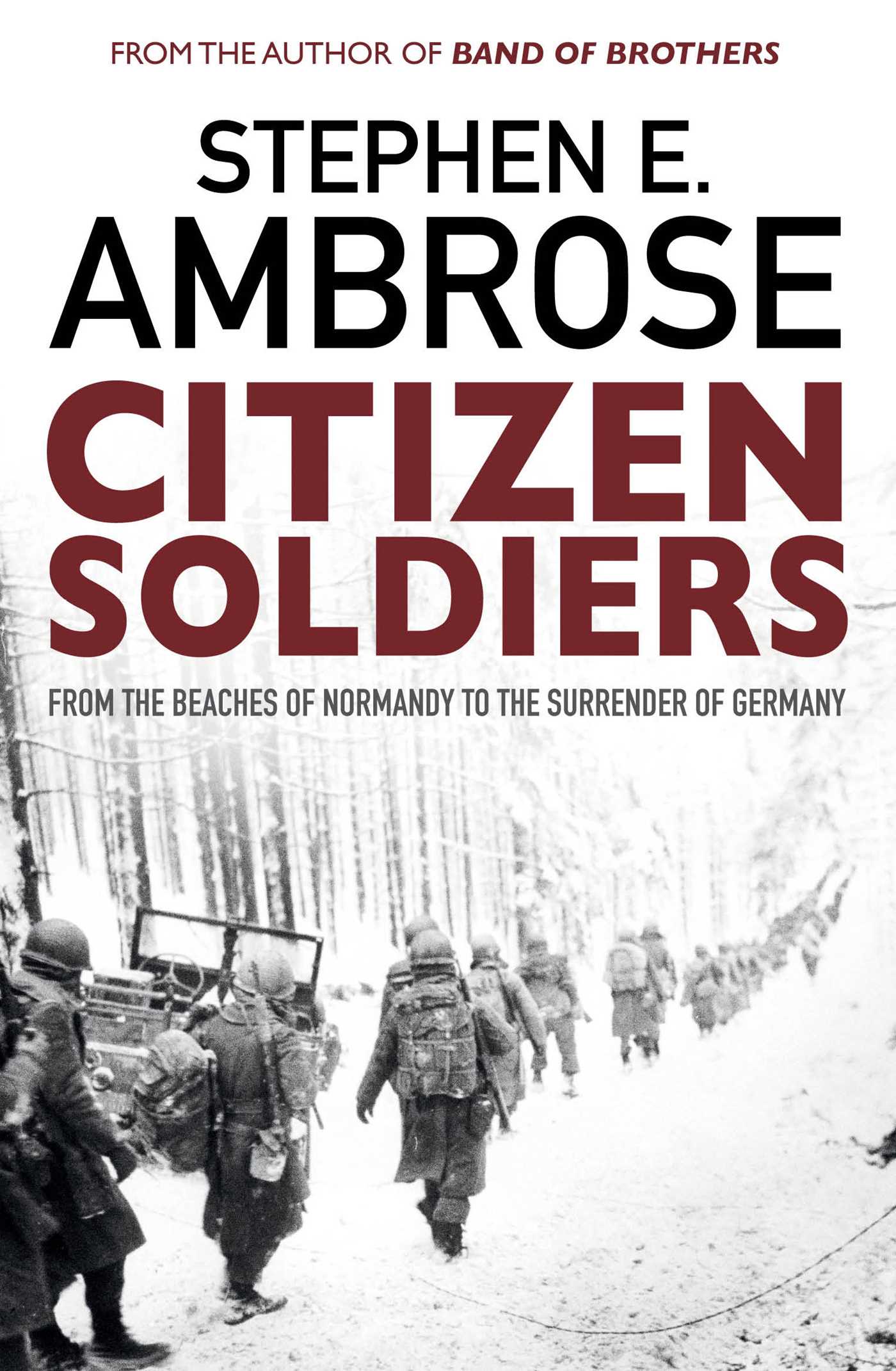
Citizen Soldiers by Stephen E. Ambrose


How Citizens Become a Soldier


The book describes how these "citizen soldiers" came to be soldiers, and what they did once they were. There is some overlap with his other titles about World War II. The book follows the battles right after the allies left the beaches of Normandy, all the way through France into German territory.

Details World War Two in Europe


This lengthy volume details the war in Europe. It tells how Americans were critical to that victory. It gives the story through the eyes of those who participated in the various units. I enjoy this title and the stories the former GI's share.

“Citizen Soldiers“ is the name for the draftees, national guard, and army reserve soldiers, the non-regular army soldiers, which were so necessary to field an army of the size that was needed in World War II. Ambrose clearly shows that both the regular army and the citizen-soldiers were required for victory.

Friday, October 25, 2019

Battle for Saigon: Tet 1968 by Keith Nolan


Battle for Saigon: Tet 1968 


Battle for Saigon: Tet 1968 by Keith Nolan gives an excellent tactical description of the fighting in and around Saigon during the Tet Offensive in 1968. While many, many other books give a larger strategic sense to the whole Offensive, this book is very specific and useful to understand what happened in South Vietnam's capital.

Accounts of Small-unit Leaders


This book has another strength, too, in that its accounts of small-unit leaders in combat provide great lessons for future junior military leaders--especially for company command level and below. The one big drawback is that it has no tactical maps, just one big map of Saigon at the beginning of the book. Detailed maps would have been a great help while trying to decipher the textual descriptions of the fight. The author should take note of this for future revisions of this book.

Promoting the study of military history through book reviews.

Friday, May 24, 2019

D-Day June 6 1944: The Climactic Battle of World War II by Stephen E. Ambrose


Over 1400 Interviews


The late Stephen E. Ambrose used over 1400 interviews for his history of the D-Day invasion. This “oral history" approach brings the reader into the heart of the battle through eye-witness testimony. The tales of the front line infantryman sweeps the reader up into their personal histories. The story is told from the individual and small unit level often failing to describe larger unit actions or explaining how the individual actions fit into the total picture. Let is shared of what happened on the Canadian and British beachheads. Historical controversies are often given minimal coverage. These are simply good stories of many individual experiences.

American Achievement in Normandy


The book is not a textbook for lessons on strategic decision making or to answer big-picture questions. Ambrose touches on these larger issues in a general focus, but that is not his focus. This is a book about the American achievement in Normandy. The individual courage and independence of the American small unit leaders is a big story of this book. Ambrose is right on target as he tells the story of their braveness and toughness.

Thursday, May 23, 2019

The Victors: Eisenhower and His Boys: The Men of World War II by Stephen E. Ambrose


The Victors: Eisenhower and His Boys: The Men of World War II by Stephen E. Ambrose is essentially a cut and paste compilation of D-DAY, Citizen Soldiers, Eisenhower, Band of Brothers, and The Wild Blue.

If you have read any of Stephen Ambrose's works on World War II, then this one is not worth the time. It has so much material covered in his lengthier works.

It is better to read D-DAY, Citizen Soldiers, Eisenhower, Band of Brothers, and The Wild Blue and to skip this book altogether.

Wednesday, May 22, 2019

Band of Brothers by Stephen E. Ambrose


Easy Company


Band of Brothers is the story of a US Army Infantry Rifle Company (Airborne). It's the story of Easy Company, 506th Infantry, 101st Airborne Division, US Army.

The book begins in the summer of 1942 telling the story of the men going through initial basic training at Camp Toccoa, Georgia. It continues as they earn their "jump wings" covering time at Benning, with additional training at Mackall, Bragg, Shanks.

The story continues with deployment and training in England as the company prepares for the invasion and undergoes changes in leadership.

The book draws on hours of interviews with survivors as well as the soldiers' journals and letters. Dr. Stephen Ambrose tells the stories, many time in the men's own words.

D-Day to the End of the War


The book takes the reader through D-Day, back to England, to Operation Market Garden, the Battle of the Bulge, and on to the end of the war and the Eagle's Nest. It recounts occupation duty and concludes looking at the survivor's post-war careers.

I read Band of Brothers by Stephen E. Ambrose in August 1996, years before it was made into an HBO mini-series. This is one of the most read and popular books in the last twenty years due to the HBO mini-series based on the book. The History Channel also periodically shows the mini-series.

The book is better than the mini-series. It tells the story of Easy Company 506th Parachute Infantry Regiment that ultimately became part of the 101st Airborne Division. I enjoyed the book because of the focus on the people in the unit. It has reached cult-like status.

Friday, May 17, 2019

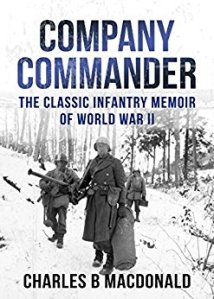
Company Commander: The Classic Infantry Memoir of World War II by Charles B. MacDonald


A Template for Writing a Personal Military Memoir


I highly recommend Company Commander: The Classic Infantry Memoir of World War II by Charles B. MacDonald. At just 21 years of age, Captain Charles B. MacDonald first commanded I Company, 3 Battalion 23rd Infantry, 2nd Infantry Division from October 1944 to January 1945 and later G Company, 2 Battalion 23rd Infantry, 2nd Infantry Division from March to May 1945. This memoir was written in 1947 when recollections were still sharp. It resulted in a very detailed account of what it was like to take command of a line infantry company and lead it into battle. The book gives us a template for writing a personal military memoir.

The Best Memoir of Any Junior Officer in World War Two


It is by far the best memoir of any junior officer in World War Two. Charles MacDonald does a great job of keeping his focus on his own experiences. He does not speculate or wastes my time by giving conjecture on the big picture. We only have first-hand information from the events of his personal participation. He sticks to what life was like for a junior officer in command of an infantry company, sleepless, hungry, dirty, stressful, and very dangerous. He takes us from the Siegfried Line in the Ardennes, through the Battle of the Bulge, and to the end of the war in Czechoslovakia.

A Must-read for all US Army Officers


This book is a must-read for all army officers who seek to command at company-level and it is informative for military historians as well. It is still required reading at West Point and on the company level officer (second lieutenant, first lieutenant, and captain) recommended reading list by the U.S. Army today.

An Official Civilian Historian of World War Two


Upon this book's publication in 1947, Charles B. MacDonald was invited to join the U.S. Army Center of Military History as a civilian historian, the start of a career during which he wrote three of the official histories of World War II in Europe and supervised the preparation of others. The book is simply the best.

Thursday, May 16, 2019

One Soldier's Story: A Memoir by Robert Dole


The Story of Robert Dole


"One Soldier's Story" by Robert Dole tells the story of former US Senator and Republican presidential candidate Robert Dole, of Kansas. It shares tales of his growing up in Russell, Kansas. We learn of his running track, attending high school, working as a soda jerk, and attending Kansas University (KU). He opens the window to his experiences at KU where we see him running track, joining a fraternity, working odd jobs to help pay for his college, buying a phonograph, and experiencing the bombing of Pearl Harbor.

US Army Air Corps or the US Army Infantry


His story continues where he struggles with the choice of joining the US Army Air Corps or the US Army infantry. He joins the Army, goes through Officer Candidate School, and ultimately becomes an infantry officer. His tour of duty in World War II takes him to the Italian theater of the war. In Italy, his life is forever altered. He receives a critical wound while on a combat mission.

Wounded Warrior's Rehabilitation


The remainder of "One Soldier's Story" tells of his struggles through hospitalization, evacuation, and transport to the USA, rehabilitation, depression, learning to walk again, falling in love and his first marriage, return to Russell, Kansas and his daily challenges. We follow Bob Dole through his return to complete his college degree and his decision to attend law school. We experience his building a career as a young lawyer, the decision to run for political office, and his ultimate service as a US Senator, and being both a vice presidential candidate (1976) and presidential candidate (1996).

A Very Inspirational Story


Whether you like Bob Dole's conservative politics or not, you will find his story very inspirational. This extremely well-written memoir is hard to put down.

Wednesday, May 15, 2019

Jungle in Black by Steve Macguire


Memoir


Jungle in Black is the memoir of Steve Maguire. McGuire was a young, gung-ho, Airborne Ranger who led a 9th Infantry Division battalion Reconnaissance Platoon in the 6th Battalion, 31st Infantry in the Mekong Delta.

Reconnaissance Platoon Leader


The story opens with drawn-out and generic combat descriptions that lead up to Maguire's wounding. The rest of the book covers his treatment. We learn that an exploding Vietcong mine blinded him for life. This is an honest first-person account that never wallows in self-pity. Unfortunately, he in no way offers enough background about his life to round out his personality.

Just Another War Story Memoir


He missed the mark with his book. He paints a broad description of the early stages of rehab. The description covers the usual male boasting, lust for nurses and hopes dashed by physicians not healing or restoring his sight. He fails to feature how he coped with his loss of sight and earned a doctorate in psychology (not mentioned until in an epilogue). This could have been a very inspirational and motivational story; instead, it’s just another war story memoir.

Tuesday, May 14, 2019

Crusade in Europe by Dwight David Eisenhower


Dwight Eisenhower's World War Two Memoir


Crusade in Europe is General Dwight David Eisenhower's memoir from the early days of World War Two through the early post-war. His story and observations are crucial to an understanding of the Great Crusade. Among memoirs, this is a gem.

Beginnings


General Eisenhower takes the reader along with him through each stage of the Crusade. Having attracted attention for his performance in Army maneuvers in Louisiana in 1940, General Eisenhower was called to Washington immediately after Pearl Harbor because of his recent experience in the Philippines. He was first assigned to work on plans for the Pacific. At this point, the reader is reminded that, in contrast to the later Germany First Policy, the American public, for a time, screamed for revenge on Japan before dealing with Germany.

Operation Torch


Assigned to command Operation Torch, the invasion of French North Africa in 1942, General Eisenhower was charged with obtaining Allied Cooperation. He was plunged into the quagmire of French politics. The disappointing involvement with General Giraud presented an intra-allied problem, as did cooperation of Admiral Darlan, who while too helpful to rebuff, brought with him the stigma of association with a collaborator. The age-old Arab-Jewish hostility further complicated the administration of the liberated territory.

Sicily


With North Africa cleared out, General Eisenhower was charged with the conquest of Sicily. Management of the Patton-Montgomery rivalry was a major challenge of the campaign. Success having been achieved, the Patton slapping incident in Sicily forced General Eisenhower to reprimand a close friend while threatening to deprive him of one of his most effective Army commanders.

Overlord


Speculation that General Eisenhower would return to the Washington as Chief Of Staff while General Marshall commanded Overlord, the invasion of Europe, distracted General Eisenhower's attention from problems at hand. General Eisenhower's eventual appointment to command Overlord forced him to leave the Mediterranean while the Italian campaign was still in doubt. Upon arrival in England, he immediately switched gears to plan the size, timing, supply and location of the invasion of France.

Operation Market-Garden, and the Battle of The Bulge


With the invasion ashore, General Eisenhower skillfully managed his coalition of impetuous commanders in their march across Europe. General Eisenhower brings the reader into the thought processes and conferences leading to decisions on the liberation of Paris, Operation Market-Garden, and the Battle of The Bulge.

General Eisenhower's Wartime Leadership


Americans are familiar with Patton's claim that, with supplies, he could capture Berlin and win the war. General Eisenhower relates that Monty bothered him with similarly impractical suggestions. He then explains why the proposals were doomed to failure. Spirited arguments with the British over Project Anvil (Invasion of Southern France) come within the reader's vision through General Eisenhower's eyes.

The greatest criticism of General Eisenhower's wartime leadership is reserved for questions about whether the Western Allies should have advanced further to limit the Red Army's area of occupation. General Eisenhower assesses the claims and presents support for his decisions.

After V-E Day


After V-E Day, General Eisenhower's role shifted more into that of a statesman as he attempted to obtain cooperation with the Russians over the administration of occupied Germany.

Some things come clearly through the pages of this book. The reader is constantly impressed with the importance of supplies, bringing to mind the adage that "Amateurs speak of tactics, professionals speak of logistics." Despite later controversies, General Eisenhower's admiration for General George Marshall is made clear on the pages of this book. Written in 1948, I find the statement that General Eisenhower disagreed with many of FDR's domestic policies to be surprising and a hint of his later political initiatives.

Crusade in Europe is written in a very clear, easy to read and follow style. It never becomes bogged down in boring details. It does not have any mention of his relationship with his female English army driver.

Monday, May 13, 2019

It Doesn’t Take a Hero by H. Norman Schwarzkopf


It Doesn’t Take a Hero


I first read this book in 1995. I have read it once since. "It Doesn’t Take a Hero" by H. Norman Schwarzkopf takes its title from a quote Schwarzkopf gave during an interview with Barbara Walters in 1991; "It Doesn’t Take a Hero to order men into battle. It takes a hero to be one of those men who goes into battle."

First, I must admit I am a Schwarzkopf fan. He commanded the 1st Brigade, 9th Infantry Division as a colonel while I was serving as a 1LT in the 9th Division. His third child (son) was born about two hours after my first son at Madigan Army General Hospital. We spent time in the Army hospital delivery room together. Our wives were in beds beside each other in the hospital ward. We were on a first name basis. He called me lieutenant and I called him sir.

Prior to his arrival at Fort Lewis, he had been the assistant commander of the 172nd Infantry Brigade (Alaska Brigade). The 172nd Infantry Brigade’s commander he served under was Major General Willard (Will) Latham who Schwarzkopf called the toughest general in the US Army. I have been an acquaintance of MG Latham’s for 35 years. Latham's son was a classmate of mine at the University of Texas at Arlington (UT Arlington). I have discussed Schwarzkopf and Schwarzkopf’s book with Latham. I also am a contributor to the Wikipedia article H. Norman Schwarzkopf.

Schwarzkopf's Background


Schwarzkopf came from an upper-middle-class family, his father was a West Point graduate, head of the New Jersey state police (who later led the hunt for the Lindbergh kidnappers), and served President Roosevelt on a special assignment in Iran. They lived in the best house in their town and even employed a maid, but there was a dark family secret... his mother's alcoholism. His experiences in the Middle East in Iran as a young man, where he lived with his general father, gave him a unique insight into the Arab world that served him personally, and the coalition as a whole. He went to boarding schools in the middle-east and in Switzerland. This helped him develop the cultural understanding and build some relationships that he would later call on during the Gulf War.

Vietnam


The part of the book that deals with his duties in Vietnam is interesting. He expresses the popular hindsight viewpoint against the stupidity and arrogance of the politicians and 'Brass' who ordered young men to lay down their lives in that far away land for no good reason. He became convinced that he had to do something to change the army from within; it was either that or he resigns his commission.

Grenada


His role in leading the rescue of the medical students in Grenada is extremely interesting. It provided him with lessons that were applied during the Gulf War.

Desert Storm


The most interesting part of the book is his telling of the Gulf War, Desert Storm. It is probably true to say that without "Stormin'" Norman, there wouldn't have been a successful, Gulf War. He was able to play on the links his father had with Arab Royalty, and then forged his own links with the current Saudi Royal Family, working with Crown Princes on a first name basis to get things done, everything from releasing endless millions of dollars in payments to the US - what is the daily rental on an aircraft carrier?! - to arranging for "tent cities" to be erected to shield the incoming troops from the scorching desert sun.

Politics of the Coalition


The most interesting aspect of the Gulf War section was the politics of the coalition, especially in the Arab world, something that was almost completely missing in Colin Powell's memoir. In this crucial, although a mostly unknown area of the War, Schwarzkopf's experiences in the Middle East were invaluable. Middle Eastern politics is a lethal minefield at the best of times - us Brits have had our fingers burnt on more than one occasion over the years! - and pouring hundreds of thousands of free thinking, free drinking, Western troops of endless religious and moral persuasions into the autocracy that is the kingdom of Saudi Arabia, should have been a recipe for utter disaster!

Schwarzkopf's deft handling of the endless 'difficulties' involving religious services, the consumption of alcohol, the reading of magazines of dubious 'artistic' merit, even the receiving of Christmas cards and the erection of Christmas decorations, were handled with a skill and subtlety that one would not have thought a mere 'soldier' possible. And then, of course, there was the Israeli question. The one thing above all else that would have blown the coalition apart would have been Israel attacking Iraq in retaliation for the Scuds that fell on Israeli territory. Although much of the efforts to keep Israel out of the action were handled directly from Washington, Schwarzkopf's handling of the Saudi's in particular, on the ground as it were was masterful.

"It Doesn’t Take a Hero" is a fascinating tale, a real inspiration; it shows what one man can achieve through clear thinking, a positive attitude, boundless enthusiasm, and profound love, not only of his own country but of mankind. I would recommend it highly.
Friday, May 10, 2019

The Civil War: A Narrative, Fort Sumter to Perryville. Vol 1


Shelby Foote's 2,934-Page Trilogy (Book One)


A few years ago I read the late Shelby Foote's 2,934-page trilogy, The Civil War A Narrative. Volume one, The Civil War: A Narrative, Fort Sumter to Perryville" was 810 pages in the version I have.

Beginning of the War through December 1862


The book covers the beginning of the war through December 1862. The late Shelby Foote writes with a down-home, comfortable style that is like he is sitting beside you telling a story. Make no mistake, he is southern and tells the story from a southern point of view. The book is a work of creative non-fiction. It is a first-class narrative. It is an example of how to write history.

Many students of the Civil War are limited in their knowledge of the war to the major battles of Fort Sumter, Bull Run, Fort Henry, and Fort Donelson, Shiloh, Corinth, Iuka, Antietam (Sharpsburg), etc. (battles in 1861 -1862) or the generals. Foote covers all the battles. And he covers what takes place in between the battles though with minor battles tend to be brushed over with the simple reference to their being fought.

Enjoyable Backstories


I admit some parts of the book were a struggle for me to get through. The time between the campaigns and battles, the endless maneuvers and debates were challenging. Once he moved on to the next battle or fight, the action and pace of the book picked up. Foote shared enough strategy and tactics as well as some of the intellectual processes the key players used to help us understand what leadership on both sides will do under such situations. At times it was like reading the strategy behind a chess game. The backstories of the political considerations were actually enjoyable at times and problematic to boring at others.

I recommend this to any American or person with an interest in American history. Yes, the battles may seem to be repetitious. Yes, the politics and maneuvers do at times get somewhat dry. They must be included to tell the entire story. We need to know the story well to know who we are as people.

I wish the editor had placed better divisions in the book. Even knowing the history of the civil war well, I had trouble at times with where we were and at what battle was happening. Many of the battles are referred to by their southern name, usually the nearest town e.g. Sharpsburg instead of their northern name e.g., Antietam, usually the nearest body of water.

Thursday, May 09, 2019

A Soldier Reports by William Westmoreland


Westmoreland's Background


The book is the memoir of one of America's most controversial military leaders. I found it refreshing to read of his background and upbringing. He briefly covers his days as a cadet at West Point where he graduated in 1936, the horse dawn artillery days, and his role in World War II where he fought with distinction in North Africa and Europe with the Ninth Division. We see his fast rise to a Brigadier General before thirty years of age and later (1952–53) in a role in the Korean War. He served as superintendent of West Point (1960–64), attained (1964) the rank of general and commanded (1964–68) U.S. military forces in Vietnam. He then assumed the position of army chief of staff, which he held until his retirement in 1972.

The Vietnam War for General Westmoreland's Point of View


I was saddened as I read Westmoreland’s comments on one of the early killed in action lists that crossed his desk. It included 2LT John J. Pershing III, grandson of World War I supreme commanding general "Blackjack" Pershing. The book looks at the Viet-Nam war from Westmoreland's point of view. It explains his decision-making process.

More Than an After-Action Report


It is more than an after action report. It is worth reading if you are a political or military history junkie. His relationship with Lyndon Johnson and Robert McNamara are not covered in the detail I would have liked. This is the story of a decent man, giving his best to his country in difficult times.

Thursday, April 30, 2015

"Special Operations in The American Revolution" by Robert Tonsetic


"Special Operations in The American Revolution" by Robert Tonsetic tells nine stories of battles or campaigns during the American Revolutionary War. In each case, the American colonist used unconventional warfare.


Experience the battles/campaigns of the American Revolutionary War. Learn the background of the principal leaders. See American know-how demonstrated by the army, navy and marines in their operations.
My favorite chapters were one and eight. "The Capture of Fort Ticonderoga" is the title and story of chapter one. It tells of Ethan Allen's leadership. "The Whaleboat Wars" is the title of chapter eight. It includes the story of Benjamin Tallmage.

The author is a very good story teller. He brings the events to life through the stories of the participants.

The book fills a void in the literature of the American Revolution.
Added bonuses are the book's bibliography. It is excellent. The operational maps and photos also compliment the narrative.

Casemate Publishing published "Special Operations in The American Revolution" by Robert Tonsetic. It is a must addition to the library of every military historian as well as students of the American revolutionary War.
Dr. Tonsectic has crafted an exciting book.


jak-moustacheJimmie Aaron Kepler is a novelist, poet, book reviewer, and award-winning short story writer. His work has appeared in over twenty venues, including Bewildering Stories and Beyond Imagination. When not writing each morning at his favorite coffee house, he supports his writing, reading, and book reviewing habit working as an IT application support analyst. He is a former Captain in the US Army. His blog Kepler's Book Reviews was named a 100 best blogs for history buffs in 2010. You can visit him at http://www.jimmiekepler.com.

Saturday, February 16, 2013

"Valor in Vietnam 1963 - 1977: Chronicles of Honor, Courage and Sacrifice" by Allen B. Clark


I enjoyed reading “Valor in Vietnam 1963 - 1977: Chronicles of Honor, Courage and Sacrifice" by Allen B. Clark. I can easily recommend the book. In the vast literature on Vietnam that is too often  memoirs full of hubris or tomes that bore you with action killing details, Mr. Clarke has given us a wonderful, fresh look at one of the most seminal events in the life of those who experienced the 1960s and 1970s. You experience the Vietnam War from the personal point of view of  some of the men and women who were there. You get both a unique boots on the ground and narrative perspective.   

I need to give a spoiler warning. I was left wondering if the actions Colonel Clyde R. Russell was the catalyst that started the war. It was interesting to see his son in high school in Saigon in 1964. Later, we learn of his son, Lieutenant Chris Russell – the reluctant warrior as the author called him. We see how his dad got his college student deferment pulled where he had to go in the Army. We see when he is in Vietnam he returns to the halls he walked as a ten grader. The building is now used for a very different purpose.

The book is full of wonderful, well told stories that sequentially take us through the war. The stories of men and women of various branches of service and ranks, both officer and enlisted gives a you were there feel.

I especially enjoyed the combat leadership lessons that were shared as we made our way through the years of the war. I would hope that such venues as the Infantry School, Command and General Staff College, and War College would include this insightful work in their required or recommended reading. I pray these are lessons that will not have to be learned over and over, but can be taught through case studies from this book.

While every chapter was well written and action packed, a couple of chapters especially touched me. They were the chapters on The Real Horrors of War covering Captain Wendy Weller's tour as a nurse in 1969-1970 and the chapter titled Ranger's Ranger covering the 1965 – 1970 tours of duty of Staff Sergeant Patrick Tadina. I was amazed at how low the casualty rate was for the units/missions he led and how long he was in Vietnam.

The book's title caught my attention when it had the date range going to 1977 instead of stopping in 1973 or 1975. Spoiler alert – the last chapter covers 1975 to 1977 and a couple who were left behind when the last Americans fled. It is intriguing.

Congratulations to author Allen B. Clark and Casemate Publishing.  You have published a special book.

"Valor in Vietnam 1963 - 1977: Chronicles of Honor, Courage and Sacrifice" by Allen B. Clark. The publisher is Casemate Publishing. 

Wednesday, September 16, 2009

A Bridge Too Far by Cornelius Ryan

A Bridge Too Far: The Classic History of the Greatest Battle of World War II by Cornelius Ryan gives one of the best accounts of General Montgomery's ill-fated plan and operation to turn the German northern flank on the Western front during September 1944 of World War II. Montgomery hoped to press into the heart of industrial Germany to end the war in 1944. This narrative non-fiction work by Cornelius Ryan brings together the objectivity and insights of a historian with the narrative style of a novelist. Ryan brings historical events to life. Ryan's writings keep your interest. He gives the experiences of the individual soldiers and Dutch resistance members. He tells the story from all sides. The roles and effects of these operations on the civilians unfortunate enough to be caught up in events are included. 

From reading Ryan's work I found a dramatic lack of urgency on the part of the British. An example is after the 82nd had secured their main bridge objective which included tremendous sacrifice the British simply camped for the night brewing their tea while their fellow countryman were still encircled and dying in Arhen. I was disappointed that Montgomery was not slammed for this operation. From he account Montgomery is lucky he wasn't relieved of command or sacked on the spot.

I recommend the book, tough at times I found the reading and the story slowly unfolding. It is one of the all time classics of World War II and should be in the library of every military history buff. Read and reviewed by Jimmie A. Kepler.

Wednesday, July 08, 2009

Utah Beach: The Amphibious Landing And Airborne Operations On D-Day, June 6, 1944 by Joseph Balkoski

Joseph Balkoski chronicles the events of the day almost minute by minute. "Utah Beach" reads like a great documentary. It is not a memoir. Readers who love first person hubris may find it lacking action.

Balkoski relies mainly on primary sources such as after action reports, unit journals, and citations to create his blow by blow narrative. Sprinkled throughout the battle account are the accounts of those in the battle. It is a must addition for any D-day library or World War II library.

A valuable resource in the book are the appendixes. They include "Allied Causalities on Utah Beach and in Cotentin Peninsula, June 6, 1944", "Medal of Honor and Distinguished Service Cross Awards for Valor on Utah Beach and in Cotentin Peninsula, June 6, 1944", "First-Wave Units on Utah Beach","Initial Parachute and Glider Assault, Cotentin Peninsula, 12:20 - 4:15 A.M., June 6, 1944","Ninth Air Force, IX Troop Carrier Command, June 6, 1944", "Ninth Air Force, IX Bomber Command, Utah Beach Bombing Mission, 6:09 - 6:27 A.M., June 6, 1944", "U.S. Navy Force U Bambardment Group", "Captain Frank Lillyman's Pathfinder Stick, June 6, 1944", and "Uniform and Equipment of U.S. Army Paratroopers, 82nd and 101st Airborne Divisions, June 6, 1944". Read and reviewed by Jimmie A. Kepler.

Friday, January 09, 2009

The Killer Angels by Michael Shaara

If you have the slightest interest in the Civil War, don't fail to read the late Michael Shaara's book The Killer Angels. It won the Pulitzer Prize for Fiction in 1974. For some reason this book had never crossed my path. It wasn't until Father's Day this year that I was even aware of its existence. My 27 year old son gave me a DVD that had both Gods and Generals and Gettysburg on it. In reading the jacket of the DVD I saw the movie was based on this book. After watching the movie, I headed off to the library. I was not disappointed.

This volume shows both the courage and determination of the Union and Confederate soldiers. It examines the story from both viewpoints. You are told the story through the key leadership of the battle. You will read about Robert E. Lee. You will learn what his decisions were based on. You will see why he was so beloved by his army. The book allows you to be present as Lee struggles with decision after decision from his headquarters. You can feel the frustration of Longstreet as he tries to convince Lee that defense is a better choice. You will get a picture of the flamboyant Pickett. You will feel Lee's and Longstreet's frustration with J.E.B. Stuart. I met a new hero in the book - Joshua Lawrence Chamberlin as I read about the 20th Maine Regiment and Chamberlain who with a bayonet charge on Little Big Top held the end of the Union line. Another new hero I encountered was General John Buford. You will experience his anguish as he decides to engage Rebel forces. He knows that he was seriously outnumbered. He is determined to save the only high ground in the area.

I was emotionally involved in the book from the beginning to the end. This is the book that blurs the line between historical fiction and creative non-fiction. It is simply great reading. While the movie was good, the book is great. Michael Shaara had the vision, did the research, and wrote one of the best books ever. Thank you! Read and reviewed by Jimmie A. Kepler.

Saturday, October 04, 2008

The Civil War: A Narrative (Three Volumes - 2968 pages) by Shelby Foote

This magnificently written trilogy of books on the American Civil War is not only a piece of first-rate history, but also an excellent work of literature. The late Shelby Foote brings an accomplished novelist's descriptive power to this grand epic. This immense three volume set should be on the bookshelf of any Civil War buff. It is the definitive example of narrative history and creative non-fiction.

I started reading this 2,968-page trilogy on June 6, 2007 and have completed it this month (September 2008). This is not a reading assignment to tackle in a single season. I read 27 other books while reading through this great work. I will review each book of the trilogy separately.

The Civil War: A Narrative--Fort Sumter to Perryville, Volume One. The book covers the beginning of the war through December 1862. The late Shelby Foote writes with a down home, comfortable style that is like he is sitting beside you telling a story. Make no mistake, he is a southern and tells the story from a southern point of view. The book is a work of creative non-fiction. It is a first class narrative. It is the example of how to write history.

Many students of the Civil War are limited in their knowledge of the war to the major battles of Fort Sumter, Bull Run, Fort Henry and Fort Donelson, Shiloh, Corinth, Iuka, Antietam (Sharpsburg), etc. (battles in 1861 -1862) or the generals. Foote covers all the battles. And he covers what takes place in between the battles though with minor battles tend to be brushed over with the simple reference to their being fought.

I admit some parts of the book were a struggle for me to get through. The time between the campaigns and battles, the endless maneuvers and debates were challenging. Once he moved on to the next battle or fight, the action and pace of the book picked up. Foote shared enough strategy and tactics as well as some of the intellectual processes the key players used to help us understand what leadership on both sides will do under such situations. At times it was like reading the strategy behind a chess game. The back stories of the political considerations were actually enjoyable at times and problematic to boring at others.

I recommend The Civil War: A Narrative--Fort Sumter to Perryville, Volume One to any American or person with an interest in American history. Yes, the battles may seem to be repetitious. Yes, the politics and maneuvers do at times get somewhat dry. They must be included to tell the entire story. We need know the story well to know who we are as a people.

I wish the editor had placed better divisions in the book. Even knowing the history of the civil war well, I had trouble at times with where we were at what battle. Many of the battles are referred to by their southern name, usually the nearest town e.g. Sharpsburg instead of their northern name e.g., Antietam, usually the nearest body of water.

The Civil War: A Narrative: Volume 2: Fredericksburg to Meridian covers from December 1862 and the Fredericksburg Battle to the Meridian , Mississippi campaign and the US Grant’s promotion to Lieutenant General. The late Shelby Foote continues writing in a down home, comfortable style that is like he is sitting beside you telling a story. Again, I point out as in the review of volume one, make no mistake; he is a southern and tells the story from a southern point of view. The book is a work of creative non-fiction. It is a first class narrative. It is the example of how to write history.

Foote covers all the battles. And he covers what takes place in between the battles though with minor battles tend to be brushed over with the simple reference to their being fought.

As in volume one I admit some parts of the book were a great struggle for me to get through. At times between the battles it was boring. The time from Fredericksburg to Vicksburg and Gettysburg took forever to cover. Foote occasionally repeated himself and would chase rabbits. The time between the campaigns and battles, the endless maneuvers and debates were challenging. Once he moved on to the next battle or fight, the action and pace of the book picked up. Foote shared enough strategy and tactics as well as some of the intellectual processes the key players used to help us understand what leadership on both sides will do under such situations. At times it was like reading the strategy behind a chess game. The back stories of the political considerations were actually enjoyable at times and problematic to boring at others.

I recommend this to any American or person with an interest in American history. Yes, the battles may seem to be repetitious. Yes, the politics and maneuvers do at times get somewhat dry. They must be included to tell the entire story. We need know the story well to know who we are as a people.

Again, I wish the editor had placed better divisions in the book.

The Civil War: A Narrative, Volume 3: Red River to Appomattox. Shelby Foote takes the Civil War and scrutinizes it in a writing style that feels as if you are hearing news from the front in an ongoing war. This book is not for the mildly curious, you will get bored and overwhelmed by the dates, names and places. This volume is longer than either of the first two volumes. But to military history, history, or civil war buffs, it is as detailed and factual as you could want. This is truly a definitive work on the War Between the States.

The book handles personalities of both individuals and cultures and their effects on the war. The reading can be slow going at times as armies march toward each other and the order of battle becomes established with the commanders’ names and stations, but the battle details seem incredibly well researched and the accounts of individual soldiers/officers bring home the reality of this conflict.

This book is well worth the effort to read, it imparts a sense of what the United States has survived and clarifies many historical perceptions of the era and the people involved in this massive conflict.

Once more I wish the editor had placed better divisions in the book.

A final thought - I have never read a better, more vivid, more understandable account of the savage battling between Grant's and Lee's armies. Shelby Foote stays with the human discord and distress, and unlike most Southern commentators, he does not take sides. In objectivity, in range, in mastery of detail in beauty of language and feeling for the people involved, this work surpasses anything else on the subject. It stands alongside the work of the best of them. Jimmie A. Kepler September 2008.

Saturday, January 31, 2004

The Wild Blue: The Men and Boys Who Flew the B-24s Over Germany by Stephen E. Ambrose

"The Wild Blue: The Men and Boys Who Flew the B-24s Over Germany" by Stephen E. Ambrose is controversial because some scholars point out Ambrose has lifted the work of other authors without placing said work inside "quotation" marks. That is a tragic error. Is it an error of omission or commission? I do not know. I do know it is ethically wrong. The book tells the story of former US Presidential candidate and US Senator George McGovern. It tells of McGovern's upbringing, his journey to college, the outbreak of World War II, his falling in love and marriage, his joining the US Army Air Corps, his training as a pilot, and his combat deployment and action where he was based out of Italy bombing the Axis war machine. It is written in Ambrose's wonderful narrative style. It is highly readable and entertaining. Read in January 2005.

Wednesday, December 31, 2003

Company Commander: The Classic Infantry Memoir of World War II by Charles B. MacDonald


I highly recommend Company Commander: The Classic Infantry Memoir of World War II by Charles B. MacDonald. At just 21 years of age, Captain Charles B. MacDonald first commanded I Company, 3 Battalion 23rd Infantry, 2nd Infantry Division from October 1944 to January 1945 and later G Company, 2 Battalion 23rd Infantry, 2nd Infantry Division from March to May 1945. This memoir was written in 1947 when recollections were still sharp. It resulted in a very detailed account of what it was like to take command of a line infantry company and lead it into battle. The book gives us template for writing a personal military memoir.

It is by far the finest memoir of any junior officer in World War II. Charles MacDonald does a great job of keeping his focus on his own experiences. He does not speculate or waste my time by giving conjecture on the big picture. We only have first hand information from the events of his personal participation. He sticks to what life was like for a junior officer in command of an infantry company, sleepless, hungry, dirty, stressful, and very dangerous. He takes us from the Siegfried Line in the Ardennes, through the Battle of the Bulge, and to the end of the war in the Czechoslovakia.

This book is a must-read for all army officers who seek to command at company-level and it is informative for military historians as well. It is still required reading at West Point and on the company level officer (second lieutenant, first lieutenant, and captain) recommended reading list by the U.S. Army today. Upon this book's publication in 1947, Charles B. MacDonald was invited to join the U.S. Army Center of Military History as a civilian historian, the start of a career during which he wrote three of the official histories of World War II in Europe and supervised the preparation of others. The book is simply the best. Read and reviewed by Jimmie A. Kepler in June 2006.

Airborne: A Combat History of American Airborne Forces by LTG (Retired) E. M. Flanagan Jr.

Airborne Airborne: A Combat History of American Airborne Forces by LTG (Retired) E. M. Flanagan Jr. Allow me to state my prejudices...