Showing posts with label Vietnam War. Show all posts

Wednesday, November 06, 2019

Steel My Soldiers' Hearts: The Hopeless to Hardcore Transformation of the U.S. Army, 4th Battalion, 39th Infantry, Vietnam by David Hackworth


Vietnam in the spring of 1969


Steel My Soldiers' Hearts: The Hopeless to Hardcore Transformation of the U.S. Army, 4th Battalion, 39th Infantry, Vietnam by Col. (Retired) David H. Hackworth and his wife Eilhys England. The book is about David Hackworth. It is a memoir about his time in Vietnam in the spring of 1969.

He embodies both the best and the worst of US Army officers. He is a hard-charging, mission-oriented, and motivated officer. He demands excellence from the men under his command. He suffers the hardships they do. He is also quite egotistical and hubris can describe his self-confidence that borders on an attitude of self-love.

9th Division, 4th Battalion, 39th Infantry


The book is about the U.S. Army’s 9th Division, 4th Battalion, 39th Infantry, Vietnam. This book is about Hackworth's transformation of what he viewed as a combat-ineffective battalion of draftees that he leads into a solid American fighting unit.

The story is a good case study of leadership. The descriptions of combat operations contained in the book are some of the best I have read and comparable with those in “We Were Soldiers Once … and Young”.

I highly recommend the book to those interested in military history or Vietnam War history. David Hackworth relates a narrative about himself.

It is a good story of the men in the 4th Battalion, 39th Infantry that deserves to be read.

Friday, October 25, 2019

Battle for Saigon: Tet 1968 by Keith Nolan


Battle for Saigon: Tet 1968 


Battle for Saigon: Tet 1968 by Keith Nolan gives an excellent tactical description of the fighting in and around Saigon during the Tet Offensive in 1968. While many, many other books give a larger strategic sense to the whole Offensive, this book is very specific and useful to understand what happened in South Vietnam's capital.

Accounts of Small-unit Leaders


This book has another strength, too, in that its accounts of small-unit leaders in combat provide great lessons for future junior military leaders--especially for company command level and below. The one big drawback is that it has no tactical maps, just one big map of Saigon at the beginning of the book. Detailed maps would have been a great help while trying to decipher the textual descriptions of the fight. The author should take note of this for future revisions of this book.

Promoting the study of military history through book reviews.

Wednesday, May 15, 2019

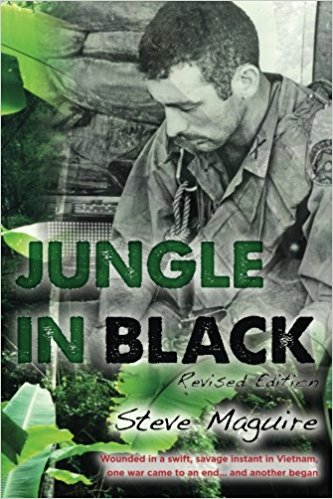
Jungle in Black by Steve Macguire


Memoir


Jungle in Black is the memoir of Steve Maguire. McGuire was a young, gung-ho, Airborne Ranger who led a 9th Infantry Division battalion Reconnaissance Platoon in the 6th Battalion, 31st Infantry in the Mekong Delta.

Reconnaissance Platoon Leader


The story opens with drawn-out and generic combat descriptions that lead up to Maguire's wounding. The rest of the book covers his treatment. We learn that an exploding Vietcong mine blinded him for life. This is an honest first-person account that never wallows in self-pity. Unfortunately, he in no way offers enough background about his life to round out his personality.

Just Another War Story Memoir


He missed the mark with his book. He paints a broad description of the early stages of rehab. The description covers the usual male boasting, lust for nurses and hopes dashed by physicians not healing or restoring his sight. He fails to feature how he coped with his loss of sight and earned a doctorate in psychology (not mentioned until in an epilogue). This could have been a very inspirational and motivational story; instead, it’s just another war story memoir.

Monday, May 13, 2019

It Doesn’t Take a Hero by H. Norman Schwarzkopf


It Doesn’t Take a Hero


I first read this book in 1995. I have read it once since. "It Doesn’t Take a Hero" by H. Norman Schwarzkopf takes its title from a quote Schwarzkopf gave during an interview with Barbara Walters in 1991; "It Doesn’t Take a Hero to order men into battle. It takes a hero to be one of those men who goes into battle."

First, I must admit I am a Schwarzkopf fan. He commanded the 1st Brigade, 9th Infantry Division as a colonel while I was serving as a 1LT in the 9th Division. His third child (son) was born about two hours after my first son at Madigan Army General Hospital. We spent time in the Army hospital delivery room together. Our wives were in beds beside each other in the hospital ward. We were on a first name basis. He called me lieutenant and I called him sir.

Prior to his arrival at Fort Lewis, he had been the assistant commander of the 172nd Infantry Brigade (Alaska Brigade). The 172nd Infantry Brigade’s commander he served under was Major General Willard (Will) Latham who Schwarzkopf called the toughest general in the US Army. I have been an acquaintance of MG Latham’s for 35 years. Latham's son was a classmate of mine at the University of Texas at Arlington (UT Arlington). I have discussed Schwarzkopf and Schwarzkopf’s book with Latham. I also am a contributor to the Wikipedia article H. Norman Schwarzkopf.

Schwarzkopf's Background


Schwarzkopf came from an upper-middle-class family, his father was a West Point graduate, head of the New Jersey state police (who later led the hunt for the Lindbergh kidnappers), and served President Roosevelt on a special assignment in Iran. They lived in the best house in their town and even employed a maid, but there was a dark family secret... his mother's alcoholism. His experiences in the Middle East in Iran as a young man, where he lived with his general father, gave him a unique insight into the Arab world that served him personally, and the coalition as a whole. He went to boarding schools in the middle-east and in Switzerland. This helped him develop the cultural understanding and build some relationships that he would later call on during the Gulf War.

Vietnam


The part of the book that deals with his duties in Vietnam is interesting. He expresses the popular hindsight viewpoint against the stupidity and arrogance of the politicians and 'Brass' who ordered young men to lay down their lives in that far away land for no good reason. He became convinced that he had to do something to change the army from within; it was either that or he resigns his commission.

Grenada


His role in leading the rescue of the medical students in Grenada is extremely interesting. It provided him with lessons that were applied during the Gulf War.

Desert Storm


The most interesting part of the book is his telling of the Gulf War, Desert Storm. It is probably true to say that without "Stormin'" Norman, there wouldn't have been a successful, Gulf War. He was able to play on the links his father had with Arab Royalty, and then forged his own links with the current Saudi Royal Family, working with Crown Princes on a first name basis to get things done, everything from releasing endless millions of dollars in payments to the US - what is the daily rental on an aircraft carrier?! - to arranging for "tent cities" to be erected to shield the incoming troops from the scorching desert sun.

Politics of the Coalition


The most interesting aspect of the Gulf War section was the politics of the coalition, especially in the Arab world, something that was almost completely missing in Colin Powell's memoir. In this crucial, although a mostly unknown area of the War, Schwarzkopf's experiences in the Middle East were invaluable. Middle Eastern politics is a lethal minefield at the best of times - us Brits have had our fingers burnt on more than one occasion over the years! - and pouring hundreds of thousands of free thinking, free drinking, Western troops of endless religious and moral persuasions into the autocracy that is the kingdom of Saudi Arabia, should have been a recipe for utter disaster!

Schwarzkopf's deft handling of the endless 'difficulties' involving religious services, the consumption of alcohol, the reading of magazines of dubious 'artistic' merit, even the receiving of Christmas cards and the erection of Christmas decorations, were handled with a skill and subtlety that one would not have thought a mere 'soldier' possible. And then, of course, there was the Israeli question. The one thing above all else that would have blown the coalition apart would have been Israel attacking Iraq in retaliation for the Scuds that fell on Israeli territory. Although much of the efforts to keep Israel out of the action were handled directly from Washington, Schwarzkopf's handling of the Saudi's in particular, on the ground as it were was masterful.

"It Doesn’t Take a Hero" is a fascinating tale, a real inspiration; it shows what one man can achieve through clear thinking, a positive attitude, boundless enthusiasm, and profound love, not only of his own country but of mankind. I would recommend it highly.

Thursday, May 09, 2019

A Soldier Reports by William Westmoreland


Westmoreland's Background


The book is the memoir of one of America's most controversial military leaders. I found it refreshing to read of his background and upbringing. He briefly covers his days as a cadet at West Point where he graduated in 1936, the horse dawn artillery days, and his role in World War II where he fought with distinction in North Africa and Europe with the Ninth Division. We see his fast rise to a Brigadier General before thirty years of age and later (1952–53) in a role in the Korean War. He served as superintendent of West Point (1960–64), attained (1964) the rank of general and commanded (1964–68) U.S. military forces in Vietnam. He then assumed the position of army chief of staff, which he held until his retirement in 1972.

The Vietnam War for General Westmoreland's Point of View


I was saddened as I read Westmoreland’s comments on one of the early killed in action lists that crossed his desk. It included 2LT John J. Pershing III, grandson of World War I supreme commanding general "Blackjack" Pershing. The book looks at the Viet-Nam war from Westmoreland's point of view. It explains his decision-making process.

More Than an After-Action Report


It is more than an after action report. It is worth reading if you are a political or military history junkie. His relationship with Lyndon Johnson and Robert McNamara are not covered in the detail I would have liked. This is the story of a decent man, giving his best to his country in difficult times.

Monday, May 29, 2017

Jungle in Black by Steve Maguire

jungle in black


A Memoir


Jungle in Black is the memoir of Steve Maguire. McGuire was a young, gung-ho, Airborne Ranger who lead a 9th Infantry Division Battalion Reconnaissance Platoon in the 6th Battalion, 31st Infantry in the Mekong Delta in 1969.


The story opens with drawn-out and generic combat descriptions that lead up to Maguire's wounding. The rest of the book covers his treatment. We learn that an exploding Vietcong mine blinded him for life.


An Honest First-person Account


This is an honest first-person account that never wallows in self-pity. Unfortunately, he in no way offers enough background about his life to round out his person.


He missed the mark with his book. He paints a broad description of the early stages of rehab. The description covers the usual male boasting, lust for nurses and hopes dashed by physicians not healing or restoring his sight. He fails to feature how he coped with his loss of sight and completed his bachelor and master's degree and began working on a doctorate in psychology (not mentioned until in an epilog).


This could have been a very inspirational and motivational story; instead, it’s just another war story memoir.

Monday, April 27, 2015

A Life in a Year: The American Infantryman in Vietnam, 1965-1972 by James R. Ebert


This review contains spoilers.

Wisconsin high school teacher James R. Ebert does a masterful job as he combines interviews and printed primary sources in this remarkable telling of the infantryman's experience during the Vietnam War. Ebert tells the story of the US Army and a few US Marine infantrymen during the Vietnam War. 

He takes the infantryman's story from induction into the service through basic and advanced individual training, arrival in Vietnam, their first combat experiences, the first killed in action they experience, in some cases the soldier's death, and the freedom birds that take them back to the world. Ebert points out while infantryman accounted for less than 10% of the American troops in Vietnam, the infantry suffered more than 80% of the losses.

Ebert uses an interesting technique starting every chapter with a letter by Leonard Dutcher to his parents. Dutcher just wanted to do his part for God and country and go home at the end of his 12-month tour (13 for Marines). In the last chapter, we find out that Dutcher was killed. It caught me off guard and really added to the impact of the book. Ebert takes many of the soldiers and Marines experiences word for word from the individual himself through interviews or letters. It is a collective look at similarities of the many infantry soldiers and Marines in the war. It is a very personal account from many points of view.

This is an important book in Vietnam War literature. This is what the grunts really went through. I was left with somewhat of feeling of guilt from reading the book. Why? I graduated high school in 1971. Some of my high classmates went to Vietnam and fought. Everett Maxwell was killed in action. I thought of him recently as his mother passed away just this month at the age of 87. I went to college and was ultimately commissioned a second lieutenant in the infantry, went through airborne school and served three years active duty. My becoming an officer deferred my entry on active duty from 1971 to 1975. This is the reason for my reflective thoughts. 

Saturday, February 16, 2013

"Valor in Vietnam 1963 - 1977: Chronicles of Honor, Courage and Sacrifice" by Allen B. Clark


I enjoyed reading “Valor in Vietnam 1963 - 1977: Chronicles of Honor, Courage and Sacrifice" by Allen B. Clark. I can easily recommend the book. In the vast literature on Vietnam that is too often  memoirs full of hubris or tomes that bore you with action killing details, Mr. Clarke has given us a wonderful, fresh look at one of the most seminal events in the life of those who experienced the 1960s and 1970s. You experience the Vietnam War from the personal point of view of  some of the men and women who were there. You get both a unique boots on the ground and narrative perspective.   

I need to give a spoiler warning. I was left wondering if the actions Colonel Clyde R. Russell was the catalyst that started the war. It was interesting to see his son in high school in Saigon in 1964. Later, we learn of his son, Lieutenant Chris Russell – the reluctant warrior as the author called him. We see how his dad got his college student deferment pulled where he had to go in the Army. We see when he is in Vietnam he returns to the halls he walked as a ten grader. The building is now used for a very different purpose.

The book is full of wonderful, well told stories that sequentially take us through the war. The stories of men and women of various branches of service and ranks, both officer and enlisted gives a you were there feel.

I especially enjoyed the combat leadership lessons that were shared as we made our way through the years of the war. I would hope that such venues as the Infantry School, Command and General Staff College, and War College would include this insightful work in their required or recommended reading. I pray these are lessons that will not have to be learned over and over, but can be taught through case studies from this book.

While every chapter was well written and action packed, a couple of chapters especially touched me. They were the chapters on The Real Horrors of War covering Captain Wendy Weller's tour as a nurse in 1969-1970 and the chapter titled Ranger's Ranger covering the 1965 – 1970 tours of duty of Staff Sergeant Patrick Tadina. I was amazed at how low the casualty rate was for the units/missions he led and how long he was in Vietnam.

The book's title caught my attention when it had the date range going to 1977 instead of stopping in 1973 or 1975. Spoiler alert – the last chapter covers 1975 to 1977 and a couple who were left behind when the last Americans fled. It is intriguing.

Congratulations to author Allen B. Clark and Casemate Publishing.  You have published a special book.

"Valor in Vietnam 1963 - 1977: Chronicles of Honor, Courage and Sacrifice" by Allen B. Clark. The publisher is Casemate Publishing. 

Monday, January 16, 2012

"Black Faces of War: A Legacy of Honor From the American Revolution to Today" by Robert V. Morris

With Black History Month just a couple of weeks away "Black Faces of War: A Legacy of Honor From the American Revolution to Today" commemorates the achievements by African Americans in the United States military from the American Revolution to the present. I loved the perfect blend of paintings, photography and prose to tell this story. The book includes contributions from prominent historian Hal Chase, W. Stephen Morris, and Luther H. Smith, one of the celebrated Tuskegee Airmen.

My own education of "The Black Faces of War" began when I was a college history major I visited Fort Davis, Texas and first learned of the Buffalo Soldiers at Fort Davis from 1867-1885. It showed a gap in my education concerning the role of African-American's in the US military.

Author Robert V. Morris' work includes black military heroes such as Crispus Attucks, the first man to die in the Revolutionary War. We learn the story of Lieutenant James Reese Europe. He brought jazz music to Europe in 1918. Lieutenant Charity Adams, commander of the only all-black Women's Army Corps unit during World War II narrative is told. The book also includes General Colin Powell, who served with merit in Vietnam. He became the first African-American Chairman of the Joint Chiefs of Staff during the Gulf War. He also retired a four-star general before becoming the first African-American Secretary of State.

This is a must addition to any military historian’s library as well as community library. The history of African-Americans in the US military is a too often neglected history. It is necessary that not only African-Americans, but also all Americans know of the import contributions made throughout history.

Friday, October 31, 2003

Jungle in Black by Steve Macguire


Jungle in Black is the memoir of Steve Maguire. McGuire was a young, gung-ho, Airborne Ranger who lead a 9th Infantry Division battalion Reconnaissance Platoon in the 6th Battalion, 31st Infantry in the Mekong Delta. The story opens with drawn-out and generic combat descriptions that lead up to Maguire's wounding. The rest of the book covers his treatment. We learn that an exploding Vietcong mine blinded him for life. This is an honest first-person account that never wallows in self-pity. Unfortunately, he in no way offers enough background about his life to round out his person. He missed the mark with his book. He paints a broad description of the early stages of rehab. The description covers the usual male boasting, lust for nurses and hopes dashed by physicians not healing or restoring his sight. He fails to feature how he coped with his loss of sight and earned a doctorate in psychology (not mentioned until in an epilogue). This could have been a very inspirational and motivational story; instead it’s just another war story memoir.

Sunday, August 31, 2003

It Doesn’t Take a Hero by H. Norman Schwarzkopf


I first read this book in 1995. I have read it once since. "It Doesn’t Take a Hero" by H. Norman Schwarzkopf takes its title from a quote Schwarzkopf gave during an interview with Barbara Walters in 1991; "It Doesn’t Take a Hero to order men into battle. It takes a hero to be one of those men who goes into battle."

First, I must admit I am a Schwarzkopf fan. He commanded the 1st Brigade, 9th Infantry Division as a colonel while I was serving as a 1LT in the 9th Division. His third child (son) was born about two hours after my first son at Madigan Army General Hospital. We spent time in the Army hospital delivery room together. Our wives were in beds besides each other in the hospital ward. We were on a first name basis. He called me lieutenant and I called him sir. Prior to his arrival at Fort Lewis he had been the assistant commander of the 172nd Infantry Brigade (Alaska Brigade). The 172nd Infantry Brigade’s commander he served under was Major General Willard (Will) Latham who Schwarzkopf called the toughest general in the US Army. I have been an acquaintance of MG Latham’s for 35 years. Latham's son was a class mate of mine at University of Texas at Arlington (UT Arlington). Will Latham and I are active members of the Corps of Cadet Alumni Council Board at the UT Arlington. I have discussed Schwarzkopf and Schwarzkopf’s book with Latham. I also am a contributor to the Wikipedia article H. Norman Schwarzkopf.

Schwarzkopf came from an upper middle class family, his father was a West Point graduate, head of the New Jersey state police (who later led the hunt for the Lindbergh kidnappers), and served President Roosevelt on a special assignment in Iran. They lived in the best house in their town, and even employed a maid, but there was a dark family secret... his mother's alcoholism. His experiences in the Middle East in Iran as a young man, where he lived with his general father, gave him a unique insight into the Arab world that served him personally, and the coalition as a whole. He went to boarding schools in the middle-east and in Switzerland. This helped him develop the cultural understanding and build some relationships that he would later call on during the Gulf War.

The part of the book that deals with his duties in Vietnam is interesting. He expresses the popular hindsight viewpoint against the stupidity and arrogance of the politicians and 'Brass' who ordered young men to lay down their lives in that far away land for no good reason. He became convinced that he had to do something to change the army from within; it was either that or he resigns his commission.

His role in leading the rescue of the medical students in Grenada is extremely interesting. It provided him with lessons that were applied during the Gulf War.

The most interesting part of the book is his telling of the Gulf War, Desert Storm. It is probably true to say that without "Stormin'" Norman, there wouldn't have been a, successful, Gulf War. He was able to play on the links his father had with Arab Royalty, and then forged his own links with the current Saudi Royal Family, working with Crown Princes on a first name basis to get things done, everything from releasing endless millions of dollars in payments to the US - what is the daily rental on an aircraft carrier?! - to arranging for "tent cities" to be erected to shield the incoming troops from the scorching desert sun.

The most interesting aspect of the Gulf War section was the politics of the coalition, especially in the Arab world, something that was almost completely missing in Colin Powell's memoir. In this crucial, although mostly unknown area of the War, Schwarzkopf's experiences in the Middle East were invaluable. Middle Eastern politics are a lethal mine field at the best of times - us Brits have had our fingers burnt on more than one occasion over the years! - and pouring hundreds of thousands of free thinking, free drinking, Western troops of endless religious and moral persuasions into the autocracy that is the kingdom of Saudi Arabia, should have been a recipe for utter disaster!

Schwarzkopf's deft handling of the endless 'difficulties' involving religious services, the consumption of alcohol, the reading of magazines of dubious 'artistic' merit, even the receiving of Christmas cards and the erection of Christmas decorations, were handled with a skill and subtlety that one would not have thought a mere 'soldier' possible. And then of course there was the Israeli question. The one thing above all else that would have blown the coalition apart would have been Israel attacking Iraq in retaliation for the Scuds that fell on Israeli territory. Although much of the efforts to keep Israel out of the action were handled direct from Washington, Schwarzkopf's handling of the Saudi's in particular, on the ground as it were was masterful.

"It Doesn’t Take a Hero" is a fascinating tale, a real inspiration; it shows what one man can achieve through clear thinking, a positive attitude, boundless enthusiasm, and a profound love, not only of his own country, but of mankind. I would recommend it highly. Read and reviewed by Jimmie A. Kepler.

Monday, June 30, 2003

A Soldier Reports by William Westmoreland


This book was found in The Colony, Texas Public Library. The book is the memoir of one of America's most controversial military leaders. I found it refreshing to read of his background and upbringing. He briefly covers his days as a cadet at West Point where he graduated in 1936, the horse dawn artillery days, and his role in World War II where he fought with distinction in North Africa and Europe with the Ninth Division. We see his fast rise to a Brigadier General before thirty years of age and later (1952–53) in role in the Korean War. He served as superintendent of West Point (1960–64), attained (1964) the rank of general and commanded (1964–68) U.S. military forces in Vietnam. He then assumed the position of army chief of staff, which he held until his retirement in 1972.

I was saddened as I read Westmoreland’s comments on one of the early killed in action lists that crossed his desk. It included 2LT John J. Pershing III, grandson of World War I supreme commanding general "Blackjack" Pershing. The book looks at the Viet-Nam war from Westmoreland's point of view. It explains his decision making process. It is more than an after action report. It is worth reading if you are a political or military history junkie. His relationship with Lyndon Johnson and Robert McNamara are not covered in the detail I would have liked. This is the story of a decent man, giving his best to his country in difficult times. Read and reviewed by Jimmie A. Kepler.

Airborne: A Combat History of American Airborne Forces by LTG (Retired) E. M. Flanagan Jr.

Airborne Airborne: A Combat History of American Airborne Forces by LTG (Retired) E. M. Flanagan Jr. Allow me to state my prejudices...