Showing posts with label Dwight D. Eisenhower. Show all posts

Friday, November 01, 2019

A Soldier's Story by General of the Army Omar Bradley


World War II as Experienced by General Omar Bradley


A Soldier's Story by General of the Army Omar Bradley is the story of World War II as General Omar Bradley saw it. It is also the primary sourcebook for the movie Patton. Bradley's unassuming and straightforward style underscores how he is portrayed by contemporary accounts. 

G.I. General


General Bradley was known as the "G.I. General". In the book, he comes across as an island of equanimity in a sea of incredible egos like Patton, Montgomery et. al.

Book Has an Aura of Authenticity


Remember, this book is Bradley's take on events. I am sure that some involved in controversies he covered would defend their actions or inactions. Yet this account has an aura of authenticity due to the author's lack of need to tout his own accomplishments. This inner peacefulness, along with command ability, probably explains Bradley's rise to the level of senior American ground commander in Europe. He even comments about working calculus problems for relaxation!

Written in 1951


Written in 1951, this book is superb. It gives insider's account of the American effort and strategic management in the European Theater of Operations. It is well written, clear and largely devoid of the bombast that can weigh down some combat and command accounts. Although a big book, it reads quickly.

The book was later used as a primary sourcebook for the movie Patton along with Patton: Ordeal and Triumph by Ladislas Farago.

A Personal Note


One of the highlights of my life was getting to interview Omar Bradley for a boy scout merit badge I was working on in 1964. He was living in a house on the William Beaumont Hospital grounds at Fort Bliss, Texas. My dad was stationed in El Paso at the time. The general was very kind to a kid interviewing him. I remember my dad getting exasperated when I told him I need a ride to do an interview for my God and Country merit badge. I told him I had called and set up an appointment with an old retired soldier though the boy scout council HQ. When he asked who and I said Omar Bradley my dad about passed out. He had served under Bradley in World War II. I remember his kindness and patience.

Thursday, May 23, 2019

The Victors: Eisenhower and His Boys: The Men of World War II by Stephen E. Ambrose


The Victors: Eisenhower and His Boys: The Men of World War II by Stephen E. Ambrose is essentially a cut and paste compilation of D-DAY, Citizen Soldiers, Eisenhower, Band of Brothers, and The Wild Blue.

If you have read any of Stephen Ambrose's works on World War II, then this one is not worth the time. It has so much material covered in his lengthier works.

It is better to read D-DAY, Citizen Soldiers, Eisenhower, Band of Brothers, and The Wild Blue and to skip this book altogether.

Tuesday, May 14, 2019

Crusade in Europe by Dwight David Eisenhower


Dwight Eisenhower's World War Two Memoir


Crusade in Europe is General Dwight David Eisenhower's memoir from the early days of World War Two through the early post-war. His story and observations are crucial to an understanding of the Great Crusade. Among memoirs, this is a gem.

Beginnings


General Eisenhower takes the reader along with him through each stage of the Crusade. Having attracted attention for his performance in Army maneuvers in Louisiana in 1940, General Eisenhower was called to Washington immediately after Pearl Harbor because of his recent experience in the Philippines. He was first assigned to work on plans for the Pacific. At this point, the reader is reminded that, in contrast to the later Germany First Policy, the American public, for a time, screamed for revenge on Japan before dealing with Germany.

Operation Torch


Assigned to command Operation Torch, the invasion of French North Africa in 1942, General Eisenhower was charged with obtaining Allied Cooperation. He was plunged into the quagmire of French politics. The disappointing involvement with General Giraud presented an intra-allied problem, as did cooperation of Admiral Darlan, who while too helpful to rebuff, brought with him the stigma of association with a collaborator. The age-old Arab-Jewish hostility further complicated the administration of the liberated territory.

Sicily


With North Africa cleared out, General Eisenhower was charged with the conquest of Sicily. Management of the Patton-Montgomery rivalry was a major challenge of the campaign. Success having been achieved, the Patton slapping incident in Sicily forced General Eisenhower to reprimand a close friend while threatening to deprive him of one of his most effective Army commanders.

Overlord


Speculation that General Eisenhower would return to the Washington as Chief Of Staff while General Marshall commanded Overlord, the invasion of Europe, distracted General Eisenhower's attention from problems at hand. General Eisenhower's eventual appointment to command Overlord forced him to leave the Mediterranean while the Italian campaign was still in doubt. Upon arrival in England, he immediately switched gears to plan the size, timing, supply and location of the invasion of France.

Operation Market-Garden, and the Battle of The Bulge


With the invasion ashore, General Eisenhower skillfully managed his coalition of impetuous commanders in their march across Europe. General Eisenhower brings the reader into the thought processes and conferences leading to decisions on the liberation of Paris, Operation Market-Garden, and the Battle of The Bulge.

General Eisenhower's Wartime Leadership


Americans are familiar with Patton's claim that, with supplies, he could capture Berlin and win the war. General Eisenhower relates that Monty bothered him with similarly impractical suggestions. He then explains why the proposals were doomed to failure. Spirited arguments with the British over Project Anvil (Invasion of Southern France) come within the reader's vision through General Eisenhower's eyes.

The greatest criticism of General Eisenhower's wartime leadership is reserved for questions about whether the Western Allies should have advanced further to limit the Red Army's area of occupation. General Eisenhower assesses the claims and presents support for his decisions.

After V-E Day


After V-E Day, General Eisenhower's role shifted more into that of a statesman as he attempted to obtain cooperation with the Russians over the administration of occupied Germany.

Some things come clearly through the pages of this book. The reader is constantly impressed with the importance of supplies, bringing to mind the adage that "Amateurs speak of tactics, professionals speak of logistics." Despite later controversies, General Eisenhower's admiration for General George Marshall is made clear on the pages of this book. Written in 1948, I find the statement that General Eisenhower disagreed with many of FDR's domestic policies to be surprising and a hint of his later political initiatives.

Crusade in Europe is written in a very clear, easy to read and follow style. It never becomes bogged down in boring details. It does not have any mention of his relationship with his female English army driver.

Sunday, June 04, 2017

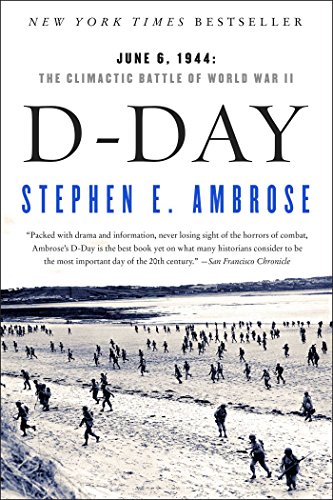
D-Day June 6, 1944: The Climactic Battle of World War II by Stephen E. Ambrose


dday


Over 1400 Interviews


The late Stephen E. Ambrose used over 1400 interviews for his history of the D-Day invasion.


This “oral history" approach brings the reader into the heart of the battle through eye-witness testimony. The tales of the front line infantryman sweeps the reader up into their personal histories.


Individual and Small Unit Stories


The story is told from the individual and small unit level often failing to describe larger unit actions or explaining how the individual actions fit into the total picture. Let is shared of what happened on the Canadian and British beachheads. Historical controversies are often given minimal coverage. These are simply good stories of many individual experiences.


The book is not a textbook for lessons on strategic decision making or to answer big picture questions. Ambrose touches on these larger issues in a general focus, but that is not his focus.


Courage of Small Unit Leaders


This is a book about the American achievement in Normandy. The individual courage and independence of the American small unit leaders is the big story of this book.


Ambrose is right on target as he tells the story of their braveness and toughness. I originally read and reviewed the book in 1999.

Monday, June 30, 2014

General Albert C. Wedemeyer: America's Unsung Strategist in World War II by John McLaughlin

General Albert C. Wedemeyer: America's Unsung Strategist in World War II by John McLaughlin. Be there no doubt, the author is a fan of General Albert C. Wedemeyer. The book is a statement of admiration for the general. This is not bad. I am very knowledgeable in military history as a historian by education and a former US Army officer. This book made me aware of a large gap in my knowledge. Yes, I had heard of General Wedemeyer. I was aware of his leadership in China. No, I had no idea he was the architect and strategist of the "Victory Program" which conceived the plans for US mobilization and included the D-Day invasion.

In the late 1930s he was an exchange student at the German Kriegsakademia, the Nazis' equivalent of Fort Leavenworth's Command and General Staff School. Because of this,he recognized the revolutionary tactics of Blitzkrieg once they were unleashed, and he knew how to respond.

The book is researched with the skill of a scholar and told in a straight forward way that is very engaging. We learn of a man who held key roles of strategizing on both the European and Asian fronts.

General Wedemeyer was an amazing intellect, one of the brightest minds the US has ever had. Dr. John McLaughlin did a great job of giving us the facts, telling the story, and leaving a tribute to General Albert C. Wedemeyer who was America's Unsung Strategist in World War II. The book is very good. It has lessons for military leaders, politicians, and strategic strategist.

Airborne: A Combat History of American Airborne Forces by LTG (Retired) E. M. Flanagan Jr.

Airborne Airborne: A Combat History of American Airborne Forces by LTG (Retired) E. M. Flanagan Jr. Allow me to state my prejudices...