Showing posts with label North Africa. Show all posts

Monday, November 04, 2019

Uncertain Seasons by Elizabeth Shelfer Morgan


Unedited Letters 

Uncertain Seasons contains the unedited letters from her uncle, 1LT Howard Shelfer, who was with the 9th Infantry Division, 60th Infantry, B Company in North Africa, Sicily, England (as S4) and France.

1LT Howard Shelfer was killed on Aug. 11, 1944, during the counterattack near Mortain.

9th Infantry Division in North Africa, Sicily, England & France


Uncertain Seasons will be of interest to 9th Infantry Division veterans of World War II and the children.

 This book has been awarded the Best Book for Young Readers by the Florida Historical Society (1995).

Example of Using Letters as Premise for a Book


It is an excellent example of using letters as the premise for a book. Elizabeth Shelfer Morgan wrote Uncertain Seasons in 1994.

It was published by the University of Alabama Press. This book has been awarded the Best Book for Young Readers by the Florida Historical Society (1995).

Saturday, January 31, 2015

“Behind the Lines: A Critical Survey of Special Operations in World War II” by Michael F. Dilley


If you enjoy reading about airborne troops, special operations, andelite troops in World War IIthen author Michael F. Dilley’s book “Behind the Lines: A Critical Survey of Special Operations in World War II” is for you.Divided into two parts, part one of the book is titled, “Behind Enemy Lines”. It tells twenty stories of special operations behind enemy lines. The excellent story telling of the author has shines in all twenty of the stories. Each story stands on its own.

Starting with the Tragino Aqueduct Mission in southern Italy where we see the foolishness of the first mission that requires a fifty mile escape and evasion trek just to get to the pickup point without radio communication to stories on the raid to kill General Rommel and eighteen others that cover every theater of operation we see a common structure. The author tells at times a very spellbinding story followed by the strength of the book – a mission critique. The mission critique show Michael F. Dilley’s strong military intelligence analysis skills.

The second part of the book, “Behind Friendly Lines” lifted back the curtain on an often missed use of special operations soldiers. We look at three amazing missions where they are dropped just behind or into friendly lines.

The pictures included in the book are not a reprinting of stock photos you have seen many times, but rather photographs of uniforms, insignias, and special troops in their special equipment.

The book’s appendixes give us the criteria for evaluation of the units and the operations deserving special recognition. The bibliography included is by itself a resource worth the purchase price of the book.

Michael F. Dailey gets my highest praise for this much needed work on a subject dear to every world war history buff.

Monday, June 30, 2014

General Albert C. Wedemeyer: America's Unsung Strategist in World War II by John McLaughlin

General Albert C. Wedemeyer: America's Unsung Strategist in World War II by John McLaughlin. Be there no doubt, the author is a fan of General Albert C. Wedemeyer. The book is a statement of admiration for the general. This is not bad. I am very knowledgeable in military history as a historian by education and a former US Army officer. This book made me aware of a large gap in my knowledge. Yes, I had heard of General Wedemeyer. I was aware of his leadership in China. No, I had no idea he was the architect and strategist of the "Victory Program" which conceived the plans for US mobilization and included the D-Day invasion.

In the late 1930s he was an exchange student at the German Kriegsakademia, the Nazis' equivalent of Fort Leavenworth's Command and General Staff School. Because of this,he recognized the revolutionary tactics of Blitzkrieg once they were unleashed, and he knew how to respond.

The book is researched with the skill of a scholar and told in a straight forward way that is very engaging. We learn of a man who held key roles of strategizing on both the European and Asian fronts.

General Wedemeyer was an amazing intellect, one of the brightest minds the US has ever had. Dr. John McLaughlin did a great job of giving us the facts, telling the story, and leaving a tribute to General Albert C. Wedemeyer who was America's Unsung Strategist in World War II. The book is very good. It has lessons for military leaders, politicians, and strategic strategist.

Tuesday, May 08, 2012

Free France's Lion: The Life Of Philippe Leclerc, De Gaulle's Greatest General by William Moore


Most students of World War II are familiar with General Charles de Gaulle. Only the most serious know of General Philippe Leclerc. I consider myself very knowledgeable when it comes to World War II history. William Mortimer Moore's biography of Philippe Leclerc filled a void in my education. The book is well-written. It held my attention.

The story begins with Leclerc’s death. We learn of his ill-fated November 1947 airplane flight and fatal crash in Algeria. We next are educated on the details of his family history including his coming from an old line of nobility being made aware of the role of his Catholic faith and heritage. We travel with Leclerc following the fall of France in 1940 to London. We go with him to Africa, as he becomes governor of French Cameroon, travel with him as he battles the Axis in Chad and moves his troops across West Africa where he distinguished himself in Tunisia.

General Leclerc commands the French 2nd Armored Division. They land in Normandy; he participates in the battle of the Falaise Pocket, and the liberation of Paris. Leclerc and de Gaulle had to persuade Eisenhower to send troops help the Parisians.

At the end of World War II in Europe, he received command of the French Far East Expeditionary Corps, and represented France during the surrender of the Japanese Empire, signing the surrender document for France. Leclerc is the commander over French Indo-China after World War II. He approved negations with Ho Chi Minh which were unsuccessful. He returned to France.

The book is a must read for any serious student of World War II in Europe. The book is extensively footnoted. The footnotes are heavy with secondary, rather than primary sources. It has an excellent index. It would be an excellent addition to any community, college or personal library. "Free France's Lion: The Life Of Philippe Leclerc, De Gaulle's Greatest General" is written by William Moore. The publisher is Casemate Publishers.


Monday, April 30, 2012

Free France's Lion: The Life Of Philippe Leclerc, De Gaulle's Greatest General by William Moore


Most students of World War II are familiar with General Charles de Gaulle. Only the most serious know of General Philippe Leclerc. I consider myself very knowledgeable when it comes to World War II history. William Mortimer Moore's biography of Philippe Leclerc filled a void in my education. The book is well-written. It held my attention.

The story begins with Leclerc’s death. We learn of his ill-fated November 1947 airplane flight and fatal crash in Algeria. We next are educated on the details of his family history including his coming from an old line of nobility being made aware of the role of his Catholic faith and heritage. We travel with Leclerc following the fall of France in 1940 to London. We go with him to Africa, as he becomes governor of French Cameroon, travel with him as he battles the Axis in Chad and moves his troops across West Africa where he distinguished himself in Tunisia.

General Leclerc commands the French 2nd Armored Division. They land in Normandy; he participates in the battle of the Falaise Pocket, and the liberation of Paris. Leclerc and de Gaulle had to persuade Eisenhower to send troops help the Parisians.

At the end of World War II in Europe, he received command of the French Far East Expeditionary Corps, and represented France during the surrender of the Japanese Empire, signing the surrender document for France. Leclerc is the commander over French Indo-China after World War II. He approved negations with Ho Chi Minh which were unsuccessful. He returned to France.

The book is a must read for any serious student of World War II in Europe. The book is extensively footnoted. The footnotes are heavy with secondary, rather than primary sources. It has an excellent index. It would be an excellent addition to any community, college or personal library. "Free France's Lion: The Life Of Philippe Leclerc, De Gaulle's Greatest General" is written by William Moore. The publisher is Casemate Publishers.

Sunday, June 05, 2011

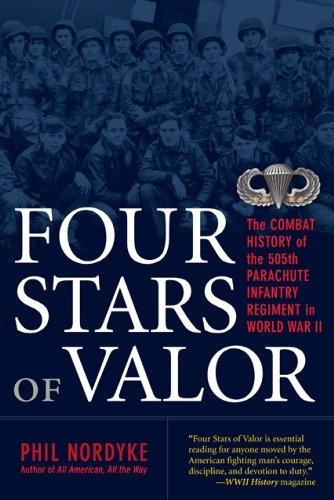
Four Stars of Valor: The Combat History of the 505th Parachute Infantry Regiment in World War II

Phil Nordyke's "Four Stars of Valor: The Combat History of the 505th Parachute Infantry Regiment in World War II" is excellent. It is must reading for any student of World War II. Mr. Nordyke does an great job as he takes us with the 505th Parachute Infantry Regiment (PIR) from its beginnings and training in the United States, through its deployment to North Africa, and through its campaigns in Sicily, Italy, Normandy, Holland, the Bulge, and Germany before returning home.

The book takes it title from the 505 PIR's record four combat jumps in Sicily, Salerno/Naples, Ste Mere Eglise/Normandy, and Nijmegen/Holland. Stars representing participation in combat jumps had been worn unofficially on parachute wings during and after World War II. FYI - this practice did not gain official sanction until after the 1983 invasion of Grenada, Operation Urgent Fury.

I took about six weeks to read the book. I found it a book that demanded I read every word on every page. Be prepared for some very graphic descriptions of the training and combat. You'll feel the heat of north Africa. I was disappointed as I read the Hermann Goring Fallschrim Panzer and 15th Panzer Grenadier Divisions were on Sicily, that General Bradley knew it, and because of secrecy of Ultra they did not pass this information on to the attacking forces! "This was a cruel deception of our own forces, but necessary in order to protect the secrets of Ultra."

Mr. Nordyke does an excellent job of using primary sources. At first I was a little confused when I encountered an incident that was described from multiple persons points of view, but quickly saw the value in seeing the way more than one person viewed/remembered an incident. It helped paint a more complete picture. Pages 300 - 301 and the actions of Private Camille E. Gagne's response to the killing of First Lieutenant John Dodd is one example. The coverage giving to the 505th's role in Nijmegen/Holland is very detailed and had me feeling I was were there.

The 505th PIR's involvement didn't stop after it's fourth jump into Nijmegen/Holland. They played a key role being deployed by truck into Belgium's Ardennes Forest as the 82 Airborne Division helped stop Hitler's in The Battle of the Bulge in freezing December 1944 and January 1945.

The book has exceptional maps and an amazing index. This book should be required reading for active duty members wearing jump wings. It is a must addition to any military historian's library and would be an excellent addition for all university and community libraries.It would a wonderful gift for anyone who has severed in the 505th.

Sunday, January 16, 2011

The All Americans in World War II: A Photographic History of the 82nd Airborne Division at War by Phil Nordyke

"The All Americans in World War II: a Photographic History of the 82nd Airborne Division at War" by Phil Nordyke delivers what the book’s title promises, a photographic history of the 82nd Airborne Division at war. The book is filled with numerous black and white photographs. The photographs are excellent and many that have never before been published.

The book is organized into 36 chapters. The chapters chronicle the 82nd Airborne Division’s from the division’s reactivation in February 1942 to the return to the USA in January 1946. The chapters begin with a one-page summary of that stage of the 82nd’s action. A skillfully produced map showing the locations of allied follows the chapter summary. It contains locations of allied and axis units visually showing their actions that are covered in the chapter. Next, the reader feasts with pages of period photographs of the action.  There are 30 detailed maps and 365 photographs.

This book is a very useful addition to or a great stand-alone volume for the reader wanting to learn more about the All American Division in World War II. It really is spectacular. It would be an excellent addition to any military historian’s library of college and community library.

I am a former US Army officer who graduated from airborne school in class 36-76. I found myself reading the book in one sitting. My father is a World War II veteran who served in the European Theater of Operations. He also could not put the book down until he had read it from cover to cover.

Saturday, March 15, 2008

Eight Stars to Victory: A History of the Veteran U.S. Ninth Infantry Division by Joseph B. Mittelman

Eight Stars to Victory: A History of the Veteran U.S. Ninth Infantry Division by Joseph B. Mittelman was written for and published by the Ninth Division Association in 1948. The book tells of how eight battle stars were won. It covers from the shores of North Africa, in 1942, to the banks of the Elbe, in 1945. Over 50,000 men served in the Ninth Infantry Division during World War II. The division had nearly 25,000 casualties including 4,747 killed in action. The copy of the book I read was found through the Dallas Public Library.

The book is 408 pages and begins by telling the story of the activation of the division and its participation in World War I.

Next the author goes into extensive detail about the division’s reactivation in 1940 at Fort Bragg, North Carolina. Stories are shared of living in tents and not having enough hot water.

We learn how in late 1942 the Ninth Infantry Division was split between the Eastern and Western Task Forces and of the division’s role in the invasion of North Africa. Part of the Ninth Infantry Division made a beach landing in French Morocco. The other part of the division landed in Algeria.

The division’s role in the Sicilian campaign is examined next. We learn of their involvement in the fighting in the mountainous heart of the island along the central route toward Messina. After Messina was taken and Sicily fell, the Ninth Infantry Division remained on Sicily. It did not move to the Italian mainland. The division’s next destination was England.

The author then informs of the Ninth Division’s time in England. He tells of the city of London, English pubs, and Constable Lane. He shares about training and planning for the invasion. We learn that although the division had heavy amphibious experience they entered the continent on D-Day + 4 at Utah Beach. The Old Reliables were involved in the campaign on the Cotentin peninsula and the assault on Cherbourg. They fought in the battles in the hedgerows. In early August the division assisted in the final breakout by American forces. They were involved in halting of the Mortain counter-offensive. They entered Belgium on September 2nd. They were involved in battle of the Huertgen Forest.

Next the Ninth Division went on to the Battle of the Bulge. They held the northern shoulder of the front. They captured Roer dams. The Ninth Infantry Division was among the first across the Rhine River and instrumental in the capturing of the Remagen bridgehead. From here we move to the final stages of the war with the battle of the Ruhr pocket and the division plunging eastward to the banks of the Elbe as the German army crumbled.

The book concludes with the Ninth Division’s role as Occupation forces and the deactivation of the division at the beginning of 1947.

The book has numerous maps, photos, and coverage of each campaign that earned the division its eight battle stars. The book falls between a divisional souvenir and a hard hitting historical research. It is what it is. It will disappoint the serious scholar. Reviewed by Jimmie A. Kepler.

Sunday, March 02, 2008

On to Berlin: Battles of an Airborne Commander 1943-1946 by General James M. Gavin


General James M. Gavin tells the story of the 82d Airborne Division during World War II. Gavin began training at the Airborne School in Fort Benning in July 1941, and graduated in August 1941. After graduating he served in an experimental unit. His first command was Commanding Officer of C Company of the newly established 503rd Parachute Infantry Battalion. Gavin's friends William Ryder — Commander of Airborne training - and William Yarborough - Communications officer of the Provisional Airborne Group - convinced General William C. Lee to let Gavin develop the tactics and basic rules of Airborne combat. Lee followed up on this recommendation, and made Gavin his Operations and Training officer (S-3). On October 16, 1941 he was promoted to Major.

One of his first priorities was determining how airborne troops could be used most effectively. His first action was writing FM 31-30: Tactics and Technique of Air-Borne Troops. He used information about Soviet and German experiences with Paratroopers and Glider troops, and also used his own experience about tactics and warfare. The manual contained information about tactics, but also about the organization of the paratroopers, what kind of operations they could execute, and what they would need to execute their task effectively.

Gavin is best suited to provide this history since he served with the Division during its entire participation in the European Campaign, starting as a Regimental Commander with the 505th to eventually commanding the division.

General Gavin gives a detailed description of all the operations the 82d participated in during World War II. He adds his analysis of why certain things went well for his unit, while other things were a struggle. He provides insight into the Allied command structure and the challenges it faced.

This is an enjoyable and informative book that provides a unique perspective of the war, much different than other general officers. Gavin personally experienced the harshness and challenges of WWII combat because of the nature of airborne operations. Gavin also he participated in numerous high-level planning sessions with other well-known leaders of the Allied Command. This participation allows him to connect the planning and the execution of how strategic decisions influenced the actual combat operations in the European Theater of Operations.

For me the most insightful and interesting part of the book was General Gavin's analysis of General Eisenhower's decision to concede Berlin to the Russians. The last chapter reflects back on the war and Berlin question with analysis of the decisions made and their impact and implications thirty years later. It is pretty interesting stuff, especially given the long-term impact that these decisions had on world events.

I strongly recommend this book. For those wanting to learn more about the 82d or airborne operations this is required reading. Read and reviewed by Jimmie A. Kepler.

Airborne: A Combat History of American Airborne Forces by LTG (Retired) E. M. Flanagan Jr.

Airborne Airborne: A Combat History of American Airborne Forces by LTG (Retired) E. M. Flanagan Jr. Allow me to state my prejudices...