Showing posts with label battle of the bulge. Show all posts

Friday, July 27, 2018

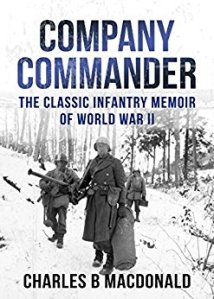
Company Commander: The Classic Infantry Memoir of World War II by Charles B. MacDonald


This past month I reread "Company Commander: The Classic Infantry Memoir of World War II" by Charles B. MacDonald. I highly recommend the book.


At just 21 years of age, Captain Charles B. MacDonald first commanded I Company, 3 Battalion 23rd Infantry, 2nd Infantry Division from October 1944 to January 1945 and later G Company, 2 Battalion 23rd Infantry, 2nd Infantry Division from March to May 1945.


This memoir was written in 1947 when recollections were still sharp. It resulted in a very detailed account of what it was like to take command of a line infantry company and lead it into battle.


The book gives us a template for writing a personal military memoir. It is by far the finest memoir of any junior officer in World War II.


Charles MacDonald does a great job of keeping his focus on his own experiences. He does not speculate or wastes my time by giving conjecture on the big picture. We only have first-hand information from the events of his personal participation.


He sticks to what life was like for a junior officer in command of an infantry company. We share his sleepless nights, hunger, the dirt and filth from lack of personal hygiene, stressful situations, and dangers. He takes us from the Siegfried Line in the Ardennes, through the Battle of the Bulge, and to the end of the war in the Czechoslovakia.


This book is a must-read for all US Army junior officers who seek to command at company-level. It is informative for military historians as well. It is still required reading at West Point and on the company level officer (second lieutenant, first lieutenant, and captain) recommended reading lists by the U.S. Army today.


Upon this book's publication in 1947, Charles B. MacDonald was invited to join the U.S. Army Center of Military History as a civilian historian, the start of a career during which he wrote three of the official histories of World War II in Europe and supervised the preparation of others.


The book is simply the best. You will be turning the pages and feel as if you are there.

Tuesday, January 01, 2013

Fighting With the Filthy Thirteen: The World War II Story of Jack Womer - Ranger and Paratrooper by Jack Womer and Stephen C. Devito


Travel with Jack Womer from the steel mills of Dundalk, Maryland through his being drafted (which he resented) and assigned to the 29th Infantry Division to his deployment to England. Experience with him his selection to and the nearly yearlong training with the British commandos as a member of the 29th’s elite Provisional Ranger battalion. You will learn how he joined the 101st Airborne Division after the disbanding of 29th Ranger Battalion.

You will meet the group of demolitionist he joined in the 506th Parachute Infantry Regiment’s demolition platoon as they fight in Normandy, Holland, the Ardennes and Germany. The detail of the combat jump into Normandy gives you the sensation of being there as well as showing the confusion on the group. Wormer shares examples how his Ranger training helped him survive in combat. Unfortunately, he does not share the same level of detail in the campaigns following Normandy.

Co-author Stephen Devito did a great job of interviewing Wormer and putting his stories into a first person narrative. The book gives the feel of a veteran telling the actions of his youth.

Wormer shares how he and other soldiers had girlfriends when in England, but his heart yearned to return to the United States and his fiancée Theresa. A side note I enjoyed was the story of how he asked Theresa for a new picture and she refused. He told the story of his desire for a replacement picture. The press picked up the story. The Baltimore newspaper carried the story. We see his fiancée Theresa’s response/reactions.

The book’s title “The Filthy Thirteen” is the nick-name of the section in the 506th's demolition platoon that Wormer was assigned. It operated/used special equipment like flame-throwers and explosives to attack and clear German positions. These men were infamous for hard living, tough fighting, and poor personal hygiene that earned them their name. The claim is made that The Filthy was an inspiration for the film the Dirty Dozen.

I recommend this well-written and interesting book.


Saturday, August 04, 2012

Battered Bastards of Bastogne by George Koskimaki


George Koskimaki wrote three books on the 101st Airborne Division. They are 1) D-Day with the Screaming Eagles, 2) Hell's Highway: Chronicle of the 101st Airborne Division in the Holland Campaign, September - November 1944, and 3) Battered Bastards of Bastogne. This is a review of book three, Battered Bastards of Bastogne. George Koskimaki offers unique insights, as he was 101st Airborne Division commanding general, General Maxwell Taylor’s radio operator.

Battered Bastards of Bastogne fleshes out in vivid detail the entire story of the Screaming Eagles' valiant struggle. It gives us information not covered in the other books by interweaving the stories of 530 soldiers interviewed who were on the ground or in the air over Bastogne. They lived, made this history and much of it is told in their own words.

The story of the Battle of the Bulge is amazing. We learn how little time had passed from the Holland Campaign before the 101st is pulled from being their reserve role. We see ill-equipped they were in terms of weapons. We find out their equipment and uniforms had not been replenished after Market Garden/Holland Campaign. We hear the often-told story of the lack of winter weather gear. We see how stupid some were in tossing their limited cold weather gear like over shoes when the weather was a little less cold at the beginning of the battle. We see circumstances with General Taylor being called back to the USA for a staff conference, the shifting of key senior NCO's due to enjoying their time off line too much, and how the division moved into combat via ground transportation for the first time.

I especially enjoyed the detail and interweaving of the soldiers stories. It is amazing to view moments on the battlefield through multiple points of view. Some readers may find the book hard or even tedious to get through because of the detail. I did not. I found it added to the story. As in the author's two previous works on the 101st I find the personal accounts gave vitality to the story. It kept it flowing instead of reading like a military after action report. Once again, Mr. Koskimaki did a superb job of telling the history the 101st Airborne Division. I appreciated the way the book is both descriptive and detailed. It gives you a feel that you are there with the men. The author did an outstanding job in this area. This is must reading for any student of World War II history.

Tuesday, July 31, 2012

Battered Bastards of Bastogne by George Koskimaki

George Koskimaki wrote three books on the 101st Airborne Division. They are 1) D-Day with the Screaming Eagles, 2) Hell's Highway: Chronicle of the 101st Airborne Division in the Holland Campaign, September - November 1944, and 3) Battered Bastards of Bastogne. This is a review of book three, Battered Bastards of Bastogne. George Koskimaki offers unique insights, as he was 101st Airborne Division commanding general, General Maxwell Taylor’s radio operator.

Battered Bastards of Bastogne fleshes out in vivid detail the entire story of the Screaming Eagles' valiant struggle. It gives us information not covered in the other books by interweaving the stories of 530 soldiers interviewed who were on the ground or in the air over Bastogne. They lived, made this history and much of it is told in their own words.

The story of the Battle of the Bulge is amazing. We learn how little time had passed from the Holland Campaign before the 101st is pulled from being their reserve role. We see ill-equipped they were in terms of weapons. We find out their equipment and uniforms had not been replenished after Market Garden/Holland Campaign. We hear the often-told story of the lack of winter weather gear. We see how stupid some were in tossing their limited cold weather gear like over shoes when the weather was a little less cold at the beginning of the battle. We see circumstances with General Taylor being called back to the USA for a staff conference, the shifting of key senior NCO's due to enjoying their time off line too much, and how the division moved into combat via ground transportation for the first time.

I especially enjoyed the detail and interweaving of the soldiers stories. It is amazing to view moments on the battlefield through multiple points of view. Some readers may find the book hard or even tedious to get through because of the detail. I did not. I found it added to the story. As in the author's two previous works on the 101st I find the personal accounts gave vitality to the story. It kept it flowing instead of reading like a military after action report. Once again, Mr. Koskimaki did a superb job of telling the history the 101st Airborne Division. I appreciated the way the book is both descriptive and detailed. It gives you a feel that you are there with the men. The author did an outstanding job in this area. This is must reading for any student of World War II history.

Sunday, March 25, 2012

"Voices of the Bulge: Untold Stories from Veterans of the Battle of the Bulge" by Michael Collins and Martin King

Oral histories are fashionable these days. When the oral history is tied to a battle or events that have been reported on repeatedly it is a challenge. "Voices of the Bulge: Untold Stories from Veterans of the Battle of the Bulge" by Michael Collins and Martin King is a book where the writers have used a dozen years’ worth of research and interviews with veterans along with historical accounts of the battle to tell the story through the eyes of the participants.

The book is a clear and direct account of the Battle of the Bulge. The authors give good coverage to the first ten days. As I read the book, I was at first taken aback by the redundancy of many of the soldier’s accounts. Their interpretations of the events were focused on the weather and retreating or being away from the front lines, either for rest and recuperation or on leave and then riding or marching to the recuse of their fellow Americans. So many of the G.I.’s included a mention of Bastogne that I wondered if this was coverage of the Battle of Bastogne. The personal recollections included are general experiences of the common G.I. There is token coverage at best of the German side of the story. If that’s what you want, it isn’t here.

The book has a number of issues I won’t address in detail.  One I will mention is when a veteran’s memory of events don’t match what actually happened (e.g. saying soldiers of the 3rd Parachute Division were dropped well behind US lines and then telling apocryphal tales) they needed to have a note saying the events recalled were incorrect and then tell what actually happened. There are a few sidebars included in the book. Unfortunately, they are somewhat redundant. 

The book needs a bibliography. It needs a listing of secondary sources. It would be helpful to have both a listing of the interviews with the units of service for the individuals. Did they verify the individuals were actually in the unit at the time of the Battle of the Bulge?

The inclusion of the DVD is nice. I was disappointed at the brevity of the DVD. I was expecting more. Yes, Oral histories are fashionable these days. All in all, it could have been better.

Wednesday, February 29, 2012

Voices of the Bulge: Untold Stories from Veterans of the Battle of the Bulge by Michael Collins and Martin King


Oral histories are fashionable these days. When the oral history is tied to a battle or events that have been reported on repeatedly it is a challenge. "Voices of the Bulge: Untold Stories from Veterans of the Battle of the Bulge" by Michael Collins and Martin King is a book where the writers have used a dozen years’ worth of research and interviews with veterans along with historical accounts of the battle to tell the story through the eyes of the participants.

The book is a clear and direct account of the Battle of the Bulge. The authors give good coverage to the first ten days. As I read the book, I was at first taken aback by the redundancy of many of the soldier’s accounts. Their interpretations of the events were focused on the weather and retreating or being away from the front lines, either for rest and recuperation or on leave and then riding or marching to the recuse of their fellow Americans. So many of the G.I.’s included a mention of Bastogne that I wondered if this was coverage of the Battle of Bastogne. The personal recollections included are general experiences of the common G.I. There is token coverage at best of the German side of the story. If that’s what you want, it isn’t here.

The book has a number of issues I won’t address in detail.  One I will mention is when a veteran’s memory of events don’t match what actually happened (e.g. saying soldiers of the 3rd Parachute Division were dropped well behind US lines and then telling apocryphal tales) they needed to have a note saying the events recalled were incorrect and then tell what actually happened. There are a few sidebars included in the book. Unfortunately, they are somewhat redundant.

The book needs a bibliography. It needs a listing of secondary sources. It would be helpful to have both a listing of the interviews with the units of service for the individuals. Did they verify the individuals were actually in the unit at the time of the Battle of the Bulge?

The inclusion of the DVD is nice. I was disappointed at the brevity of the DVD. I was expecting more. Yes, Oral histories are fashionable these days. All in all, it could have been better.

Friday, September 02, 2011

Skorzeny's Special Missions: The Memoirs of Hitler's Most Daring Commando by Otto Skorzeny

"Skorzeny's Special Missions: The Memoirs of Hitler's Most Daring Commando" by Otto Skorzeny.  Zenith Press has produced an excellent new edition of the book.

Prior to reading the book I did not know of Otto Skorzeny. He isn’t a well known World War II German soldier. From a little research I found his memoirs had been originally written in German. At first, the book didn't grab my attention. Maybe this was because I had never thought of viewing World War II from the point of view of a German commando.

As I read the book I found Otto Skorzeny does something few do. He lets us into his mind. It helped me understand his point of view. The book is action paced. It experience commando action as if you were there. The more I read the more I came to realize this book is one of the must read, must have books of World War II. I would call the book historical literature and a required study for all World War II buffs.

The telling of the story of the rescue of Mussolini is worth the purchase price alone. You learn that Skorzeny was selected for the mission because Hitler was aware the shared an Austrian heritage. The story of how the German intelligence learned of Mussolini's location is amazing. You experience the planning and execution of the mission. You experience the concept of the operation down to Skorzeny deployed his unit.

After the Mussolini mission you journey with Skorzeny to France to put down a possible coup whose mission is the overthrow of the Germany loyal Vichy government.  The threat failed to materialize.

Skorzeny became involved in research and development of tactics and the weapons needed for commando operational support. You travel with him to the Russian front were he began commando operations. You next find him back on the western front. Here he used one of the most controversial attacks deployed during the war. He used English-speaking German soldiers to work behind American lines during the Battle of the Bulge. The detail of the plan is shared including its development, organization, equipping, implementation, and what caused the plan be found out and it failure.

It is always interesting to look at military events from a different point of view. Here you get the best insights into German commando operations. It is amazing. It is worth the purchase price and should be part of your library.

After reading the book, I believe no military education of World War II is complete without having read this classic work.

Monday, May 17, 2010

War Stories of the Battle of the Bulge by Michael Green and James D. Brown

Michael Green and James D. Brown have put together a fascinating book titled “War Stories of the Battle of the Bulge.”  If you are looking for a definitive book on The Battle of the Bulge this is not it.  If you want a powerful account of the battle from the mouths of those who were there, this is it.  The authors do a great job of telling the the story with first-person accounts from the American soldiers, both officers and enlisted. Their stories are spellbinding. You will keep turning the pages.

The book is divided into four sections: The Germans Attack, The Americans Fight Back, Christmas in the Ardennes, and Closing the Gap. The book's structure follows the ebb and flow of the battle.  The source material is drawn for the 'Bulge Bugle”, the quarterly newsletter of the Veterans of the Battle of the Bulge Association, first person accounts from members of the association, and the files of the U.S. Army Military Historical Institute.  We learn of the failure of higher command to realize this area of the Ardennes (Losheim Gap) had three times previously in history been used as an attack route.  The fact it was so poorly defended is nearly criminal.

The cold weather of the battle was mentioned by almost everyone in their accounts.  Cold, tired, miserable, under equipped, were comments included in almost every story.  I knew the 106th Infantry Division had lost two regiments, but had not realized they had over 6,500 taken POWs during the battle. We are reminded again and again that the individual heroism of the soldier made the difference over the course of the battle.

One of my favorite stories was found from pages 40 - 72 “Charles Haug, B Company, 112th Infantry Regiment, 28th Infantry Division”. It was from  the files of the U.S. Army Military Historical Institute.  The story is a breath taking account of being pushed back by the Germans.   James A. Steinhaufel of C Company, 134th Infantry Regiment, 35th Infantry Division tells the tale of his units chilling encounter with the much feared German Tiger Tank. His story leaves you feeling you were there.

I highly recommend the book.  It is one you will want to read from cover to cover.  The stories are generally only a few pages long.  This would be a excellent resource for any public library to add to its collection. It is also a great way to get a feel for what you father or grand father went through if he was one of the men that confronted the 250,000 German soldiers as they made their last major attack against the Allied Forces.  Read and reviewed by Jimmie A. Kepler May 2010.

Wednesday, August 26, 2009

Honor Untarnished by Gen. Donald V. Bennett (Ret), William R. Fortschen


The book is well written and was hard to put down. It tells Gen. Donald V. Bennett's story of the struggle to get in and through West Point. It next moves to initial artillery training. Here he learns how to ride a horse while pulling his artillery piece. In addition, he learned how to place his foot where it would not be crushed while riding the horse. His stories of North Africa included the sights, smells, running a bordello (to get the disease rate down), and fighting Rommell. His insights and experiences in Sicily were preparations for his Normandy experience. His spell binding account of Normandy is the best chapter in the book and as good as any ever written. He gives a fresh point of view on the Battle of the Bulge pointing out the signs and intelligence higher up overlooked. His conclusion with experiences and insights about the Russians are eye opening. Read by Jimmie A. Kepler. This review was originally written for the Military History Book Club.

Thursday, February 28, 2008

Company Commander: The Classic Infantry Memoir of World War II by Charles B. MacDonald

Company Commander: The Classic Infantry Memoir of World War II by Charles B. MacDonald. I highly recommend Company Commander: The Classic Infantry Memoir of World War II by Charles B. MacDonald. At just 21 years of age, Captain Charles B. MacDonald first commanded I Company, 3 Battalion 23rd Infantry, 2nd Infantry Division from October 1944 to January 1945 and later G Company, 2 Battalion 23rd Infantry, 2nd Infantry Division from March to May 1945. This memoir was written in 1947 when recollections were still sharp. It resulted in a very detailed account of what it was like to take command of a line infantry company and lead it into battle. The book gives us template for writing a personal military memoir.

It is by far the finest memoir of any junior officer in World War II. Charles MacDonald does a great job of keeping his focus on his own experiences. He does not speculate or waste my time by giving conjecture on the big picture. We only have first hand information from the events of his personal participation. He sticks to what life was like for a junior officer in command of an infantry company, sleepless, hungry, dirty, stressful, and very dangerous. He takes us from the Siegfried Line in the Ardennes, through the Battle of the Bulge, and to the end of the war in the Czechoslovakia.

This book is a must-read for all army officers who seek to command at company-level and it is informative for military historians as well. It is still required reading at West Point and on the company level officer (second lieutenant, first lieutenant, and captain) recommended reading list by the U.S. Army today. Upon this book's publication in 1947, Charles B. MacDonald was invited to join the U.S. Army Center of Military History as a civilian historian, the start of a career during which he wrote three of the official histories of World War II in Europe and supervised the preparation of others. The book is simply the best. Read and reviewed by Jimmie A. Kepler in June 2006.

Sunday, December 31, 2006

Company Commander: The Classic Infantry Memoir of World War II by Charles B. MacDonald

Company Commander: The Classic Infantry Memoir of World War II by Charles B. MacDonald. I highly recommend Company Commander: The Classic Infantry Memoir of World War II by Charles B. MacDonald. At just 21 years of age, Captain Charles B. MacDonald first commanded I Company, 3 Battalion 23rd Infantry, 2nd Infantry Division from October 1944 to January 1945 and later G Company, 2 Battalion 23rd Infantry, 2nd Infantry Division from March to May 1945. This memoir was written in 1947 when recollections were still sharp. It resulted in a very detailed account of what it was like to take command of a line infantry company and lead it into battle. The book gives us template for writing a personal military memoir.

It is by far the finest memoir of any junior officer in World War II. Charles MacDonald does a great job of keeping his focus on his own experiences. He does not speculate or waste my time by giving conjecture on the big picture. We only have first hand information from the events of his personal participation. He sticks to what life was like for a junior officer in command of an infantry company, sleepless, hungry, dirty, stressful, and very dangerous. He takes us from the Siegfried Line in the Ardennes, through the Battle of the Bulge, and to the end of the war in the Czechoslovakia.

This book is a must-read for all army officers who seek to command at company-level and it is informative for military historians as well. It is still required reading at West Point and on the company level officer (second lieutenant, first lieutenant, and captain) recommended reading list by the U.S. Army today. Upon this book's publication in 1947, Charles B. MacDonald was invited to join the U.S. Army Center of Military History as a civilian historian, the start of a career during which he wrote three of the official histories of World War II in Europe and supervised the preparation of others. The book is simply the best. Read and reviewed by Jimmie A. Kepler in June 2006.

Airborne: A Combat History of American Airborne Forces by LTG (Retired) E. M. Flanagan Jr.

Airborne Airborne: A Combat History of American Airborne Forces by LTG (Retired) E. M. Flanagan Jr. Allow me to state my prejudices...