Showing posts with label World War Two. Show all posts

Monday, October 28, 2019

Citizen Soldiers by Stephen E. Ambrose


How Citizens Become a Soldier


The book describes how these "citizen soldiers" came to be soldiers, and what they did once they were. There is some overlap with his other titles about World War II. The book follows the battles right after the allies left the beaches of Normandy, all the way through France into German territory.

Details World War Two in Europe


This lengthy volume details the war in Europe. It tells how Americans were critical to that victory. It gives the story through the eyes of those who participated in the various units. I enjoy this title and the stories the former GI's share.

“Citizen Soldiers“ is the name for the draftees, national guard, and army reserve soldiers, the non-regular army soldiers, which were so necessary to field an army of the size that was needed in World War II. Ambrose clearly shows that both the regular army and the citizen-soldiers were required for victory.

Friday, May 24, 2019

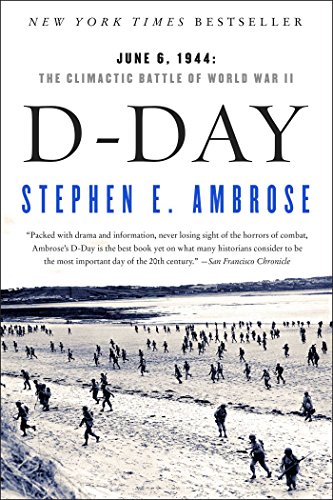
D-Day June 6 1944: The Climactic Battle of World War II by Stephen E. Ambrose


Over 1400 Interviews


The late Stephen E. Ambrose used over 1400 interviews for his history of the D-Day invasion. This “oral history" approach brings the reader into the heart of the battle through eye-witness testimony. The tales of the front line infantryman sweeps the reader up into their personal histories. The story is told from the individual and small unit level often failing to describe larger unit actions or explaining how the individual actions fit into the total picture. Let is shared of what happened on the Canadian and British beachheads. Historical controversies are often given minimal coverage. These are simply good stories of many individual experiences.

American Achievement in Normandy


The book is not a textbook for lessons on strategic decision making or to answer big-picture questions. Ambrose touches on these larger issues in a general focus, but that is not his focus. This is a book about the American achievement in Normandy. The individual courage and independence of the American small unit leaders is a big story of this book. Ambrose is right on target as he tells the story of their braveness and toughness.

Thursday, May 23, 2019

The Victors: Eisenhower and His Boys: The Men of World War II by Stephen E. Ambrose


The Victors: Eisenhower and His Boys: The Men of World War II by Stephen E. Ambrose is essentially a cut and paste compilation of D-DAY, Citizen Soldiers, Eisenhower, Band of Brothers, and The Wild Blue.

If you have read any of Stephen Ambrose's works on World War II, then this one is not worth the time. It has so much material covered in his lengthier works.

It is better to read D-DAY, Citizen Soldiers, Eisenhower, Band of Brothers, and The Wild Blue and to skip this book altogether.

Wednesday, May 22, 2019

Band of Brothers by Stephen E. Ambrose


Easy Company


Band of Brothers is the story of a US Army Infantry Rifle Company (Airborne). It's the story of Easy Company, 506th Infantry, 101st Airborne Division, US Army.

The book begins in the summer of 1942 telling the story of the men going through initial basic training at Camp Toccoa, Georgia. It continues as they earn their "jump wings" covering time at Benning, with additional training at Mackall, Bragg, Shanks.

The story continues with deployment and training in England as the company prepares for the invasion and undergoes changes in leadership.

The book draws on hours of interviews with survivors as well as the soldiers' journals and letters. Dr. Stephen Ambrose tells the stories, many time in the men's own words.

D-Day to the End of the War


The book takes the reader through D-Day, back to England, to Operation Market Garden, the Battle of the Bulge, and on to the end of the war and the Eagle's Nest. It recounts occupation duty and concludes looking at the survivor's post-war careers.

I read Band of Brothers by Stephen E. Ambrose in August 1996, years before it was made into an HBO mini-series. This is one of the most read and popular books in the last twenty years due to the HBO mini-series based on the book. The History Channel also periodically shows the mini-series.

The book is better than the mini-series. It tells the story of Easy Company 506th Parachute Infantry Regiment that ultimately became part of the 101st Airborne Division. I enjoyed the book because of the focus on the people in the unit. It has reached cult-like status.

Monday, May 20, 2019

The Wild Blue: The Men and Boys Who Flew the B-24s Over Germany by Stephen E. Ambrose


Controversial


"The Wild Blue: The Men and Boys Who Flew the B-24s Over Germany" by Stephen E. Ambrose is controversial because some scholars point out Ambrose has lifted the work of other authors without placing said work inside "quotation" marks. That is a tragic error. Is it an error of omission or commission? I do not know. I do know it is ethically wrong.

The Story of the Late US Senator George McGovern


The book tells the story of former US Presidential candidate and US Senator George McGovern. It tells of McGovern's upbringing, his journey to college, the outbreak of World War II, his falling in love and marriage, his joining the US Army Air Corps, his training as a pilot, and his combat deployment and action where he was based out of Italy bombing the Axis war machine.

Nonfiction Narrative Style


It is written in Ambrose's wonderful narrative style. It is highly readable and entertaining.

Friday, May 17, 2019

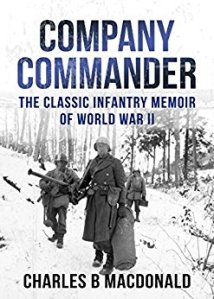
Company Commander: The Classic Infantry Memoir of World War II by Charles B. MacDonald


A Template for Writing a Personal Military Memoir


I highly recommend Company Commander: The Classic Infantry Memoir of World War II by Charles B. MacDonald. At just 21 years of age, Captain Charles B. MacDonald first commanded I Company, 3 Battalion 23rd Infantry, 2nd Infantry Division from October 1944 to January 1945 and later G Company, 2 Battalion 23rd Infantry, 2nd Infantry Division from March to May 1945. This memoir was written in 1947 when recollections were still sharp. It resulted in a very detailed account of what it was like to take command of a line infantry company and lead it into battle. The book gives us a template for writing a personal military memoir.

The Best Memoir of Any Junior Officer in World War Two


It is by far the best memoir of any junior officer in World War Two. Charles MacDonald does a great job of keeping his focus on his own experiences. He does not speculate or wastes my time by giving conjecture on the big picture. We only have first-hand information from the events of his personal participation. He sticks to what life was like for a junior officer in command of an infantry company, sleepless, hungry, dirty, stressful, and very dangerous. He takes us from the Siegfried Line in the Ardennes, through the Battle of the Bulge, and to the end of the war in Czechoslovakia.

A Must-read for all US Army Officers


This book is a must-read for all army officers who seek to command at company-level and it is informative for military historians as well. It is still required reading at West Point and on the company level officer (second lieutenant, first lieutenant, and captain) recommended reading list by the U.S. Army today.

An Official Civilian Historian of World War Two


Upon this book's publication in 1947, Charles B. MacDonald was invited to join the U.S. Army Center of Military History as a civilian historian, the start of a career during which he wrote three of the official histories of World War II in Europe and supervised the preparation of others. The book is simply the best.

Thursday, May 16, 2019

One Soldier's Story: A Memoir by Robert Dole


The Story of Robert Dole


"One Soldier's Story" by Robert Dole tells the story of former US Senator and Republican presidential candidate Robert Dole, of Kansas. It shares tales of his growing up in Russell, Kansas. We learn of his running track, attending high school, working as a soda jerk, and attending Kansas University (KU). He opens the window to his experiences at KU where we see him running track, joining a fraternity, working odd jobs to help pay for his college, buying a phonograph, and experiencing the bombing of Pearl Harbor.

US Army Air Corps or the US Army Infantry


His story continues where he struggles with the choice of joining the US Army Air Corps or the US Army infantry. He joins the Army, goes through Officer Candidate School, and ultimately becomes an infantry officer. His tour of duty in World War II takes him to the Italian theater of the war. In Italy, his life is forever altered. He receives a critical wound while on a combat mission.

Wounded Warrior's Rehabilitation


The remainder of "One Soldier's Story" tells of his struggles through hospitalization, evacuation, and transport to the USA, rehabilitation, depression, learning to walk again, falling in love and his first marriage, return to Russell, Kansas and his daily challenges. We follow Bob Dole through his return to complete his college degree and his decision to attend law school. We experience his building a career as a young lawyer, the decision to run for political office, and his ultimate service as a US Senator, and being both a vice presidential candidate (1976) and presidential candidate (1996).

A Very Inspirational Story


Whether you like Bob Dole's conservative politics or not, you will find his story very inspirational. This extremely well-written memoir is hard to put down.

Tuesday, May 14, 2019

Crusade in Europe by Dwight David Eisenhower


Dwight Eisenhower's World War Two Memoir


Crusade in Europe is General Dwight David Eisenhower's memoir from the early days of World War Two through the early post-war. His story and observations are crucial to an understanding of the Great Crusade. Among memoirs, this is a gem.

Beginnings


General Eisenhower takes the reader along with him through each stage of the Crusade. Having attracted attention for his performance in Army maneuvers in Louisiana in 1940, General Eisenhower was called to Washington immediately after Pearl Harbor because of his recent experience in the Philippines. He was first assigned to work on plans for the Pacific. At this point, the reader is reminded that, in contrast to the later Germany First Policy, the American public, for a time, screamed for revenge on Japan before dealing with Germany.

Operation Torch


Assigned to command Operation Torch, the invasion of French North Africa in 1942, General Eisenhower was charged with obtaining Allied Cooperation. He was plunged into the quagmire of French politics. The disappointing involvement with General Giraud presented an intra-allied problem, as did cooperation of Admiral Darlan, who while too helpful to rebuff, brought with him the stigma of association with a collaborator. The age-old Arab-Jewish hostility further complicated the administration of the liberated territory.

Sicily


With North Africa cleared out, General Eisenhower was charged with the conquest of Sicily. Management of the Patton-Montgomery rivalry was a major challenge of the campaign. Success having been achieved, the Patton slapping incident in Sicily forced General Eisenhower to reprimand a close friend while threatening to deprive him of one of his most effective Army commanders.

Overlord


Speculation that General Eisenhower would return to the Washington as Chief Of Staff while General Marshall commanded Overlord, the invasion of Europe, distracted General Eisenhower's attention from problems at hand. General Eisenhower's eventual appointment to command Overlord forced him to leave the Mediterranean while the Italian campaign was still in doubt. Upon arrival in England, he immediately switched gears to plan the size, timing, supply and location of the invasion of France.

Operation Market-Garden, and the Battle of The Bulge


With the invasion ashore, General Eisenhower skillfully managed his coalition of impetuous commanders in their march across Europe. General Eisenhower brings the reader into the thought processes and conferences leading to decisions on the liberation of Paris, Operation Market-Garden, and the Battle of The Bulge.

General Eisenhower's Wartime Leadership


Americans are familiar with Patton's claim that, with supplies, he could capture Berlin and win the war. General Eisenhower relates that Monty bothered him with similarly impractical suggestions. He then explains why the proposals were doomed to failure. Spirited arguments with the British over Project Anvil (Invasion of Southern France) come within the reader's vision through General Eisenhower's eyes.

The greatest criticism of General Eisenhower's wartime leadership is reserved for questions about whether the Western Allies should have advanced further to limit the Red Army's area of occupation. General Eisenhower assesses the claims and presents support for his decisions.

After V-E Day


After V-E Day, General Eisenhower's role shifted more into that of a statesman as he attempted to obtain cooperation with the Russians over the administration of occupied Germany.

Some things come clearly through the pages of this book. The reader is constantly impressed with the importance of supplies, bringing to mind the adage that "Amateurs speak of tactics, professionals speak of logistics." Despite later controversies, General Eisenhower's admiration for General George Marshall is made clear on the pages of this book. Written in 1948, I find the statement that General Eisenhower disagreed with many of FDR's domestic policies to be surprising and a hint of his later political initiatives.

Crusade in Europe is written in a very clear, easy to read and follow style. It never becomes bogged down in boring details. It does not have any mention of his relationship with his female English army driver.
Thursday, May 09, 2019

A Soldier Reports by William Westmoreland


Westmoreland's Background


The book is the memoir of one of America's most controversial military leaders. I found it refreshing to read of his background and upbringing. He briefly covers his days as a cadet at West Point where he graduated in 1936, the horse dawn artillery days, and his role in World War II where he fought with distinction in North Africa and Europe with the Ninth Division. We see his fast rise to a Brigadier General before thirty years of age and later (1952–53) in a role in the Korean War. He served as superintendent of West Point (1960–64), attained (1964) the rank of general and commanded (1964–68) U.S. military forces in Vietnam. He then assumed the position of army chief of staff, which he held until his retirement in 1972.

The Vietnam War for General Westmoreland's Point of View


I was saddened as I read Westmoreland’s comments on one of the early killed in action lists that crossed his desk. It included 2LT John J. Pershing III, grandson of World War I supreme commanding general "Blackjack" Pershing. The book looks at the Viet-Nam war from Westmoreland's point of view. It explains his decision-making process.

More Than an After-Action Report


It is more than an after action report. It is worth reading if you are a political or military history junkie. His relationship with Lyndon Johnson and Robert McNamara are not covered in the detail I would have liked. This is the story of a decent man, giving his best to his country in difficult times.

Monday, January 07, 2019

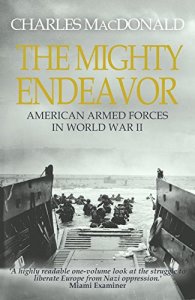
The Mighty Endeavor: American Armed Forces in the European Theater in World War II by Charles B. MacDonald


An Excellent General Military History


"The Mighty Endeavor: American Armed Forces in the European Theater in World War II" by Charles B. MacDonald is an excellent general military history of the US forces in Europe in WWII. Mr. MacDonald served as a Company Commander in the 2nd Infantry Division during World War II. He also was one of the US Army's official historians of World War II.


This lengthy book tells what the forces did and how they did it while not being pedantic. He includes many of the needed details that are necessary for understanding how the US Army was composed and armed. The details are foundational to understand how command decisions were made. This background really helps with an understanding of the political and personal rivalries that were an important part of World War Two's history.


Written With a VIew of the Operational Level


Most of the book is written with a view of the operational level. MacDonald does this skillfully keeping it in the context of what was happening at the corps, army, and army group level, as well as in the realm of the overall strategy.


The author includes many descriptions of small battles, down to the company level. They serve to make readers understand, just what was happening on the ground once higher-level decisions were made.


The book's scope is the American effort in the European Theater in World War II. Beginning in North Africa and ending on the Elbe River, Charles MacDonald describes the development and growth of the American soldiers, sailors, and airmen as they became essential players in the destruction of Nazi Germany. Included are the famous battles and campaigns like the landing in North Africa, Kasserine Pass, Salerno and Anzio, D-Day, the liberation of Paris, the Battle of the Bulge, the crossing of the Rhine, and the race across Germany. The subject matter of the book is very comprehensive. I like that he included the conflicts between American and other Allied leaders over strategy, the important Battle of the Atlantic, the air war, and the major land campaigns.


He does a great job starting with the delicate balance involved in the build-up to war, and the decision to concentrate on victory in Europe first. The famous personalities are described, including, Marshall, Eisenhower, Patton, Mark W. Clark, Hitler, Mussolini, as well as other British and German military leaders which is informative and enlightening.


Stories of the Individual Soldiers


He does not neglect the stories of individual soldiers. They are included throughout the narrative.
The prose is solid and the text readable, having just the right amount of detail. The book is balanced, thought-provoking, very comprehensive, and provides context and perspective of these historic events.


If you only read one book on World War Two, this is the book you should read.

Sunday, December 30, 2018

The Ragged Edge of Night by Olivia Hawker


The Ragged Edge of Night by Olivia Hawker is a passionate, elegantly written (maybe the most beautiful prose I have ever read), historical novel about amazing hope, redemption, and one man’s quest for enlightenment during the darkest times of World War II.


The setting is Germany. The time is 1942. The protagonist is Franciscan friar Anton Starzmann. The story finds Anton torn from his place in the world when his school is seized by the Nazis. He relocates to a small German hamlet.


The purpose of the move is a marriage of convenience. Anton needs a place to live. He weds Elisabeth Herter, a widow. She desires a marriage in name only to a man who can help support her and her three children. Anton seeks the union as a way to amend failing to shield his young students from the madness of the Nazis.


Neither Anton nor Elisabeth foresees their lives to be shaken once again by the inescapable rumble of war.


As Anton struggles to adjust to the roles of husband and father, he hears of the Red Orchestra. It is an underground network of militants plotting to assassinate Hitler.


While Elisabeth has reservations, Anton joins this army of shadows. As the SS discovers his schemes, Anton begins a final act of resistance that may cost him his life. He realizes his defiance to Hitler, the SS, and Nazis could cost him the new family he has come to love more than he ever thought imaginable.


The Ragged Edge of Night is the best book I read in 2018 and in years. Olivia Hawker has crafted a masterpiece for the ages.

Friday, July 27, 2018

Company Commander: The Classic Infantry Memoir of World War II by Charles B. MacDonald


This past month I reread "Company Commander: The Classic Infantry Memoir of World War II" by Charles B. MacDonald. I highly recommend the book.


At just 21 years of age, Captain Charles B. MacDonald first commanded I Company, 3 Battalion 23rd Infantry, 2nd Infantry Division from October 1944 to January 1945 and later G Company, 2 Battalion 23rd Infantry, 2nd Infantry Division from March to May 1945.


This memoir was written in 1947 when recollections were still sharp. It resulted in a very detailed account of what it was like to take command of a line infantry company and lead it into battle.


The book gives us a template for writing a personal military memoir. It is by far the finest memoir of any junior officer in World War II.


Charles MacDonald does a great job of keeping his focus on his own experiences. He does not speculate or wastes my time by giving conjecture on the big picture. We only have first-hand information from the events of his personal participation.


He sticks to what life was like for a junior officer in command of an infantry company. We share his sleepless nights, hunger, the dirt and filth from lack of personal hygiene, stressful situations, and dangers. He takes us from the Siegfried Line in the Ardennes, through the Battle of the Bulge, and to the end of the war in the Czechoslovakia.


This book is a must-read for all US Army junior officers who seek to command at company-level. It is informative for military historians as well. It is still required reading at West Point and on the company level officer (second lieutenant, first lieutenant, and captain) recommended reading lists by the U.S. Army today.


Upon this book's publication in 1947, Charles B. MacDonald was invited to join the U.S. Army Center of Military History as a civilian historian, the start of a career during which he wrote three of the official histories of World War II in Europe and supervised the preparation of others.


The book is simply the best. You will be turning the pages and feel as if you are there.

Wednesday, March 14, 2018

Four Stars of Valor: The Combat History of the 505th Parachute Infantry Regiment in World War II


505th Parachute Infantry Regiment (PIR)


Phil Nordyke's "Four Stars of Valor: The Combat History of the 505th Parachute Infantry Regiment (PIR) in World War II" is excellent. It is a must-read for any student of World War II.


Mr. Nordyke does a great job as he takes us with the 505th PIR from its beginnings and training in the United States, through its deployment to North Africa, and through its campaigns in Sicily, Italy, Normandy, Holland, the Bulge, and Germany before returning home.


Record Four Combat Jumps


The book takes its title from the 505 PIR's record four combat jumps in Sicily, Salerno/Naples, Ste Mere Eglise/Normandy, and Nijmegen/Holland. Stars representing participation in combat jumps had been worn unofficially on parachute wings during and after World War II. FYI - this practice did not gain official sanction until after the 1983 invasion of Grenada, Operation Urgent Fury.


Sicily and The Secrets of Ultra


I found it a book that that demanded I read every word on every page. Be prepared for some very graphic descriptions of the training and combat. You'll feel the heat of North Africa. I was disappointed as I read the Hermann Goring Fallschrim Panzer and 15th Panzer Grenadier Divisions were on Sicily, that General Bradley knew it, and because of secrecy of Ultra they did not pass this information on to the attacking forces! "This was a cruel deception of our own forces, but necessary in order to protect the secrets of Ultra."


Excellent Job of Using Primary Sources


Mr. Nordyke does an excellent job of using primary sources. At first, I was a little confused when I encountered an incident that was described from multiple people’s points of view, but quickly saw the value in seeing the way more than one person viewed/remembered an incident. It helped paint a more complete picture. Pages 300 - 301 and the actions of Private Camille E. Gagne's response to the killing of First Lieutenant John Dodd is one example. The coverage giving to the 505th's role in Nijmegen Holland is very detailed and had me feeling I was there.


The Battle of the Bulge


The 505th PIR's involvement didn't stop after its fourth jump into Nijmegen/Holland. They played a key role being deployed by truck into Belgium's Ardennes Forest as the 82 Airborne Divisions helped stop Hitler's in The Battle of the Bulge in freezing December 1944 and January 1945.


The book has exception maps and an amazing index. This book should be required reading for active duty members wearing jump wings. It is a must addition to any military historian's library and would be an excellent addition to all university and community libraries.

Tuesday, September 12, 2017

Hell's Highway by George Koskimaki


George Koskimaki was 101st Airborne Division Commanding General, Major General Maxwell Taylor’s radio operator. He wrote the three-book history of the 101st Airborne during World War Two. Hell's Highway: Chronicle of the 101st Airborne Division in the Holland Campaign, September - November 1944 is the second book in the series. The book focuses on Operation Market Garden which began on 17 September 1944 and concluded in the month of November 1944.


I had previously read Cornelius Ryan’s “A Bridge Too Far”, Stephen Ambrose’s “Band of Brothers” and “Citizen Soldiers”, Robert Kershaw's “It Never Snows in September: The German View of Market-Garden and the Battle of Arnhem, September 1944”, Martin Middlebrooks’s “Arnhem 1944: The Airborne Battle” (focusing on the British specifically at the Arnhem sector), and the 82nd Airborne Commanding General, Major General James Gavin’s “On to Berlin.” All of the books gave good presentations and different points of view of Operation Market Garden. George Koskimaki’s book is based on interviews with more than six hundred paratroopers journals the soldiers' intense personal accounts. It gives the vivid previously untold versions of the Screaming Eagles' valiant struggle.


Hell's Highway gives us something not covered in the other books. It tells of the Dutch people and members of the underground and their liberation after five years of oppression by the Nazis. It shares how they have never forgotten America's airborne heroes and how the 101st endangered and even sacrificed their lives for the freedom of the Netherlands and Europe.


While some readers may find the book hard or even tedious to get through because of the detail, I did not. The personal accounts gave vitality to the story. It kept it flowing instead of reading like a military after action report. Mr. Koskimaki did a superb job of telling the history the 101st Airborne Division during Operation Market Garden.


The book is just right for beginners and experts of the 101st Airborne Division. The three books George Koskimaki wrote on the 101stAirborne Division are 1) D-Day with the Screaming Eagles, 2) Hell's Highway: Chronicle of the 101st Airborne Division in the Holland Campaign, September - November 1944, and 3) Battered Bastards of Bastogne.


I highly recommend the book.

Tuesday, June 06, 2017

D-Day With The Screaming Eagles By George Koskimaki


Written by General Maxwell Taylor’s Radio Operator


George Koskimaki the noted historian of the 101st Airborne Division wrote “D-Day with the Screaming Eagles”.  Mr. Koskimaki was 101st Airborne Division Commanding General Maxwell Taylor’s radio operator. The book was written in 1970. Interviews with hundreds of paratroopers contributed to the book. Their stories are attention-grabbing and captivating. They cover the first hours of Normandy. The fact that the book covers only the first couple of days of the D-Day invasion allows fascinating details to be covered.


A You Are There Book


The book gives you the feel that you are there during the frenzied first hours of the invasion. Detailed accounts of the activities of the pathfinders were enthralling. You encounter stories where paratroopers are sleepily drugged by the motion sickness medication they took preflight. You are under antiaircraft fire with them as they make their final approaches to the drop zones. In some cases, you are within the aircraft as it is going down in flames. You feel the fear of being captured by the Germans. You experience the myriad of broken legs, sprained ankles and other injuries from jumping at too fast of air speeds and too low of altitudes while being shot at. You land with them in the trees and nearly drown in the flooded areas during your parachute landing. You feel the downright confusion of the event.


Glider Unit Coverage Included


The coverage of the glider units landing later during the D-day is information rarely covered in other books. Familiar stories like Lieutenant Dick Winters leading troops taking out the guns on Normandy are shared with a freshness that predates “Band of Brothers” by nearly twenty-five years.


I strongly recommend the book. It is necessary for any military history library, college library or community library.  Books like “Band of Brother’s”, "D-Day: June 6, 1944: The Climactic Battle of World War II”, “Citizen Soldiers” and “The Greatest Generation” follow the historical method used by Mr.  Koskimaki.


Sunday, June 04, 2017

D-Day June 6, 1944: The Climactic Battle of World War II by Stephen E. Ambrose


dday


Over 1400 Interviews


The late Stephen E. Ambrose used over 1400 interviews for his history of the D-Day invasion.


This “oral history" approach brings the reader into the heart of the battle through eye-witness testimony. The tales of the front line infantryman sweeps the reader up into their personal histories.


Individual and Small Unit Stories


The story is told from the individual and small unit level often failing to describe larger unit actions or explaining how the individual actions fit into the total picture. Let is shared of what happened on the Canadian and British beachheads. Historical controversies are often given minimal coverage. These are simply good stories of many individual experiences.


The book is not a textbook for lessons on strategic decision making or to answer big picture questions. Ambrose touches on these larger issues in a general focus, but that is not his focus.


Courage of Small Unit Leaders


This is a book about the American achievement in Normandy. The individual courage and independence of the American small unit leaders is the big story of this book.


Ambrose is right on target as he tells the story of their braveness and toughness. I originally read and reviewed the book in 1999.

Monday, May 08, 2017

Omaha Beach: D-Day, June 6, 1944 by Joseph Balkoski

Joseph Balkoski's book on Omaha Beach is a great historical resource like his book Utah Beach. Omaha Beach tells the story of when largely untested American troops assaulted the German army's Atlantic wall. This is a great read covering the events of the day almost minute by minute. It reads like a great documentary. This is not written in the format of a memoir. Balkoski relies mainly on primary sources such as after-action reports, unit journals, and citations to create his blow by blow narrative. He includes the invasion's diplomatic and strategic context. Omaha Beach is the closest the modern reader can get to experiencing the Normandy landings firsthand.


Sprinkled throughout the battle account are the accounts of those in the battle. It is a classic. It is a must for any D-day library. It also included comprehensive lists of all Medal of Honor and Distinguished Service Cross winners at Omaha Beach. It has the Order of Battle, unit casualty list for the first twenty-four hours, a unit organization of a 30man assault boat unit weapons, and equipment carried in the assault by a typical soldier, and a series of detailed maps allowing the reader unparalleled insight into the minute-by-minute combat on Omaha Beach.

Tuesday, February 28, 2017

The Gathering Storm by Sir Winston Churchill


The Gathering Storm by Sir Winston Churchill is the first volume of Churchill's Noble Prize winning six-part chronicle of World War II. This six book series is Churchill's personal memoirs.


The Gathering Storm depicts the rise of Hitler and the indifference of the leaders of the European democracies to the clouds of the gathering storm. Churchill incorporates contemporary documentation and his reminiscence in this opening memoir. Churchill's mastery of English is reason enough to read this book.


I like what was said in a review on Amazon.com, "Winston Churchill was not only a statesman and leader of historic proportions, he also possessed substantial literary talents. These two factors combine to make The Gathering Storm a unique work."


The book tells the story of the events between World War One and World War Two. Churchill shows how key events were ignored or the people simply hoped they would go away without dealing with them. The resulting inaction allowed many of the later events to occur, thus escalating the size and difficulty of the task.


Sir Winston Churchill won the Nobel Prize in Literature in 1953 for this book and the other five books in the series.

Thursday, June 09, 2016

Hitler's Last Witness: The Memoirs of Hitler's Bodyguard Rochus Misch

Hitler


Hitler's Last Witness: The Memoirs of Hitler's Bodyguard Rochus Misch.


This is an insightful historical non-fiction book. It gives the reader a glimpse of history from Rochus Misch's point of view.


Who was Rochus Misch? He was Adolph Hitler's bodyguard. He never joined the Nazi Party. He was a man of circumstance. He had a bad injury, was the last surviving son of his family, and did not cause trouble. He was sent to be Hitler's courier, telephonist, and bodyguard. This book tells his story.


The book is filled with some familiar stories and some events he recounted were surprising. Roach Misch viewed Adolph Hitler as his boss, just the man he worked for. He lived a long life. He passed away in 2013. He was the last remaining member of the Fuhrerbunker.


What I enjoyed about the book was getting the unfiltered viewpoint of Mr. Misch. He was an eyewitness to history. I was not surprised to find some events accepted as historical fact recounted differently by Mr. Misch.


The unique insider view alone is worth the price of the book. You gain insights into the lives of the people closest to Adolph Hitler. You also receive a rare look at the human side of a Hitler.


I was interesting in seeing his dealings with Eva Braun, to his duties for Hitler and Hitler's remembering his name when a female cloakroom attendant told Hitler she wanted to go out with Misch, but he said no because he was on duty (Hitler called him by name which surprised him and let him have the evening off). Rochus Misch has allowed us a rare view of the world rarely visited. His account seems balanced as both fond and difficult memories are seen throughout his writings.


The book is an easy read with a very insight view of history.


Tuesday, March 01, 2016

Hollow Heroes: An Unvarnished Look at the Wartime Careers of Churchill, Montgomery and Mountbatten

Hollow Heroes


Hollow Heroes: An Unvarnished Look at the Wartime Careers of Churchill, Montgomery, and Mountbatten by Michael Arnold opens the curtain where the reader can see beyond the spin and public relations images given to learn the "unvarnished" stories of the three men.


Churchill, Montgomery, and Mountbatten were three of Great Britain's key leaders during and following World War Two. I remember Churchill is credited with the comment that history would be kind to him because he intended to write it.


When researching I find, "According to some accounts he (Churchill) told Stalin and Roosevelt at the 1943 Tehran Conference that 'History will judge us kindly,"


When asked how he could be so confident, he replied: "because I shall write the history" (which he did, of course, in a massive tome on the Second World War).


In other accounts have Churchill said in 1948 in a House of Commons Speech: 'For my part, I consider that it will be found much better by all Parties to leave the past to history, especially as I propose to write that history.' In both cases, the spirit of the misquotation is very much evident, albeit in rather different contexts. And it’s entirely likely that intending to 'write history' was the kind of clever double entendre to which Churchill might willingly have referred more than once." My point - Churchill wanted to make sure his spin was the one remembered. (Source: http://eganhistory.com/2012/10/30/on-doing-history-empathy-accuracy-in-the-undergraduate-classroom/).


The book unveils the truths behind their public images. Arnold's book shows a different view of each man. His approach is demonstrating an extensive part resume is inaccurately being built on false results, chicanery, and deceit.


The author looks at the influence and obstruction of officers who obtained their rank based on their "social class”. He demonstrates the negative impact of "class-based officers" on the performance of the British Army in World War II. He quotes the views of the Americans that saw far too often the British failed to base officer promotion on effectiveness. Instead, it was on social background. Conforming was more important to the British.


Montgomery's fear of and jealously of Patton is clearly shown.


Churchill's self-preservation attitude and bungling are shown in his handling of Field Marshals Wavell and Auchinleck, two of Britain’s finest commanders of the war. Their service was mostly lost to Britain because of Churchill’s constant interfering in field matters especially after the fall of Singapore.


Arnold includes the case of Major-General Dorman-Smith. Dorman-Smith was one of Britain’s most brilliant original thinkers. Sacked by Churchill for what appears to be his overachievement as the tactician who had produced Britain’s victory over Rommel at the first battle of Alamein, This was an unpardonable sin in some eyes.


Mountbatten’s fumbling in India is also accurately portrayed. It shows the “man for the century’s” overly embellished reputation.

Airborne: A Combat History of American Airborne Forces by LTG (Retired) E. M. Flanagan Jr.

Airborne Airborne: A Combat History of American Airborne Forces by LTG (Retired) E. M. Flanagan Jr. Allow me to state my prejudices...