Wednesday, July 27, 2011

"Predator: The Remote-Control Air War Over Iraq and Afghanistan: A Pilot's Story" by Matt J. Martin

Wow! This is one well written book. The story is well told. The book is surprisingly interesting exceeding my expectations.

My thought going in is a book about flying remote control airplanes from half a world away? What I found was a compelling story that kept my interest and had me viewing modern warfare through a new set of eyes ... and I am a former US Army officer! The book will make an amazing movie.

You travel with Gen-X author Matt Martin from his graduation at Purdue University and commissioning as a second lieutenant in the US Air Force through his navigator training and his RC-135 crew experience. We see how his passion to pilot an aircraft fly leads him to apply for the Predator.

The stories are amazing. I laughed when his growing up on a farm experience lead him to identify the suspicious object between the two builds as a manure pile that was generating heat. The chases of the green Toyota was both educational and spell binding. The story of the rocket man and their motivation to get the bad guys had me turning each page.

I loved the chapter with the Peugeot chase and surveillance, especially with the Abrams Tank pointing its main gun at the driver. In another chapter I was amazed when they blew off the front end of the vehicle with the machine gun surviving. The story of the double air strike’s success in taking out the mortar crew made me glad I am no longer a mortar platoon leader as I was 35 years ago!

I enjoyed the human side of the stories in the book. You realize how warfare has changed. You realize people go to war for their shift and then go home at the end of their work day. You learn how both restrictive the rules were on the US and yet see how hard we work to protect the innocent.

Lt. Col. Martin gives some of the best historical background on the conflict I have read. It helps explain both Iraq and Afghanistan. He also looks at the morality of war in a very personal way that helps show the human side of our military. The book deserves more attention as it is a significant contribution to the literature of modern warfare. When I first received the book to review my initial thought was we are too close to the war. I highly recommend the book giving it five out of five stars. You will not be disappointed when you read "Predator: The Remote-Control Air War Over Iraq and Afghanistan: A Pilot's Story" by Matt J. Martin.

The book has a few typos that a forward explains. They did not impact my enjoyment of the book. It looks like "quarters" being replaced with "Bobby" ... so you have the word "headBobby" instead of headquarters a few times as well a "quarters" being replaced with "Bobby". It was no big deal.


Well done!

Saturday, July 02, 2011

"The Pacific War: The Strategy, Politics, and Players That Won The War" by William B. Hopkins

"The Pacific War: The Strategy, Politics, and Players That Won the War" is the best book I have read on the Pacific War Theater of World War Two. The book presents the decision-making processes, strategies, and at times politics that guided the Allied Forces to victory. You are there decision by decision and campaign.

This is both an extremely readable book filled with recent scholarly research. It is as entertaining as a novel. The prose is amazing. I cannot over emphasize how well written the book is. It has an amazing freshness readers will enjoy and is a book you will read from cover to cover. The book covers all the familiar episodes as well as censored or little known events that played a major role in final victory.

The book begins with the first few chapters setting the background. The chapters that follow tell the story chronologically. The chapters are so well written they could stand as independent historical journal articles. They cover the various campaigns.

You receive insights into all aspects of the war. You learn about the big picture items like Plan Orange (a series of United States Joint Army and Navy Board war plans for dealing with a possible war with Japan during the years between the First and Second World Wars) and it's implementation.

You learn of the economic mobilization of the USA. You learn of the size of the role of Australia's involvement in the defeat of Japan as well as the size of General MacArthur's ego. You learn of the role of breaking code and how it was critical to victories in the Coral Sea and Midway.

The battle between the Army and Navy over command and control amazed me. The infighting between services was childish. It shows the need for strong command and control - I think of the removal of an Army general by a USMC general which from the facts given was justified, but caused inter-service strife. You learn how 1944 presidential candidate Thomas Dewey was made aware of the role of the code breaking by General Marshall to keep him from causing grave injury to the war effort.

The role of the submarines is given due credit. The problems with the torpedoes at the war's beginning and their resolution show bureaucratic failures and American ingenuity.  The decisions to keep US Army Divisions out of Burma and China as well as the struggles between Generalissimo and Madame Chiang Kai Shek and Lieutenant General Joseph W. Stilwell, Commanding General, China Expeditionary Forces. You learn the details of the Battle of Leyte Gulf and Philippines as well as realize General MacArthur's personal obsession with the Philippines.

I highly recommend the book. It should be required reading for every Army, Navy, and USMC officer. It should be included in every military and university library as well. This is a very import addition to the history of the Pacific War in World War Two.

Thursday, June 30, 2011

"The Pacific War: The Strategy, Politics, and Players That Won The War" by William B. Hopkins

"The Pacific War: The Strategy, Politics, and Players That Won the War" is the best book I have read on the Pacific War Theater of World War Two. The book presents the decision-making processes, strategies, and at times politics that guided the Allied Forces to victory. You are there decision by decision and campaign.

This is both an extremely readable book filled with recent scholarly research. It is as entertaining as a novel. The prose is amazing. I cannot over emphasize how well written the book is. It has an amazing freshness readers will enjoy and is a book you will read from cover to cover. The book covers all the familiar episodes as well as censored or little known events that played a major role in final victory.

The book begins with the first few chapters setting the background. The chapters that follow tell the story chronologically. The chapters are so well written they could stand as independent historical journal articles. They cover the various campaigns.

You receive insights into all aspects of the war. You learn about the big picture items like Plan Orange (a series of United States Joint Army and Navy Board war plans for dealing with a possible war with Japan during the years between the First and Second World Wars) and it's implementation.

You learn of the economic mobilization of the USA. You learn of the size of the role of Australia's involvement in the defeat of Japan as well as the size of General MacArthur's ego. You learn of the role of breaking code and how it was critical to victories in the Coral Sea and Midway.

The battle between the Army and Navy over command and control amazed me. The infighting between services was childish. It shows the need for strong command and control - I think of the removal of an Army general by a USMC general which from the facts given was justified, but caused inter-service strife. You learn how 1944 presidential candidate Thomas Dewey was made aware of the role of the code breaking by General Marshall to keep him from causing grave injury to the war effort.

The role of the submarines is given due credit. The problems with the torpedoes at the war's beginning and their resolution show bureaucratic failures and American ingenuity.  The decisions to keep US Army Divisions out of Burma and China as well as the struggles between Generalissimo and Madame Chiang Kai Shek and Lieutenant General Joseph W. Stilwell, Commanding General, China Expeditionary Forces. You learn the details of the Battle of Leyte Gulf and Philippines as well as realize General MacArthur's personal obsession with the Philippines.

I highly recommend the book. It should be required reading for every Army, Navy, and USMC officer. It should be included in every military and university library as well. This is a very import addition to the history of the Pacific War in World War Two.

Sunday, June 05, 2011

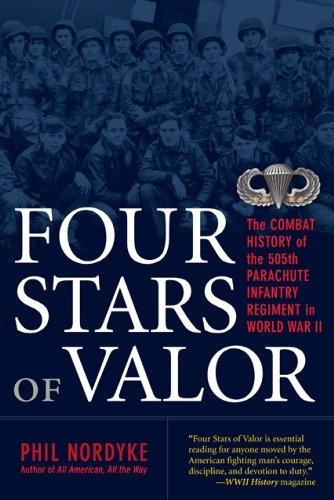
Four Stars of Valor: The Combat History of the 505th Parachute Infantry Regiment in World War II

Phil Nordyke's "Four Stars of Valor: The Combat History of the 505th Parachute Infantry Regiment in World War II" is excellent. It is must reading for any student of World War II. Mr. Nordyke does an great job as he takes us with the 505th Parachute Infantry Regiment (PIR) from its beginnings and training in the United States, through its deployment to North Africa, and through its campaigns in Sicily, Italy, Normandy, Holland, the Bulge, and Germany before returning home.

The book takes it title from the 505 PIR's record four combat jumps in Sicily, Salerno/Naples, Ste Mere Eglise/Normandy, and Nijmegen/Holland. Stars representing participation in combat jumps had been worn unofficially on parachute wings during and after World War II. FYI - this practice did not gain official sanction until after the 1983 invasion of Grenada, Operation Urgent Fury.

I took about six weeks to read the book. I found it a book that demanded I read every word on every page. Be prepared for some very graphic descriptions of the training and combat. You'll feel the heat of north Africa. I was disappointed as I read the Hermann Goring Fallschrim Panzer and 15th Panzer Grenadier Divisions were on Sicily, that General Bradley knew it, and because of secrecy of Ultra they did not pass this information on to the attacking forces! "This was a cruel deception of our own forces, but necessary in order to protect the secrets of Ultra."

Mr. Nordyke does an excellent job of using primary sources. At first I was a little confused when I encountered an incident that was described from multiple persons points of view, but quickly saw the value in seeing the way more than one person viewed/remembered an incident. It helped paint a more complete picture. Pages 300 - 301 and the actions of Private Camille E. Gagne's response to the killing of First Lieutenant John Dodd is one example. The coverage giving to the 505th's role in Nijmegen/Holland is very detailed and had me feeling I was were there.

The 505th PIR's involvement didn't stop after it's fourth jump into Nijmegen/Holland. They played a key role being deployed by truck into Belgium's Ardennes Forest as the 82 Airborne Division helped stop Hitler's in The Battle of the Bulge in freezing December 1944 and January 1945.

The book has exceptional maps and an amazing index. This book should be required reading for active duty members wearing jump wings. It is a must addition to any military historian's library and would be an excellent addition for all university and community libraries.It would a wonderful gift for anyone who has severed in the 505th.

Tuesday, May 31, 2011

Four Stars of Valor: The Combat History of the 505th Parachute Infantry Regiment in World War II

Phil Nordyke's "Four Stars of Valor: The Combat History of the 505th Parachute Infantry Regiment in World War II" is an excellent. It is must reading for any student of World War II. Mr. Nordyke does an great job as he takes us with the 505th Parachute Infantry Regiment (PIR) from its beginnings and training in the United States, through its deployment to North Africa, and through its campaigns in Sicily, Italy, Normandy, Holland, the Bulge, and Germany before returning home.

The book takes it title from the 505 PIR's record four combat jumps in Sicily, Salerno/Naples, Ste Mere Eglise/Normandy, and Nijmegen/Holland. Stars representing participation in combat jumps had been worn unofficially on parachute wings during and after World War II. FYI - this practice did not gain official sanction until after the 1983 invasion of Grenada, Operation Urgent Fury.

I took about six weeks to read the book. I found it a book that that demanded I read every word on every page. Be prepared for some very graphic descriptions of the training and combat. You'll feel the heat of north Africa. I was disappointed as I read the Hermann Goring Fallschrim Panzer and 15th Panzer Grenadier Divisions were on Sicily, that General Bradley knew it, and because of secrecy of Ultra they did not pass this information on to the attacking forces! "This was a cruel deception of our own forces, but necessary in order to protect the secrets of Ultra."

Mr. Nordyke does an excellent job of using primary sources. At first I was a little confused when I encountered an incident that was described from multiple persons points of view, but quickly saw the value in seeing the way more than one person viewed/remembered an incident. It helped paint a more complete picture. Pages 300 - 301 and the actions of Private Camille E. Gagne's response to the killing of First Lieutenant John Dodd is one example. The coverage giving to the 505th's role in Nijmegen/Holland is very detailed and had me feeling I was were there.

The 505th PIR's involvement didn't stop after it's fourth jump into Nijmegen/Holland. They played a key role being deployed by truck into Belgium's Ardennes Forest as the 82 Airborne Divisions helped stop Hitler's in The Battle of the Bulge in freezing December 1944 and January 1945.

The book has exceptional maps and an amazing index. This book should be required reading for active duty members wearing jump wings. It is a must addition to any military historian's library and would be an excellent addition for all university and community libraries.

Saturday, April 30, 2011

The German Wars: A Concise History, 1859-1945 by Michael A. Palmer

This is not another book on the history of the German military. Instead, Michael A. Palmer’s excellent volume takes a wide-ranging approach looking at political, social, economic, and military developments across Europe, and the United States of the period. He outlines the history of the European political and military landscape.  Between 1859 –1945 the German were engaged in the War of German Unification, Franco-Prussian War, World War I and World II. They won two of wars and lost two wars.   

Dr. Palmer’s book is a small volume. Including indexes, it is only 248 pages. There is an amazing amount of information contained in this small space. While not a detailed tome, the author supplies enough information for you to get the general picture of a subject.  For example, he surveys the reasons for World War II, including the role of the Treaty of Versailles and the Kellogg-Brand Pact but does not get bogged down in the finer points.

Dr. Palmer's book has a wonderful blend of scholarship and readability. He communicates the information in an interesting manner. I loved the sidebars he has throughout the book. They cover a variety of subjects relevant to the wars. They expand and explain various points. For example, he does an excellent job of explaining the strategic bombing in World War II. In February 1944, the around the clock bombing of the Eighth sand Fifteen Air Forces quickly ground down the Luftwaffe to their knees. Learning of the role the air war hard in reducing German production output by as much as forty percent amazed me.

Excellent critical thinking is demonstrated in the last chapter title “Conclusions”. The focus of the chapter is conclusions that can be drawn from the wars.  He shows an innate error in the German plans for World War I and World War II. He shows how the leadership anticipated the wars quick conclusion. They failed to plan for a war that lasted more than a few weeks. For instance, German war production for World War II did not reach maximum efficiency until the war was several years along. Why? The Germans thought their prewar supplies would be sufficient for a short war.

The origination of the index at the book’s end is very helpful. First, there is traditional index. Next, battles, military units, organizations, people, places/geography, wars, and weapons organize the index. This makes it easy to locate information.

This is an excellent book  - well done, Dr. Palmer. It is highly readable. It would be an excellent addition to the library of any military historian, public library, university library as well as personal collection of persons with interest in European or Trans-Atlantic History. 

Friday, April 29, 2011

The German Wars: A Concise History, 1859-1945 by Michael A. Palmer

This is not another book on the history of the German military. Instead, Michael A. Palmer’s excellent volume takes a wide-ranging approach looking at political, social, economic, and military developments across Europe, and the United States of the period. He outlines the history of the European political and military landscape.  Between 1859 –1945 the German were engaged in the War of German Unification, Franco-Prussian War, World War I and World II. They won two of wars and lost two wars.   

Dr. Palmer’s book is a small volume. Including indexes, it is only 248 pages. There is an amazing amount of information contained in this small space. While not a detailed tome, the author supplies enough information for you to get the general picture of a subject.  For example, he surveys the reasons for World War II, including the role of the Treaty of Versailles and the Kellogg-Brand Pact but does not get bogged down in the finer points.

Dr. Palmer's book has a wonderful blend of scholarship and readability. He communicates the information in an interesting manner. I loved the sidebars he has throughout the book. They cover a variety of subjects relevant to the wars. They expand and explain various points. For example, he does an excellent job of explaining the strategic bombing in World War II. In February 1944, the around the clock bombing of the Eighth sand Fifteen Air Forces quickly ground down the Luftwaffe to their knees. Learning of the role the air war hard in reducing German production output by as much as forty percent amazed me.

Excellent critical thinking is demonstrated in the last chapter title “Conclusions”. The focus of the chapter is conclusions that can be drawn from the wars.  He shows an innate error in the German plans for World War I and World War II. He shows how the leadership anticipated the wars quick conclusion. They failed to plan for a war that lasted more than a few weeks. For instance, German war production for World War II did not reach maximum efficiency until the war was several years along. Why? The Germans thought their prewar supplies would be sufficient for a short war.

The origination of the index at the book’s end is very helpful. First, there is traditional index. Next, battles, military units, organizations, people, places/geography, wars, and weapons organize the index. This makes it easy to locate information.

This is an excellent book  - well done, Dr. Palmer. It is highly readable. It would be an excellent addition to the library of any military historian, public library, university library as well as personal collection of persons with interest in European or Trans-Atlantic History. 

Airborne: A Combat History of American Airborne Forces by LTG (Retired) E. M. Flanagan Jr.

Airborne Airborne: A Combat History of American Airborne Forces by LTG (Retired) E. M. Flanagan Jr. Allow me to state my prejudices...