Thursday, July 07, 2016

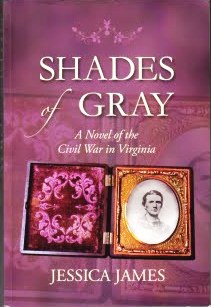
“Shades of Gray: A Novel of the Civil War in Virginia” by Jessica James

68faf-shadesofgray


Let me start with a confession. I am a man. I read Jessica James' “Shades of Gray: A Novel of the Civil War in Virginia”. I found the book interesting and engaging. I liked it!

The story is about Andrea (Sinclair) and Hunter. She is a southerner who works as a Union scout while hiding under a floppy hat impersonating a young man. Hunter is the confederate Cavalry commander. The beginning and end of the book were excellent and deserve five stars.

The middle part of the book slowed down a little for me. A lack of action and repetitiveness had the middle lacking the magic found at the book’s beginning and end. I pressed on in my reading because of all the great reviews and awards “Shades of Gray” had received. I was wondering what I was missing. I am glad I continued reading and finished the book. The last third had me turning the pages and unable to put the book down.

The story line is Andrea is the Union scout with world-class horseman skills that gives Hunter fits. Andrea saves Hunter's life. Their fates become intertwined. She goes to Richmond as a spy posing as a Southern woman. She is captured and reveals her true identity as a Unionist. She spends time in a dreadful prison. Eventually, she ends up near death under house arrest in Hunter’s home as he makes good on a promise (read the book to find out!).

Andrea and Hunter are inflexible to an obsession. Andre has a volatile temper. She and Hunter have a clash of wills and wits. Their attraction for each other builds throughout the novel. They finally admit their feelings, and nothing but difficulties come their way. About this point, the book grabbed me with their fighting and the plot twists where I just read the book straight through to the end.

Jessica James' novel is very good. I am a Civil War buff, holder of a B.A. degree in history, former U.S. Army officer and reader of over a hundred books about the Civil War. That said, the book is up there with the best I've read on the Civil War. I am glad I continued through the middle and finished the book. Even guys will like the book!

“Shades of Gray: A Novel of the Civil War in Virginia” hit number one on Amazon.com in the romance/ historical category, beating “Gone with the Wind”.

Awards and Honors for “Shades of Gray”: 2008 IPPY Award, 2008 Indie Award, 2008 Book Of The Year Finalist (ForeWord Magazine), 2009 Top Five Best Southern Theme (Virginia Romance Writers), and 2008 Favorite Book by The Book Connection and Bookworm's Dinner.

Thursday, June 09, 2016

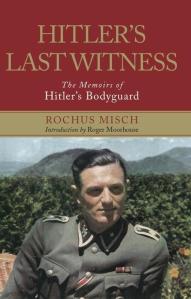
Hitler's Last Witness: The Memoirs of Hitler's Bodyguard Rochus Misch

Hitler


Hitler's Last Witness: The Memoirs of Hitler's Bodyguard Rochus Misch.


This is an insightful historical non-fiction book. It gives the reader a glimpse of history from Rochus Misch's point of view.


Who was Rochus Misch? He was Adolph Hitler's bodyguard. He never joined the Nazi Party. He was a man of circumstance. He had a bad injury, was the last surviving son of his family, and did not cause trouble. He was sent to be Hitler's courier, telephonist, and bodyguard. This book tells his story.


The book is filled with some familiar stories and some events he recounted were surprising. Roach Misch viewed Adolph Hitler as his boss, just the man he worked for. He lived a long life. He passed away in 2013. He was the last remaining member of the Fuhrerbunker.


What I enjoyed about the book was getting the unfiltered viewpoint of Mr. Misch. He was an eyewitness to history. I was not surprised to find some events accepted as historical fact recounted differently by Mr. Misch.


The unique insider view alone is worth the price of the book. You gain insights into the lives of the people closest to Adolph Hitler. You also receive a rare look at the human side of a Hitler.


I was interesting in seeing his dealings with Eva Braun, to his duties for Hitler and Hitler's remembering his name when a female cloakroom attendant told Hitler she wanted to go out with Misch, but he said no because he was on duty (Hitler called him by name which surprised him and let him have the evening off). Rochus Misch has allowed us a rare view of the world rarely visited. His account seems balanced as both fond and difficult memories are seen throughout his writings.


The book is an easy read with a very insight view of history.


Monday, May 16, 2016

The Campaigns for Vicksburg, 1862-63: Leadership Lessons by Kevin Dougherty


Five stars plus! I loved reading this fantastic book by Kevin Dougherty. “The Campaigns for Vicksburg, 1862-63: Leadership Lessons” is too good for a book to be relegated to just another history of Vicksburg. Bookstores should not limit the book to an assignment in the military history section. It deserves a prominent place in the business section with the books on leadership and management as well as the military history section. As I read the book, I was reminded of a book I read in the early 1990s, "Leadership Secrets of Attila the Hun." The book is that good!


Kevin Dougherty does an excellent job of providing leadership lessons from the key military and political leaders of the time.  He helps us understand Vicksburg. He does this by sharing the challenges, characteristics, and styles associated with leadership during the Civil War. He follows with an overview of the entire Vicksburg Campaign.


Next, he provides thirty case studies or leadership vignettes. He starts with General Winfield Scott’s Anaconda Plan. He carries us systematically through the campaign. We meet and learn about the key leaders and engagements. Each of the thirty vignettes begins with the summary. It follows with a concise history of the event (e.g. Chickasaw Bayou: William Sherman and Knowing When to Quit). Sharing the resulting leadership lessons learned from the event follow. The chapters (vignettes) conclude with a sidebar of “Takeaways” which provide a succinct summary of the lessons learned.


As you are enjoying reading the book, you learn valuable lessons about the difference between management and leadership. You gain an understanding of servant leadership. You see the value of clear communication from leaders to their subordinates. You comprehend the worth of personal presence of the leader in an organization.


The author ends the book with conclusions about leadership during the Vicksburg campaign. The areas covered are the strategy, confidence, unity of effort, the frame of reference, situational awareness, risk-taking, problem-solving, personal bravery, and technical skill. The inclusion of the Vicksburg Campaign Order of Battle as an appendix is appreciated and helps to understand the size of the leadership task faced by General U.S. Grant.


“The Campaigns for Vicksburg, 1862-63: Leadership Lessons” is a valuable addition to the study of leadership and Vicksburg.  It would be an excellent study for business leaders as well as the professional officer and soldier. I recommend its addition to the personal library of all students of military science. My hope is it would be included on the reading lists of the officer basic or advanced courses. As in "Leadership Secrets of Attila the Hun," the lessons presented in "The Campaigns for Vicksburg, 1862-63: Leadership Lessons" are timeless.


Well done, Lt. Col. Kevin Dougherty, Ph.D., US Army (retired) Adjunct Professor, Tactical Officer at The Citadel. I enjoyed your book. Well done, indeed!

Tuesday, March 01, 2016

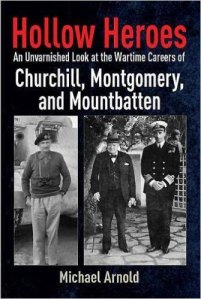
Hollow Heroes: An Unvarnished Look at the Wartime Careers of Churchill, Montgomery and Mountbatten

Hollow Heroes


Hollow Heroes: An Unvarnished Look at the Wartime Careers of Churchill, Montgomery, and Mountbatten by Michael Arnold opens the curtain where the reader can see beyond the spin and public relations images given to learn the "unvarnished" stories of the three men.


Churchill, Montgomery, and Mountbatten were three of Great Britain's key leaders during and following World War Two. I remember Churchill is credited with the comment that history would be kind to him because he intended to write it.


When researching I find, "According to some accounts he (Churchill) told Stalin and Roosevelt at the 1943 Tehran Conference that 'History will judge us kindly,"


When asked how he could be so confident, he replied: "because I shall write the history" (which he did, of course, in a massive tome on the Second World War).


In other accounts have Churchill said in 1948 in a House of Commons Speech: 'For my part, I consider that it will be found much better by all Parties to leave the past to history, especially as I propose to write that history.' In both cases, the spirit of the misquotation is very much evident, albeit in rather different contexts. And it’s entirely likely that intending to 'write history' was the kind of clever double entendre to which Churchill might willingly have referred more than once." My point - Churchill wanted to make sure his spin was the one remembered. (Source: http://eganhistory.com/2012/10/30/on-doing-history-empathy-accuracy-in-the-undergraduate-classroom/).


The book unveils the truths behind their public images. Arnold's book shows a different view of each man. His approach is demonstrating an extensive part resume is inaccurately being built on false results, chicanery, and deceit.


The author looks at the influence and obstruction of officers who obtained their rank based on their "social class”. He demonstrates the negative impact of "class-based officers" on the performance of the British Army in World War II. He quotes the views of the Americans that saw far too often the British failed to base officer promotion on effectiveness. Instead, it was on social background. Conforming was more important to the British.


Montgomery's fear of and jealously of Patton is clearly shown.


Churchill's self-preservation attitude and bungling are shown in his handling of Field Marshals Wavell and Auchinleck, two of Britain’s finest commanders of the war. Their service was mostly lost to Britain because of Churchill’s constant interfering in field matters especially after the fall of Singapore.


Arnold includes the case of Major-General Dorman-Smith. Dorman-Smith was one of Britain’s most brilliant original thinkers. Sacked by Churchill for what appears to be his overachievement as the tactician who had produced Britain’s victory over Rommel at the first battle of Alamein, This was an unpardonable sin in some eyes.


Mountbatten’s fumbling in India is also accurately portrayed. It shows the “man for the century’s” overly embellished reputation.

Tuesday, February 02, 2016

Black Faces of War: A Legacy of Honor From the American Revolution to Today

"Black Faces of War: A Legacy of Honor From the American Revolution to Today" commemorates the achievements by African-Americans in the United States military from the American Revolution to the present. I loved the perfect blend of paintings, photography and prose to tell this story. The book includes contributions from prominent historian Hal Chase, W. Stephen Morris, and Luther H. Smith, one of the celebrated Tuskegee Airmen.


My own education of "The Black Faces of War" began when I was a college history major I visited Fort Davis, Texas and first learned of the Buffalo Soldiers at Fort Davis from 1867-1885. It showed a gap in my education concerning the role of African-American's in the US military.


Author Robert V. Morris' work includes black military heroes such as Crispus Attucks, the first man to die in the Revolutionary War. We learn the story of Lieutenant James Reese Europe. He brought jazz music to Europe in 1918. Lieutenant Charity Adams, commander of the only all-black Women's Army Corps unit during World War II narrative is told. The book also includes General Colin Powell, who served with merit in Vietnam. He became the first African-American Chairman of the Joint Chiefs of Staff during the Gulf War. He also retired a four-star general before becoming the first African-American Secretary of State.
This is a must addition to any military historian’s library as well as community library. The history of African-Americans in the US military is a too often neglected history. It is necessary that not only African-Americans, but also all Americans know of the import contributions made throughout history.


Jimmie Aaron Kepler is a novelist, poet, book reviewer, and award-winning short story writer. His work has appeared in over twenty venues, including Bewildering Stories and Beyond Imagination. When not writing each morning at his favorite coffee house, he supports his writing, reading, and book reviewing habit working as an IT application support analyst. He is a former Captain in the US Army. His blog Kepler's Book Reviews was named a 100 best blogs for history buffs. You can visit him at http://www.jimmiekepler.com.

Saturday, October 31, 2015

How the North Won: A Military History of the Civil War by Herman Hattaway and Archer Jones


How the North Won: A Military History of the Civil War by Herman Hattaway and Archer Jones is a scholarly look at the Civil War. Hattaway and Jones have produced a great book on Civil War logistics, planning, and administration. They authors seem to focus more on the logistics and strategy side over the tactical side. The book was very good, but at times, it was a dry recitation of chronology, dull facts, and statistics. I had to force my way to complete the book, and it took two attempts to get it read. Most copies of the book will collect dust on some university library bookshelf. It is too deep and too dry for most readers. Better to borrow this book from your library than spend your money purchasing the book. Read in April - June 2005 by Jimmie A. Kepler.

Wednesday, September 30, 2015

A Soldier's Story by General of the Army Omar Bradley


A Soldier's Story by General of the Army Omar Bradley is the story of World War II as General Omar Bradley saw it. It is also the primary source book for the movie Patton. Bradley's unassuming and straightforward style underscores how he is portrayed by contemporary accounts. General Bradley was known as the "G.I. General". In the book, he comes across as an island of equanimity in a sea of incredible egos like Patton, Montgomery et. al.

Remember, this book is Bradley's take on events. I am sure that some involved in controversies he covered would defend their actions or inactions. Yet this account has an aura of authenticity due to the author's lack of need to tout his own accomplishments. This inner peacefulness, along with command ability, probably explains Bradley's rise to the level of senior American ground commander in Europe. He even comments about working calculus problems for relaxation!

Written in 1951, this book is superb. It gives insider's account of the American effort and strategic management in the European Theater of Operations. It is well written, clear and largely devoid of the bombast that can weigh down some combat and command accounts. Although a big book, it reads quickly.

One of the highlights of my life was getting to interview Omar Bradley for a boy scout merit badge I was working on in 1964. He was living in a house on the William Beaumont Hospital grounds at Fort Bliss, Texas. My dad was stationed in El Paso at the time. The general was very kind to a kid interviewing him. I remember my dad getting exasperated when I told him I need a ride to do an interview for my God and Country merit badge. I told him I had called and set up an appointment with an old retired soldier though the boy scout council HQ. When he asked who and I said Omar Bradley my dad about passed out. He had served under Bradley in North Africa and Europe. I remember his kindness and patience. Read and reviewed by Jimmie A. Kepler.

Airborne: A Combat History of American Airborne Forces by LTG (Retired) E. M. Flanagan Jr.

Airborne Airborne: A Combat History of American Airborne Forces by LTG (Retired) E. M. Flanagan Jr. Allow me to state my prejudices...