Tuesday, September 12, 2017
Hell's Highway by George Koskimaki
Thursday, July 06, 2017
7 Leadership Lessons of the American Revolution: The Founding Fathers, Liberty, and the Struggle for Independence by John Antal
Leadership Lessons Brought to Life
John Antal’s “7 Leadership Lessons of the American Revolution: The Founding Fathers, Liberty, and the Struggle for Independence”. The author uses seven case studies to bring the lessons to life. The case studies are in narrative story form.
Excellent Story-teller
He is an excellent story-teller who paints a clear picture that brings each story alive.The stories make for great illustrations for the lessons learned. The lessons learned are as applicable to the business enterprise as to military leadership. He does a wonderful job of demonstrating liberty as a motivator demonstrating the importance of the person.
Strongly Recommend the Book
While tempted to do to a chapter by chapter summary of the book, I won't. If you love history if you love the USA if you have a sense of patriotism and if you enjoy the study of leadership you will like the book. I strongly recommend “7 Leadership Lessons of the American Revolution: The Founding Fathers, Liberty, and the Struggle for Independence”.
Tuesday, June 06, 2017
D-Day With The Screaming Eagles By George Koskimaki
Written by General Maxwell Taylor’s Radio Operator
George Koskimaki the noted historian of the 101st Airborne Division wrote “D-Day with the Screaming Eagles”. Mr. Koskimaki was 101st Airborne Division Commanding General Maxwell Taylor’s radio operator. The book was written in 1970. Interviews with hundreds of paratroopers contributed to the book. Their stories are attention-grabbing and captivating. They cover the first hours of Normandy. The fact that the book covers only the first couple of days of the D-Day invasion allows fascinating details to be covered.
A You Are There Book
The book gives you the feel that you are there during the frenzied first hours of the invasion. Detailed accounts of the activities of the pathfinders were enthralling. You encounter stories where paratroopers are sleepily drugged by the motion sickness medication they took preflight. You are under antiaircraft fire with them as they make their final approaches to the drop zones. In some cases, you are within the aircraft as it is going down in flames. You feel the fear of being captured by the Germans. You experience the myriad of broken legs, sprained ankles and other injuries from jumping at too fast of air speeds and too low of altitudes while being shot at. You land with them in the trees and nearly drown in the flooded areas during your parachute landing. You feel the downright confusion of the event.
Glider Unit Coverage Included
The coverage of the glider units landing later during the D-day is information rarely covered in other books. Familiar stories like Lieutenant Dick Winters leading troops taking out the guns on Normandy are shared with a freshness that predates “Band of Brothers” by nearly twenty-five years.
I strongly recommend the book. It is necessary for any military history library, college library or community library. Books like “Band of Brother’s”, "D-Day: June 6, 1944: The Climactic Battle of World War II”, “Citizen Soldiers” and “The Greatest Generation” follow the historical method used by Mr. Koskimaki.
Sunday, June 04, 2017
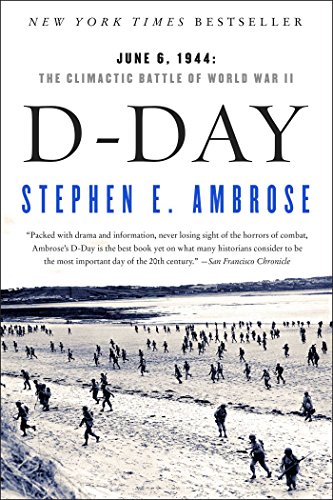
D-Day June 6, 1944: The Climactic Battle of World War II by Stephen E. Ambrose
Over 1400 Interviews
The late Stephen E. Ambrose used over 1400 interviews for his history of the D-Day invasion.
This “oral history" approach brings the reader into the heart of the battle through eye-witness testimony. The tales of the front line infantryman sweeps the reader up into their personal histories.
Individual and Small Unit Stories
The story is told from the individual and small unit level often failing to describe larger unit actions or explaining how the individual actions fit into the total picture. Let is shared of what happened on the Canadian and British beachheads. Historical controversies are often given minimal coverage. These are simply good stories of many individual experiences.
The book is not a textbook for lessons on strategic decision making or to answer big picture questions. Ambrose touches on these larger issues in a general focus, but that is not his focus.
Courage of Small Unit Leaders
This is a book about the American achievement in Normandy. The individual courage and independence of the American small unit leaders is the big story of this book.
Ambrose is right on target as he tells the story of their braveness and toughness. I originally read and reviewed the book in 1999.
Monday, May 29, 2017
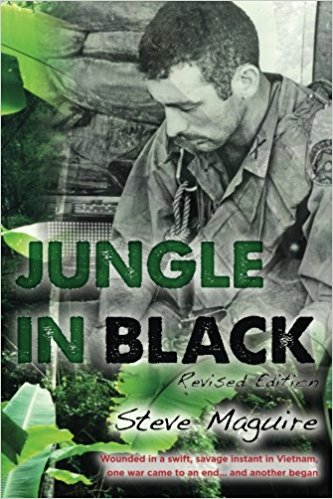
Jungle in Black by Steve Maguire
A Memoir
Jungle in Black is the memoir of Steve Maguire. McGuire was a young, gung-ho, Airborne Ranger who lead a 9th Infantry Division Battalion Reconnaissance Platoon in the 6th Battalion, 31st Infantry in the Mekong Delta in 1969.
The story opens with drawn-out and generic combat descriptions that lead up to Maguire's wounding. The rest of the book covers his treatment. We learn that an exploding Vietcong mine blinded him for life.
An Honest First-person Account
This is an honest first-person account that never wallows in self-pity. Unfortunately, he in no way offers enough background about his life to round out his person.
He missed the mark with his book. He paints a broad description of the early stages of rehab. The description covers the usual male boasting, lust for nurses and hopes dashed by physicians not healing or restoring his sight. He fails to feature how he coped with his loss of sight and completed his bachelor and master's degree and began working on a doctorate in psychology (not mentioned until in an epilog).
This could have been a very inspirational and motivational story; instead, it’s just another war story memoir.
Tuesday, May 09, 2017
White Heat: The Friendship of Emily Dickinson and Thomas Wentworth Higginson by Brenda Wineapple

He had seen men enslaved, and seen death in battle on a terrible scale. So when a young, unknown poet named Emily Dickinson wrote to ask whether he thought her verse was “alive”, Thomas Wentworth Higginson – a critic for The Atlantic Monthly and a decorated Union veteran – knew he was seeing poetry that lived and breathed like nothing he had seen before.
Higginson was immediately awed by Emily Dickinson and went on to become her editor, mentor, and one of the reclusive poet’s closest confidantes. The two met only twice, but exchanged hundreds of deeply personal letters over the next twenty-five years; they commented on each other’s work, mulled over writers they admired, and dazzled each other with nimble turns of phrase. After she died, he shepherded the first collected edition of her poetry into publication and was a tireless champion of her work in his influential Recent Poems column for The Nation.
Later generations of literary scholars have dismissed Higginson as a dull, ordinary mind, blaming him for the decision to strip some of the distinctive, unusual structure from Dickinson’s poems for publication. However, Brenda Wineapple offers a portrait of Higginson that is far beyond ordinary. He was a widely respected writer, a fervent abolitionist, and a secret accomplice to John Brown’s raid on Harpers Ferry; wounded in the first year of the Civil War, he returned to service as colonel of the first federally authorized regiment of former slaves. White Heat reveals a rich, remarkable friendship between the citizen soldier and the poet, a correspondence from which Dickinson drew tremendous passion and inspiration – and which she credited, more than once, with saving her life.
Brenda Wineapple is the author and editor of five books, including the award-winning Hawthorne: A Life and Sister Brother: Gertrude and Leo Stein. Her essays, articles, and reviews have appeared in The American Scholar, The New York Times Book Review, Parnassus, Poetry, and The Nation. She teaches in the MFA programs at Columbia University and The New School in New York.
Monday, May 08, 2017
Omaha Beach: D-Day, June 6, 1944 by Joseph Balkoski
Joseph Balkoski's book on Omaha Beach is a great historical resource like his book Utah Beach. Omaha Beach tells the story of when largely untested American troops assaulted the German army's Atlantic wall. This is a great read covering the events of the day almost minute by minute. It reads like a great documentary. This is not written in the format of a memoir. Balkoski relies mainly on primary sources such as after-action reports, unit journals, and citations to create his blow by blow narrative. He includes the invasion's diplomatic and strategic context. Omaha Beach is the closest the modern reader can get to experiencing the Normandy landings firsthand.
Sprinkled throughout the battle account are the accounts of those in the battle. It is a classic. It is a must for any D-day library. It also included comprehensive lists of all Medal of Honor and Distinguished Service Cross winners at Omaha Beach. It has the Order of Battle, unit casualty list for the first twenty-four hours, a unit organization of a 30man assault boat unit weapons, and equipment carried in the assault by a typical soldier, and a series of detailed maps allowing the reader unparalleled insight into the minute-by-minute combat on Omaha Beach.
Airborne: A Combat History of American Airborne Forces by LTG (Retired) E. M. Flanagan Jr.
Airborne Airborne: A Combat History of American Airborne Forces by LTG (Retired) E. M. Flanagan Jr. Allow me to state my prejudices...
-
David Laskin's "The Long Way Home: An American Journey from Ellis Island to the Great War" tells the story of the millions of ...
-
Summary of Book: The Rising Tide is military historical fiction and the first novel of a continuing series by Jeff Shaara based on certain t...
-
Few people have been involved in as many significant US military operations over the past three decades as has LTG (ret.) William G. "...