Friday, January 31, 2014

Book Review: Mission to Berlin: The American Airmen Who Struck the Heart of Hitler’s Reich By Robert F. Dorr


Robert F. Dorr's “Mission to Berlin” documents the mission that took place on February 3, 1945 to bomb Berlin, the capital of Nazi Germany.  The author does a very skilful job of telling the stories of the men who flew on it. He shares the incredible story of American fearlessness in the last months of World War II. The size of the air battle challenges our belief as in excess of 1,000 bombers and multiple-hundreds of fighter aircraft originating from Allied bases journey to the heart of Nazi Germany. You also get a good overview and understanding of the structure and operations of the United States Eighth Air Force.

Author Robert F. Dorr gives a detailed report of its evolution. He takes us from the pre-takeoff preparation and activities to the concluding landing.  The book is well paced. The basic structure of the book is spellbinding narrative. The storyline presents a mesmerizing description of many of the aviators on this historic mission. His use of primary source references such as first person interviews and personal letters adds warmth and the human touch to the narrative.

I found the way Mr. Dorr combines his interviews and letters with the detailed duties of each member of the crew a great way to explain the duties and procedures of the B-17 crew. The way he tells the story you feel as if you are there from take off to landing seeing the point of view of each member of the crew. He does an amazing job of drawing the reader into the life of the crew. This alone is reason to read the book.

Another reason to read the book includes the good picture of how the war affected the young crews, the technical side of the B-17 and its development and deployment as well as the evolution of fighting strategies. It was fascinating to see the change in philosophy as to the use of the fighters and to see how the Thunderbolts and especially the P-51s made a great difference in the  survival rates of the B-17s once they were able to escort all the way to Berlin.

I enjoyed the appendix that explained “What Happened to Them?” It told us of what key personalities mentioned in the book did after the war. It was a pleasant addition to the book.

This is an outstanding book.  Every World War II buff as well as aviation enthusiast will want it in their library. This is the second book I have read written by Robert F. Dorr. The first was “Hell Hawks!” which I also strongly recommend.  Zenith Press is the publisher.

Tuesday, December 31, 2013

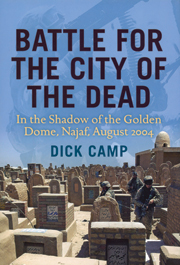
Battle for the City of the Dead: In the Shadow of the Golden Dome, Najaf, August 2004 by Dick Camp

The year was 2004. During the spring and summer the Iraqi nation was overwhelmed with violence. The nation's Shiites and Sunnis headlined the sectarian fighting. The Army of Iraq had been disbanded by the United States Proconsul. The results of his actions were infusing a large number of angry young men into the streets of the population centers in Iraq. These men had no jobs skills, no jobs, and no prospects for employment. These men were literally angry in the streets. The clergy fueled their anger which developed into a rage and campaign for jihad against the United States and all "occupation forces". 

By August 2004, Muqtada Al-Sadr, a Shiite cleric, called upon thousands of Mahdi Militia, his armed followers and de facto private army, to resist the occupation. Fighting would break out in several locations. The holy city of Najaf, the site of the largest Moslem cemetery in the world, and the Imam Ali Mosque were major sites of fighting. U.S. forces found themselves fighting in 120-degree heat. The battleground was through a tangle of crypts, mausoleums, and crumbling graves. The fight was rough. It had the religious zealots against the motivated and disciplined United States Army and Marine Corps troopers. It makes for a spellbinding account of Americans in battle.

The book itself is excellent. Dick Camp tells an excellent story. The quality of the book is remarkable. I am referring to everything from the writing, the large amount of high quality color pictures, and even quality of the paper the book on which the book is printed.

Tuesday, December 24, 2013

10 Best I Read in 2013.


2. "The Projection Room: Two from the Cubist Mist" by Carol Golembiewski. See my review at: http://www.keplersmilitaryhistorybookreviews.com/2013/10/the-projection-room-two-from-cubist.html

3. "The Shambling Guide to New York City" by Mur Lafferty. See my review on iTunes.

4. “Shades of Gray: A Novel of the Civil War in Virginia” by Jessica James. See my review at: http://www.keplersmilitaryhistorybookreviews.com/2013/08/shades-of-gray-novel-of-civil-war-in.html

5. "Foundation" by Issac Assimov

6. "The Machine Stops" by E. M. Forster (Short Story)

7. "The Bears Discover Get Fire" by Terry Bisson (Short Story)

8. "Misfit" by Robert A. Heinlein (Short Story)

9. "Out of Copyright" by Charles Sheffield. (Short Story)  Published in Clarkesworld Magazine.

10."The Promise of Space" by James Patrick Kelly (Short Story) Published in Clarkesworld Magazine.

Saturday, November 30, 2013

The Most Dangerous Enemy: An Illustrated History of the Battle of Britain by Stephen Bungay

"The Most Dangerous Enemy: An Illustrated History of the Battle of Britain" is spectacular. It merits a five-star rating. It is in a large-format of 11.9 x 9.8 x 1.1 inches. The quality of the book is immaculate. If you are a history buff with an interest in the Battle of Britain this is the book for you. The book is divided into three sections: Part 1: Build-up, Part 2: Battle, and Part 3: Aftermath. It takes you on a journey of understanding. You learn of the organization of the air forces. You learn about the various types of aircraft. You learn of the radar and air defenses as well as air craft production. The detail of the information is astounding.

The book has over 150 photographs. This includes a large number of rare color photos. The book is a treasure full of color maps and diagrams. There are a number of excellent "sidebar" features as well. Using numerous first-hand experience stories Mr. Bungay brings this critical story from history alive in an exciting way. The quality and quantity of the photographs alone is reason enough to purchase the book. He has many never before published pictures of planes, aircraft pilots, and pivotal military leaders. The diagrams of aerial fights add clarity to the story they illustrate.

Well done Stephen Bungay. The book will be an excellent addition to any history buff's library. Any World War II European Theater veteran will enjoy seeing and owning the book. It would make a great addition to school and community libraries.

Reviewers note: I did not compare Stephen Bungay's "The Most Dangerous Enemy: An Illustrated History of the Battle of Britain" with the original release by Stephen Bungay of "The Most Dangerous Enemy: A History of the Battle of Britain". That is not the purpose of this review. The non-illustrated "original" book is the definitive reference work that stands. It is the classic on the subject. "The Most Dangerous Enemy: An Illustrated History of the Battle of Britain" is spectacular and deserves to join its predecessor as the illustrated definitive work on the Battle of Britain. Well done Mr. Stephen Bungay!

Sunday, November 24, 2013

Eastern Inferno: The Journals of a German Panzerjager on the Eastern Front, 1941-43 by Hans Roth, edited by Alexander Christine and Mason Kunze.

I have read six books dealing with the Eastern Front in World War II. All were either memoirs written after the fact or traditionally researched works. "Eastern Inferno: The Journals of a German Panzerjager on the Eastern Front, 1941-43" by Hans Roth, edited by Alexander Christine and Mason Kunze is different. 

The book is the results of three diaries of Hans Roth. He was accounted as missing in action in 1944. Amazingly a buddy on leave delivered the three volumes of diaries to Roth’s relatives. They cover the years 1941, 1942 and 1943. Sadly, Hans Roth vanishes as another MIA unaccounted for casualty of war.

The diaries are incredible. They show that he viewed part of the actions as being pre-emptive (p. 27). There was a clear fear of the Russians being on German soil and killing his loved ones. We learn that the diaries include content that would have never cleared the censors plus he was glad to keep the horrors away from his dear wife.

The book is spectacular. Hans Roth provided a wonderful service for his family and future generations by recording what he witnessed and what he was ordered to do.

You can feel the fear he felt. You can sense the mixed emotions he experienced. The day to day log of his units actions with his understanding of what was going on are amazing. The detail and description he provides of the surroundings paints a remarkable portrait of the times.

Hans Roth realized that luck was a key part of survival. He makes this clear time and time again. The amount of artillery and equipment the Russians had seems to have caught the Germans by surprise.  The aircraft strafing runs and Russian counterattacks in 1941 caught me by surprise. Other works reported little or none on these until 1942 and later. 

Note: As I read I could feel the growing fatigue and cynicism Hans Roth had a result of the war. His love of his wife and family shows regularly in his comments. The book is an important resource for anyone interested in the Eastern Front as well as those who want a realistic look at the terrors of war. It is gripping and paints one of the clearest pictures ever of how war is horrendous.

Christine Alexander and Mason Kuntze deserve a big thank you for the editing and translation of this project.


Saturday, November 23, 2013

Barksdale's Charge: The True High Tide of the Confederacy at Gettysburg, July 2, 1863 by Phillip Thomas Tucker

Phillip Thomas Tucker’s has written a well researched, very readable book titled "Barksdale's Charge: The True High Tide of the Confederacy at Gettysburg, July 2, 1863". 

Dr. Tucker’s book makes the premise that at the Battle of Gettysburg General Barksdale's charge is more significant that General Picket’s charge. The author presents detail after detail. 

The book gives a wonderful history of the Mississippi Brigade. He points out they are tall, straight shooters, and brave.  I found the book redundant at points.

The author makes good arguments for Barksdale’s charge being more important than Pickett’s. If Barksdale had lived and expended the same energy that Pickett did in defending his actions, we think more highly of his Mississippi brigade’s contributions. Interestingly, the point of view presented was almost exclusively southern apologetic.

The book was an enjoyable read. The history of the Mississippi brigade and its contributions is worth the purchase price.  I think the historians have already decided Pickett charge was more important than Barksdale’s, but it made me reevaluate. 

I am well read on the subject of Gettysburg having read more than twenty books and memoirs on the battle. I am a trained historian by education who studied military history. I am a former US Army infantry officer who has studied the battle in detail in my military science curriculum.  All this said; I can examine the premise, but respectfully disagree with it.

Friday, October 18, 2013

"The Projection Room: Two from the Cubist Mist" by Carol Golembiewski

Master story-teller Carol Golembiewski hooked me from the opening World War One battlefield scene. She weaves a thriller making excellent use of her subject matter expertise in the field of art with technology. She beautifully visualized scenes. This is a rare skill. Her use of technology had this geek intrigued.

Meet struggling artist George Bosque. He has a brush with death while attacking the German soldiers during World War One. During his charge toward the enemy lines, he sees two men collecting the souls of those killed in action. Obsessed by what he saw, Bosque draws them in his sketchbook. In late life, he does two large paintings, one of each of them.

His widow sold both paintings many years later. The purchaser is a Milwaukee museum. The museum has in the testing phase a new technology projecting images and allowing patrons to experience art in 3-D. They see great potential. However, a mutinous employee and his friend experiment on the two paintings with the technology. The results are horrific.

The men recognize that artist George Bosque incarcerated something from the other side of the grave. Dreadful consequences await everybody who cross the threshold into the Projection Room.

In this spellbinding account, two paintings out of sight from humankind for years let loose their powers onto an unwary museum and community absolutely not ready for what lies ahead for them.

I give it five-stars. It would make an amazing movie. I hope Carol’s agent is shopping it with Hollywood.

The Kindle version of "The Projection Room: Two from the Cubist Mist" by Carol Golembiewski was purchased, read and reviewed by Jimmie A. Kepler.

Airborne: A Combat History of American Airborne Forces by LTG (Retired) E. M. Flanagan Jr.

Airborne Airborne: A Combat History of American Airborne Forces by LTG (Retired) E. M. Flanagan Jr. Allow me to state my prejudices...