Wednesday, April 30, 2014

Inferno: The Epic Life and Death Struggle of the USS Franklin in World War II by Joseph A. Springer


Joseph A. Springer sets the standard for how oral histories should be written with "Inferno: The Epic Life and Death Struggle of the USS Franklin in World War II”. You feel as if you are on-board as the story of "Big Ben", the USS Franklin, in World War II unfolds. It is necessary read for anyone who claims to be a World War II history buff.

The book divides into two parts. The ship's change of commanders is the dividing point - Captain Shoemaker's command and Captain Gehres' command. It is a well-structured book. It starts with the specs and construction of "Big Ben". It takes us through the training of the crew and shakedown voyages. We travel through the Panama Canal to San Diego and on to Pearl Harbor laying all the appropriate groundwork along the way.

The author rapidly moves us into naval carrier operations. You are there in the South Pacific for many of the famous battles. You experience Iwo Jima, Peleliu, Luzon, Manila, Leyte, and Honshu.

Mr. Springer takes great care in organizing and selecting interviews. You are in the aircraft cockpits experiencing the words and emotions of the men who lived through the survived the events. The stories are breath taking eyewitness accounts and survival stories. He manages to get you inside the heads of the pilots and ship's crew. You feel the fear and experience the heroism.

The USS Franklin's size and importance led to one of the Navy's first encounters with Japan's Kamikaze attack planes. The suicide pilots delivered terrible damage to "Big Ben" in October 1944 off the Philippines. The damage forced Big Ben back to Bremerton, WA for repairs and a change of command.

In March 1945, "Big Ben" experienced the devastating bomb attack off Honshu, Japan. That attack defined her crews' extraordinary valor. Somehow, they saved the ship. "Big Ben" traveled back to New York. She was rebuilt, but would never be the same.

Mr. Springer makes good arguments to restore the entire crew of the USS Franklin's honor. You learn how the spiteful and hateful actions of her second captain attempted to segregate the crew into two groups. Group one was the sailors and airmen that remained on board during the entire ordeal. Group two was the person who did not stay onboard for the entire ordeal. Unfortunately, Captain Gehres made no differentiation for those who may have been blown overboard by exploding ordnance, forced off due to flames and heat, removed to a rescue vessel as a result of injury or simply because they were ordered to abandon ship. Joseph A. Springer wins the argument that All Hands of the USS Franklin were the real heroes of this gut-wrenching ordeal and fight for survival. This includes those on the rescue vessels.

The book gets my highest rating. It has excellent photographs, maps, illustrations. The reference material at the end of the book will make ever the most critical historian smile. Buy the book. "Inferno: The Epic Life and Death Struggle of the USS Franklin in WWII" is an excellent book.

Tuesday, April 15, 2014

7 Leadership Lessons of the American Revolution: The Founding Fathers, Liberty, and the Struggle for Independence by John Antal

John Antal’s “7 Leadership Lessons of the American Revolution: The Founding Fathers, Liberty, and the Struggle for Independence”. The author uses seven case studies to bring the lessons to life. The case studies are in narrative story form. He is an excellent story teller who paints a clear picture that brings each story alive.The stories make for great illustrations for the lessons learned. The lessons learned are as applicable to the business enterprise as to military leadership. He does a wonderful job of demonstrating liberty as a motivator demonstrating the importance of the individual.

While tempted to do to a chapter by chapter summary of the book, I won't. If you love history. If you love the USA. I you have a sense of patriotism and if you enjoy the study of leadership youwill like the book. I strongly recommend  “7 Leadership Lessons of the American Revolution: The Founding Fathers, Liberty, and the Struggle for Independence”.

Monday, March 31, 2014

“Sacrifice On the Steppe: The Italian Alpine Corps in the Stalingrad Campaign, 1942-1943″ by Hope Hamilton


As a lifelong history buff, military history enthusiast, former US Army officer and holder of a BA degree in history, I find myself pleasantly surprised from time to  time when I encounter a book that fills a void in my historical education. “Sacrifice On The Steppe: The Italian Alpine Corps in the Stalingrad Campaign, 1942-1943″ written by Hope Hamilton and published by Casemate is one such book. The idea for the book originated when the author listened to her uncles’ reflections of his participation in World War II.

When Hitler had Germany invade Russia in June 1941, Prime Minister of Italy Mussolini declared war on Russia. He quickly sent a hastily organized Italian Expeditionary force of 62,000 men to join the Russian campaign even though Adolf Hitler discouraged such a move. Italy was unprepared militarily. Mussolini’s motivation was to join Hitler in receiving the spoils following an imagined rapid Nazi victory against Russia.”

Hope Hamilton’s book draws on personal interviews, exhaustive research and the written accounts of Italians who participated in and survived Mussolini’s tragic decision of Italian involvement. Mussolini compounded his mistake by sending even more troops the following year. The author does a good job of showing the human side of the Italian involvement on the Russian front. This is not a scholarly work on the tactics and logistics of the Italian involvement. Rather, it is the story of the people who made the terrible trek from Italy to Russia to support their German ally. The German’s had little trust of and kept the Italians minimally informed and I believe misused the Alpine troops by not maximizing the troops mountain fighting ability by their placement along the Don River.

The author does a great job of telling the soldier’s story. Her writing style focuses on the individual accounts of the soldiers. She discusses how the Alpine Corps was caught up in the German campaign capture Stalingrad in the autumn of 1942. She takes us through the Soviet offensive that followed in late November. We experience the collapse of the entire Axis front and the Alpine Corps’ withdrawal to the Don. I could have used a more background about the Stalingrad Campaign. The book does not take a strategic view of the campaign. Little attention is given to the big picture. The story is told from the Italian point of view instead of looking at it from the Axis point of view.

The book includes good notes, is well indexed, and has a great bibliography. I enjoyed the book. If you are looking for an after action report of the Italian participation or a critical analysis of the campaign this is not the book for you. If you’re looking for a good overview and an understanding of what the Italian soldiers experienced then you’ll enjoy the book. I give it four stars. It is a must addition to any military historian’s library. It is a good first volume to fill a long void of an English language account of the Italian involvement on the eastern front.

Friday, February 28, 2014

"Tiger Tank Manual: Panzerkampfwagen VI Tiger 1 Ausf.E (SdKfz 181) Model (Owner's Workshop Manual)" by David Fletcher, David Wiley and Mike Hayden


"Tiger Tank Manual: Panzerkampfwagen VI Tiger 1 Ausf.E (SdKfz 181) Model (Owner's Workshop Manual)" by David Fletcher, David Wiley and Mike Hayden and published by Zenith Press.  The Tank Museum in South Dorset in the United Kingdom (UK) was in a unique position to write a new chapter in the Tank story with its own discoveries on restoring and running Tiger 131, which is the centerpiece of the manual.

"Tiger Tank Manual" is unique as we follow the story of Tiger 131 from April 1943 in Tunisia in North Africa to its arrival in the UK in October 1943 to its renovation and refurbishing thanks to the national Lottery. It is a short work of only 164 pages. "Tiger Tank Manual" gives an amazing insight and inside look into purchasing, owning, and even operating one of the world’s most outstanding engineering feats and fighting vehicles.

The use of personal remembrances of what it was like to operate and command such a vehicle in wartime gives you a "you were there" feeling. The recollections of what it was like to be on the receiving end of the Tiger's 88 mmm gun shared by Lieutenant Gundgin in the Foreword really helps set the book's tone.

The pictures, illustrations, line drawings, statics are amazing. The "Tiger Tank Manual" gives the necessary background on the history and development of the tank. You get the story of Tiger 131 down including forensic and crime scene analysis of the battlefield damage to the tank to include the ammunition used against the tank!

You are given a specular cutaway drawing of the tank from the School of Tank Technology. Note: I am a former US Army Ordnance Corps officer whose military occupational specialty was maintenance. I supported the old US Army M60A2 tank. The detail in "Tiger Tank Manual" rivals any Technical Manual. I cannot over emphasize the quality and variety of the pictures. They left me with the felling I had crawled all over the vehicle as well as I examined every detail inside the tank. They are amazing.

You get a glimpse into the mind of the museum as to why they restored Tiger 131. Again, detail pictures as well as description guides you through the process. Such details as paint selection and viewpoints from volunteers working on the project make you feel part of the project.

The "Tiger tank Manual" includes a chapter on running the tank. The detail given to the start-up procedures and riving the tank makes me want to get in the driver's seat and take it for a test drive.

The detail given to "The May back Engine" may appear to be overkill to some, but the tank enthusiast or automotive engineer will enjoy the examination of the engine and its auxiliaries. Everything from ventilation to the gearbox and transmission as well as the steering and drive shafts (final drive) is covered.

Having supported annual tank gunnery for several years had my curiosity peak in the chapter devoted to firepower. Excellent coverage is given to tank gunnery from the ammunition down to aiming and firing the gun.
The explanation of the deployment and tactics of the Tiger lets you have an understanding of the German's strategy. The book concludes with a nice appendix of the surviving Tigers.

While the book may not be for everyone, any military enthusiast will enjoy the book. Any tanker or former tank crewmember will enjoy the book. I believe it would be a worthwhile addition to any military history library as well as any collection dealing with World War II. Additionally, automotive engineers will find the book simply amazing.

Read and reviewed by: Jimmie A. Kepler February 29, 2012. Note: Jimmie is honorably discharged as a Captain in the ordnance Corps US Army where he served as a maintenance office and supported a tank battalion (2nd Bn 77th Armor 2nd Brigade 9th Infantry Division) in 1978.

Friday, January 31, 2014

Book Review: Mission to Berlin: The American Airmen Who Struck the Heart of Hitler’s Reich By Robert F. Dorr


Robert F. Dorr's “Mission to Berlin” documents the mission that took place on February 3, 1945 to bomb Berlin, the capital of Nazi Germany.  The author does a very skilful job of telling the stories of the men who flew on it. He shares the incredible story of American fearlessness in the last months of World War II. The size of the air battle challenges our belief as in excess of 1,000 bombers and multiple-hundreds of fighter aircraft originating from Allied bases journey to the heart of Nazi Germany. You also get a good overview and understanding of the structure and operations of the United States Eighth Air Force.

Author Robert F. Dorr gives a detailed report of its evolution. He takes us from the pre-takeoff preparation and activities to the concluding landing.  The book is well paced. The basic structure of the book is spellbinding narrative. The storyline presents a mesmerizing description of many of the aviators on this historic mission. His use of primary source references such as first person interviews and personal letters adds warmth and the human touch to the narrative.

I found the way Mr. Dorr combines his interviews and letters with the detailed duties of each member of the crew a great way to explain the duties and procedures of the B-17 crew. The way he tells the story you feel as if you are there from take off to landing seeing the point of view of each member of the crew. He does an amazing job of drawing the reader into the life of the crew. This alone is reason to read the book.

Another reason to read the book includes the good picture of how the war affected the young crews, the technical side of the B-17 and its development and deployment as well as the evolution of fighting strategies. It was fascinating to see the change in philosophy as to the use of the fighters and to see how the Thunderbolts and especially the P-51s made a great difference in the  survival rates of the B-17s once they were able to escort all the way to Berlin.

I enjoyed the appendix that explained “What Happened to Them?” It told us of what key personalities mentioned in the book did after the war. It was a pleasant addition to the book.

This is an outstanding book.  Every World War II buff as well as aviation enthusiast will want it in their library. This is the second book I have read written by Robert F. Dorr. The first was “Hell Hawks!” which I also strongly recommend.  Zenith Press is the publisher.

Tuesday, December 31, 2013

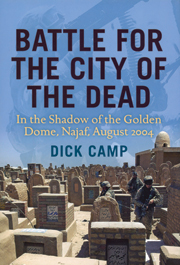
Battle for the City of the Dead: In the Shadow of the Golden Dome, Najaf, August 2004 by Dick Camp

The year was 2004. During the spring and summer the Iraqi nation was overwhelmed with violence. The nation's Shiites and Sunnis headlined the sectarian fighting. The Army of Iraq had been disbanded by the United States Proconsul. The results of his actions were infusing a large number of angry young men into the streets of the population centers in Iraq. These men had no jobs skills, no jobs, and no prospects for employment. These men were literally angry in the streets. The clergy fueled their anger which developed into a rage and campaign for jihad against the United States and all "occupation forces". 

By August 2004, Muqtada Al-Sadr, a Shiite cleric, called upon thousands of Mahdi Militia, his armed followers and de facto private army, to resist the occupation. Fighting would break out in several locations. The holy city of Najaf, the site of the largest Moslem cemetery in the world, and the Imam Ali Mosque were major sites of fighting. U.S. forces found themselves fighting in 120-degree heat. The battleground was through a tangle of crypts, mausoleums, and crumbling graves. The fight was rough. It had the religious zealots against the motivated and disciplined United States Army and Marine Corps troopers. It makes for a spellbinding account of Americans in battle.

The book itself is excellent. Dick Camp tells an excellent story. The quality of the book is remarkable. I am referring to everything from the writing, the large amount of high quality color pictures, and even quality of the paper the book on which the book is printed.

Tuesday, December 24, 2013

10 Best I Read in 2013.


2. "The Projection Room: Two from the Cubist Mist" by Carol Golembiewski. See my review at: http://www.keplersmilitaryhistorybookreviews.com/2013/10/the-projection-room-two-from-cubist.html

3. "The Shambling Guide to New York City" by Mur Lafferty. See my review on iTunes.

4. “Shades of Gray: A Novel of the Civil War in Virginia” by Jessica James. See my review at: http://www.keplersmilitaryhistorybookreviews.com/2013/08/shades-of-gray-novel-of-civil-war-in.html

5. "Foundation" by Issac Assimov

6. "The Machine Stops" by E. M. Forster (Short Story)

7. "The Bears Discover Get Fire" by Terry Bisson (Short Story)

8. "Misfit" by Robert A. Heinlein (Short Story)

9. "Out of Copyright" by Charles Sheffield. (Short Story)  Published in Clarkesworld Magazine.

10."The Promise of Space" by James Patrick Kelly (Short Story) Published in Clarkesworld Magazine.

Airborne: A Combat History of American Airborne Forces by LTG (Retired) E. M. Flanagan Jr.

Airborne Airborne: A Combat History of American Airborne Forces by LTG (Retired) E. M. Flanagan Jr. Allow me to state my prejudices...